Changing the World
with Flyers
Columbia University’s Divestment
From Apartheid South Africa
Find A Tree Pathway: Lead Yourself
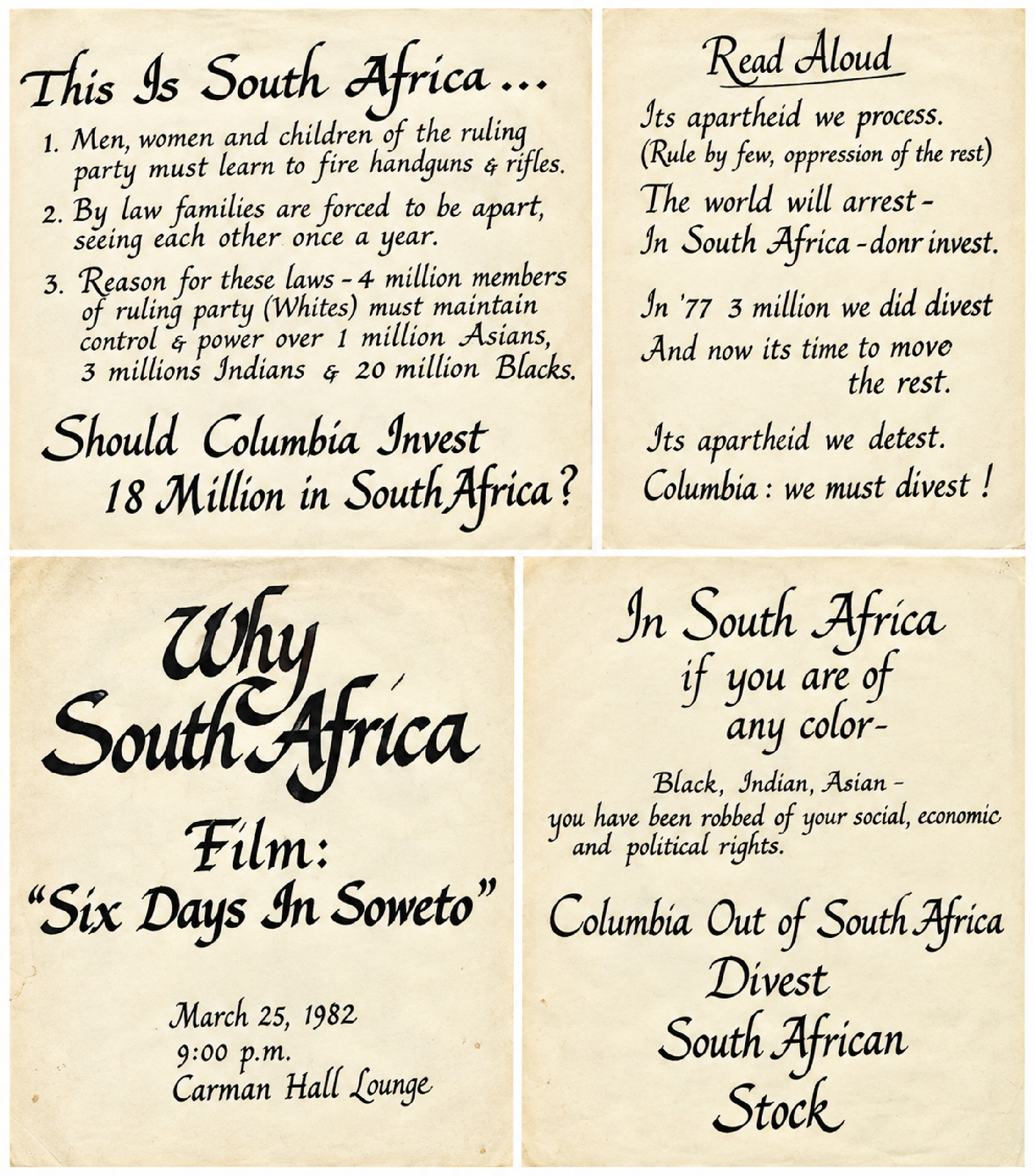
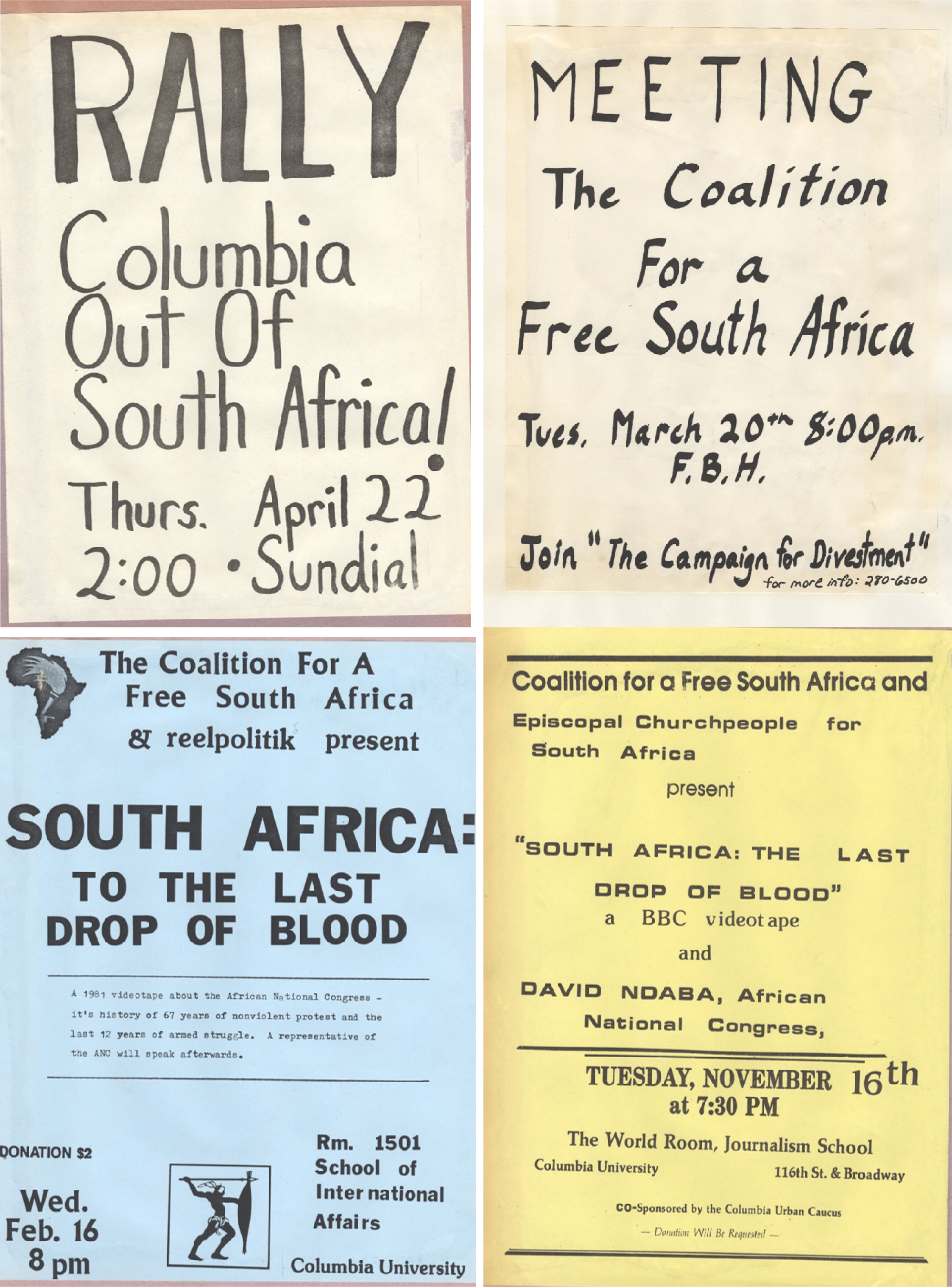
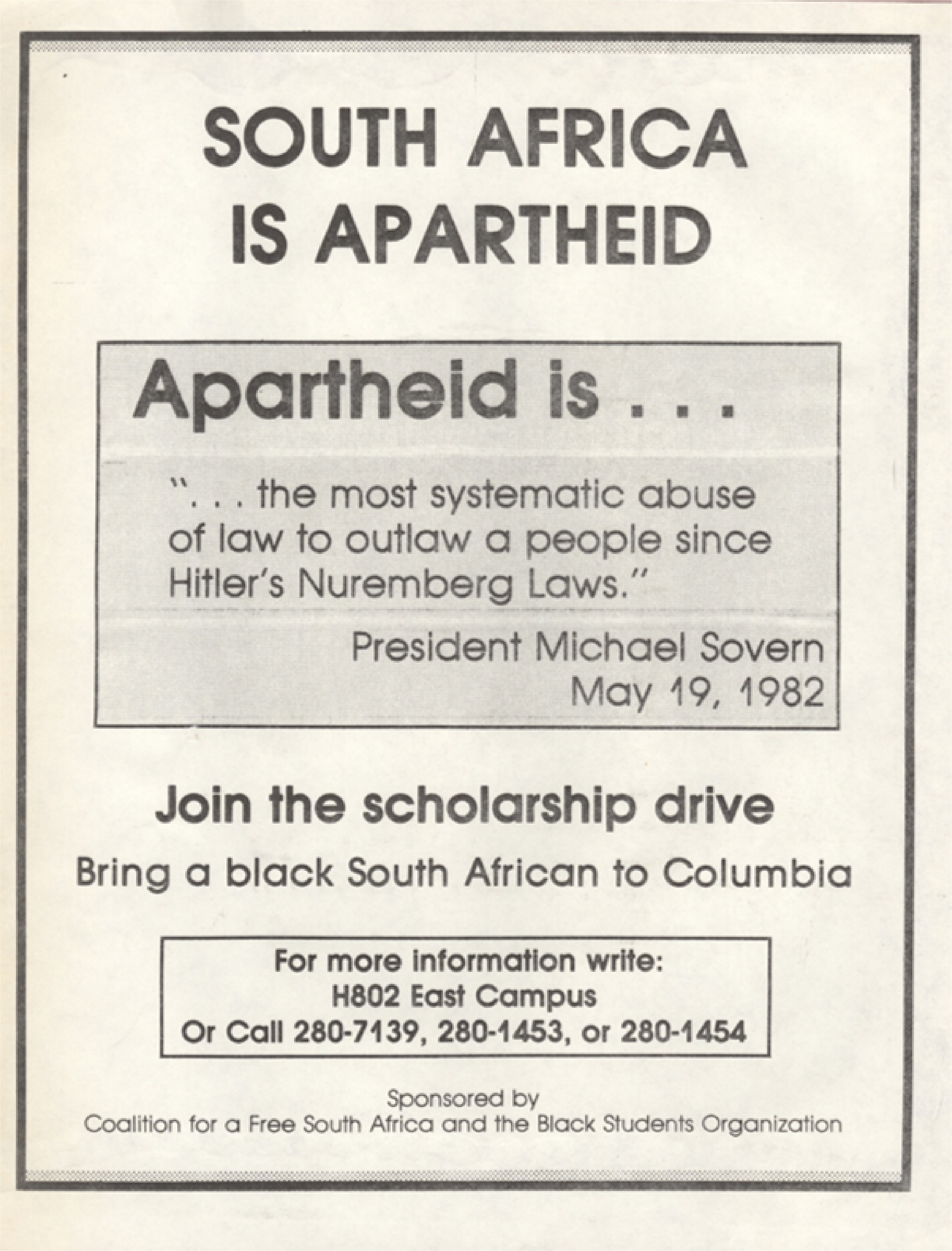
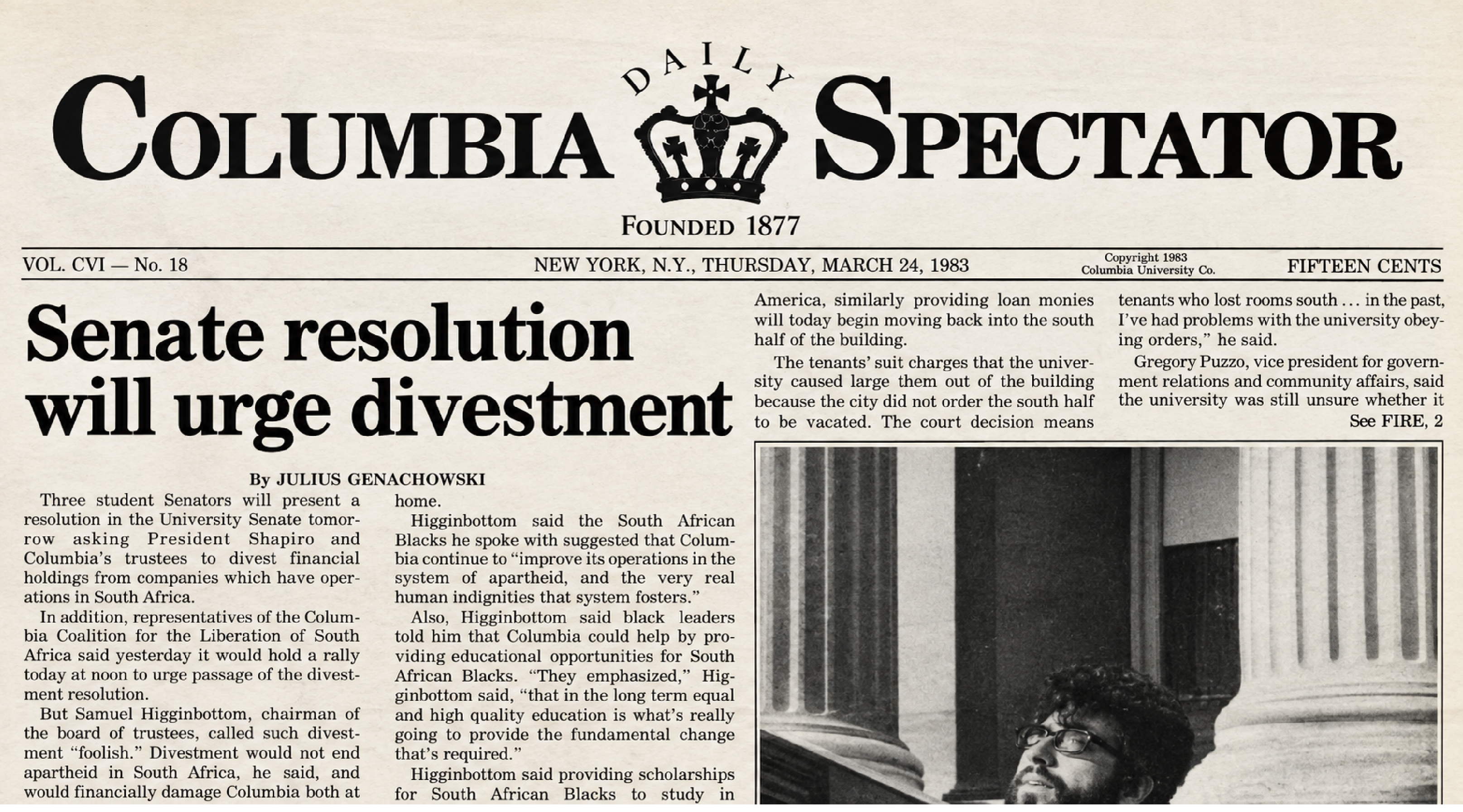
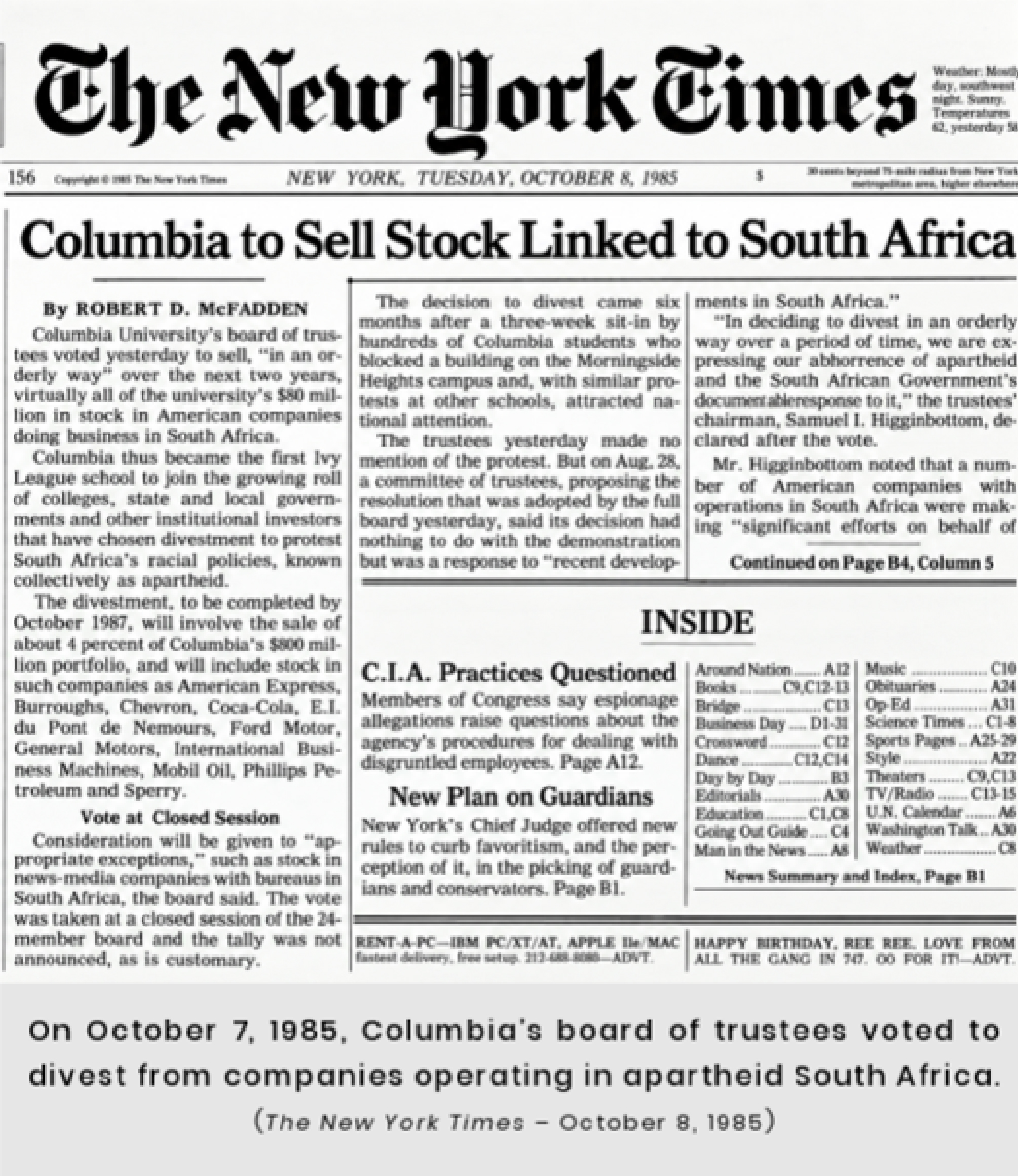
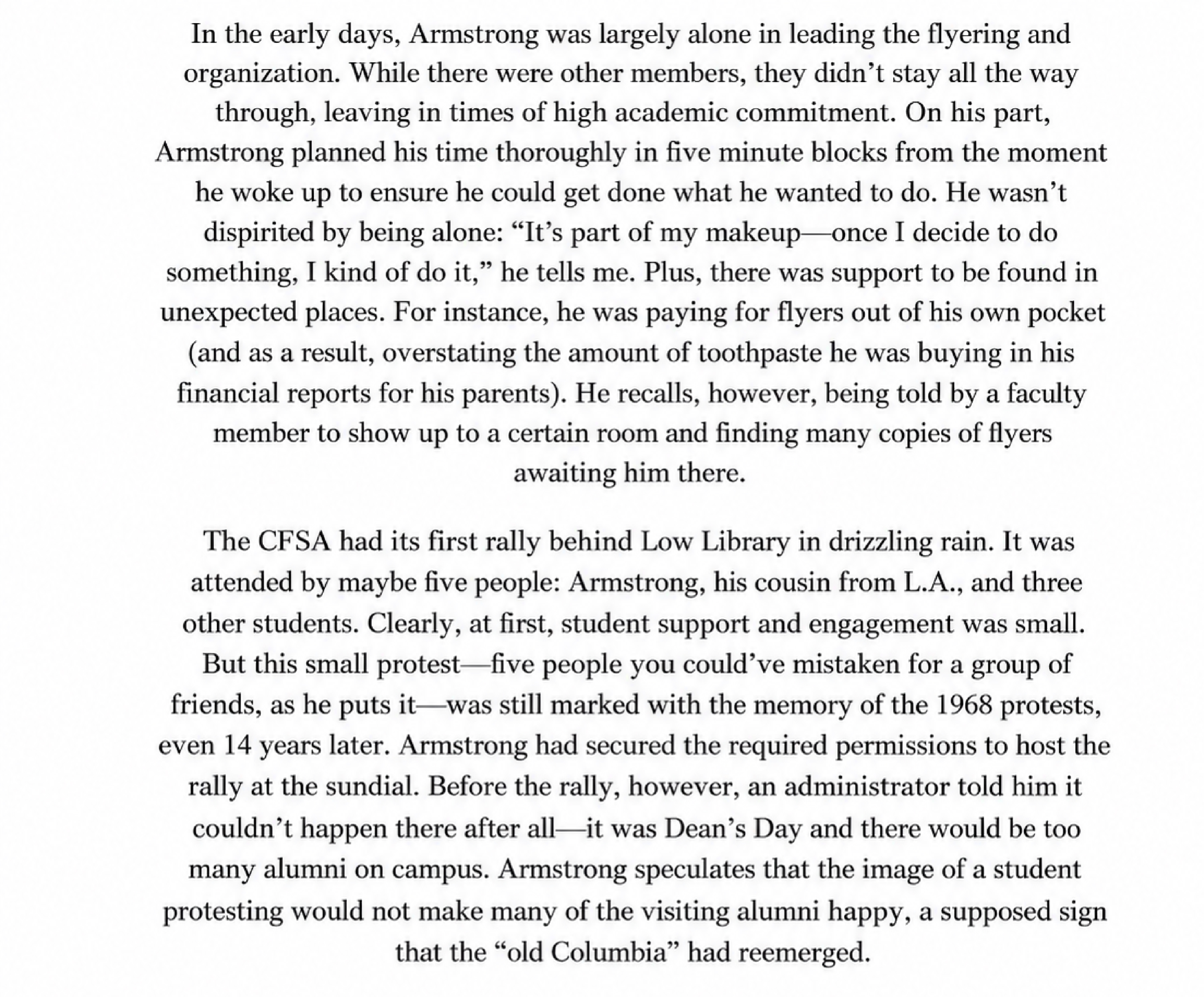
On October 8, 1985, The New York Times announced that Columbia University’s Board of Trustees had committed to divesting its portfolio of stocks linked to companies with operations in Apartheid South Africa. Ultimately, Columbia divested $55 million. Daniel was the founding chairman of The Coalition for a Free South Africa, the student organization that led the campaign for divestment. Daniel started this campaign by posting flyers.
"
Columbia was the first university with a significant endowment to divest from Apartheid South Africa.
"

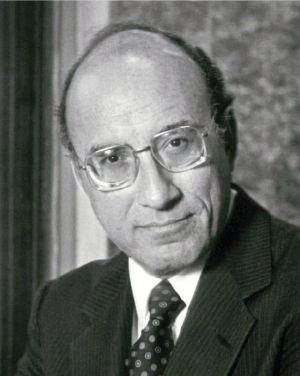
─Michael I. Sovern
President Emeritus
Columbia University
Source: An Improbable Life: My Sixty Years at Columbia and Other Adventures (Columbia Press)
"
The work of the Coalition for a Free South Africa is cited by many as the catalyst for campus protests around the issue of apartheid that exploded in the United States during the ‘80s.
"
Source: ─Public Broadcast Service (PBS) documentary Have You Heard from Johannesburg?
Changing the World
with Flyers
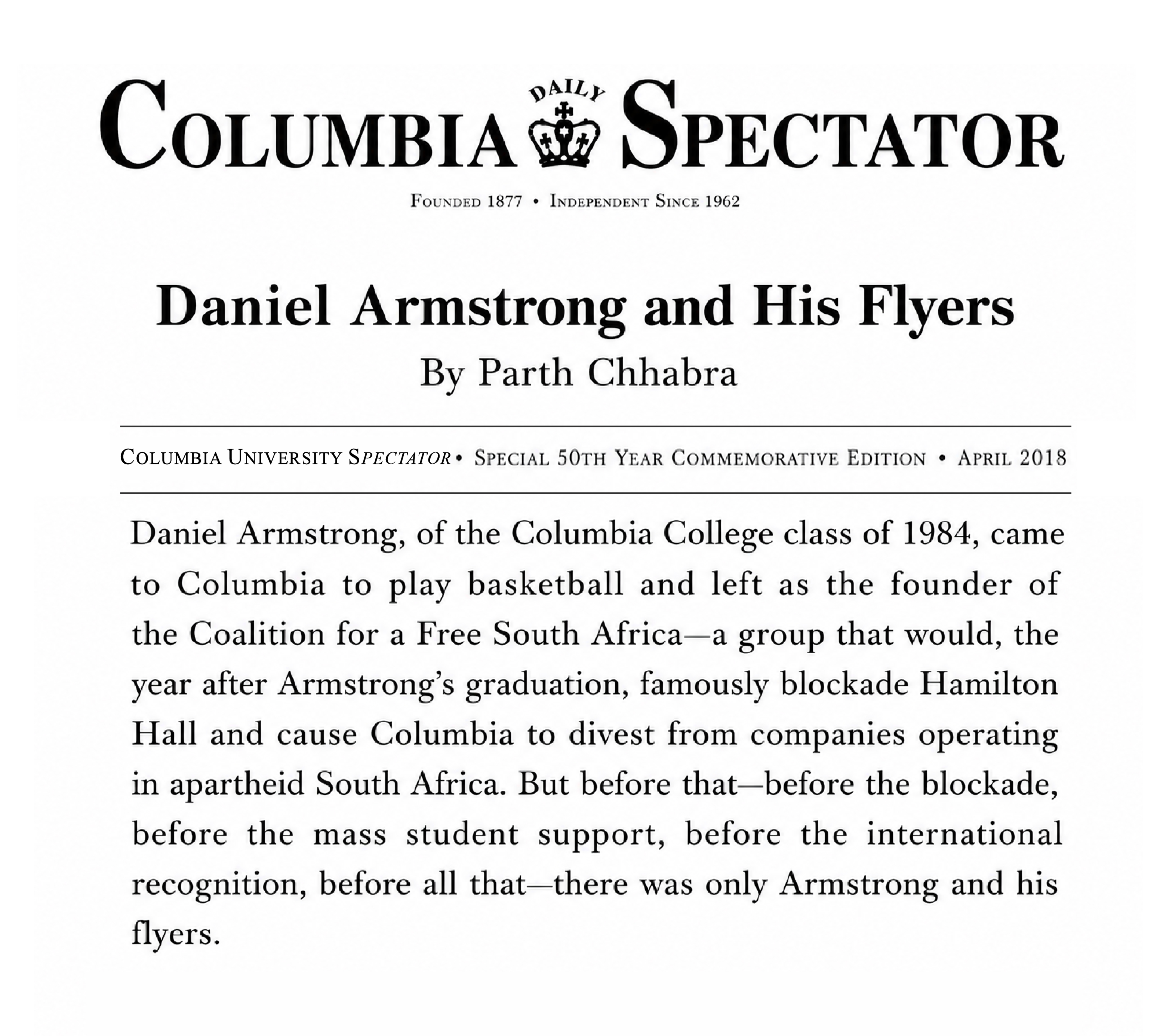
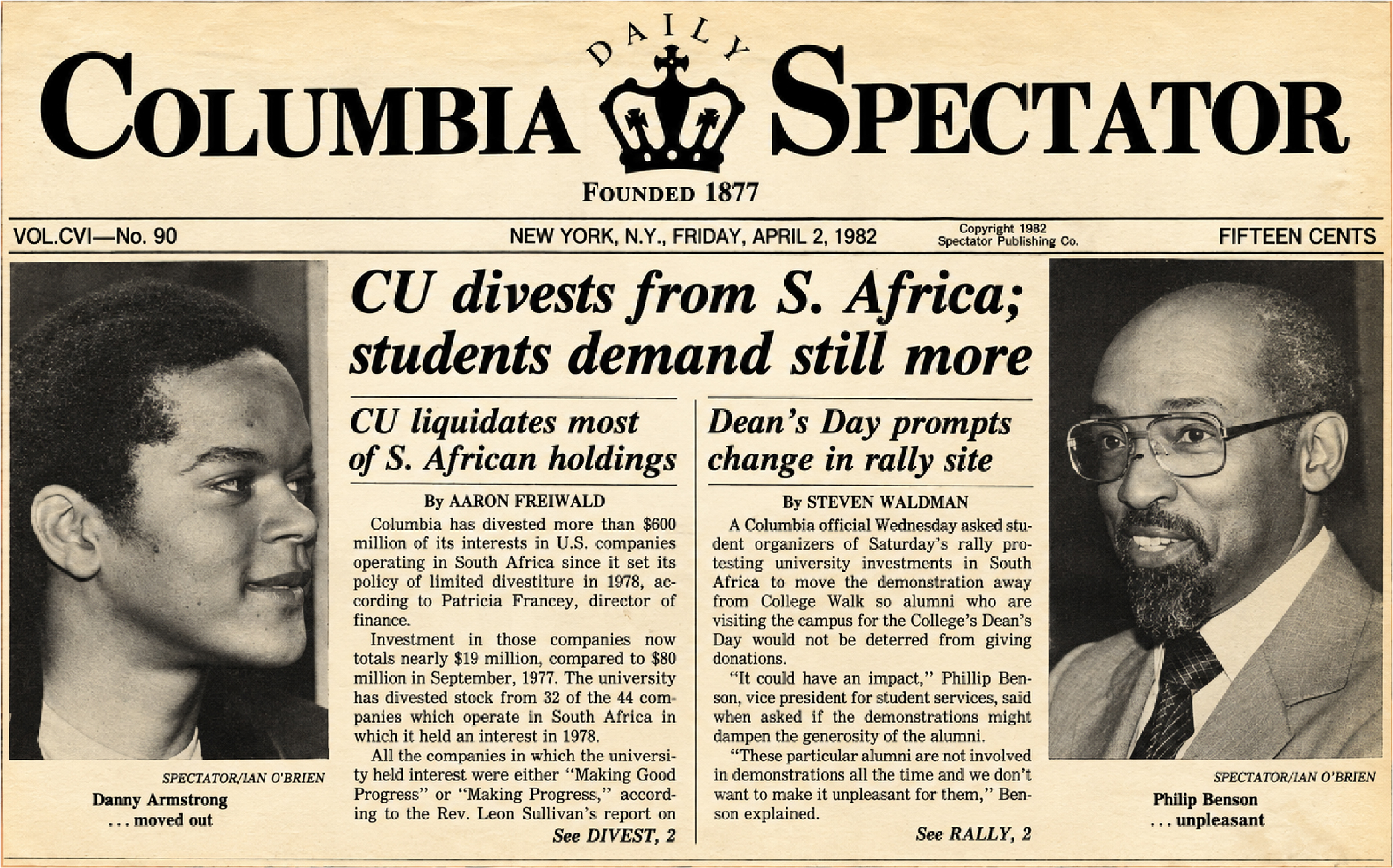
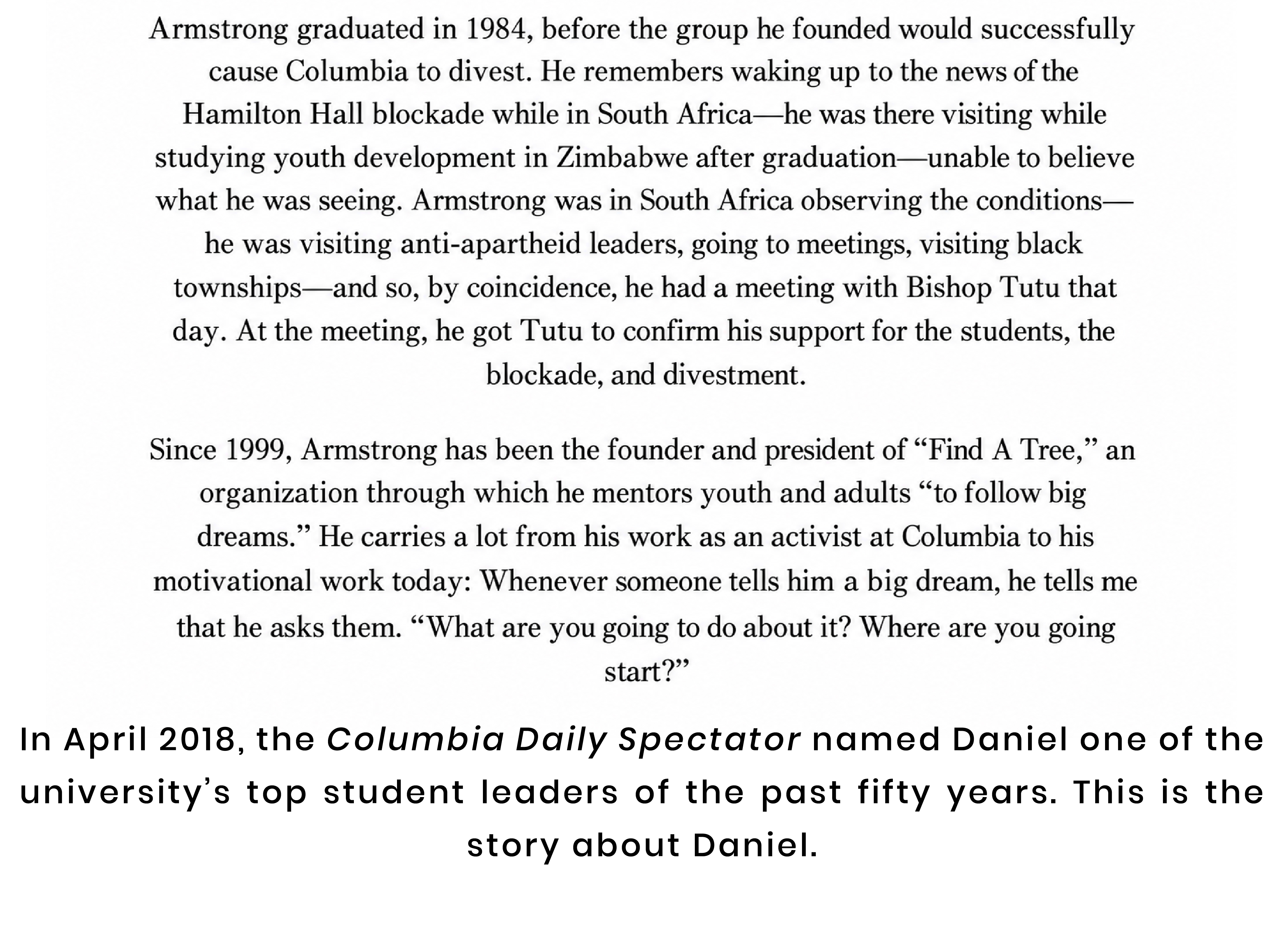
In April 2018, the Columbia Daily Spectator named Daniel one of the university’s top student leaders of the past fifty years. The excerpt above is the opening paragraph of that story.
READ THE FULL ARTICLE
Timeline Overview
> The Beginning: 1981
> Raising Awareness: 1981–1983
> The University Senate Resolution: 1983
> Resistance from the Trustees: 1983–1985
> Divestment Victory: October 7, 1985
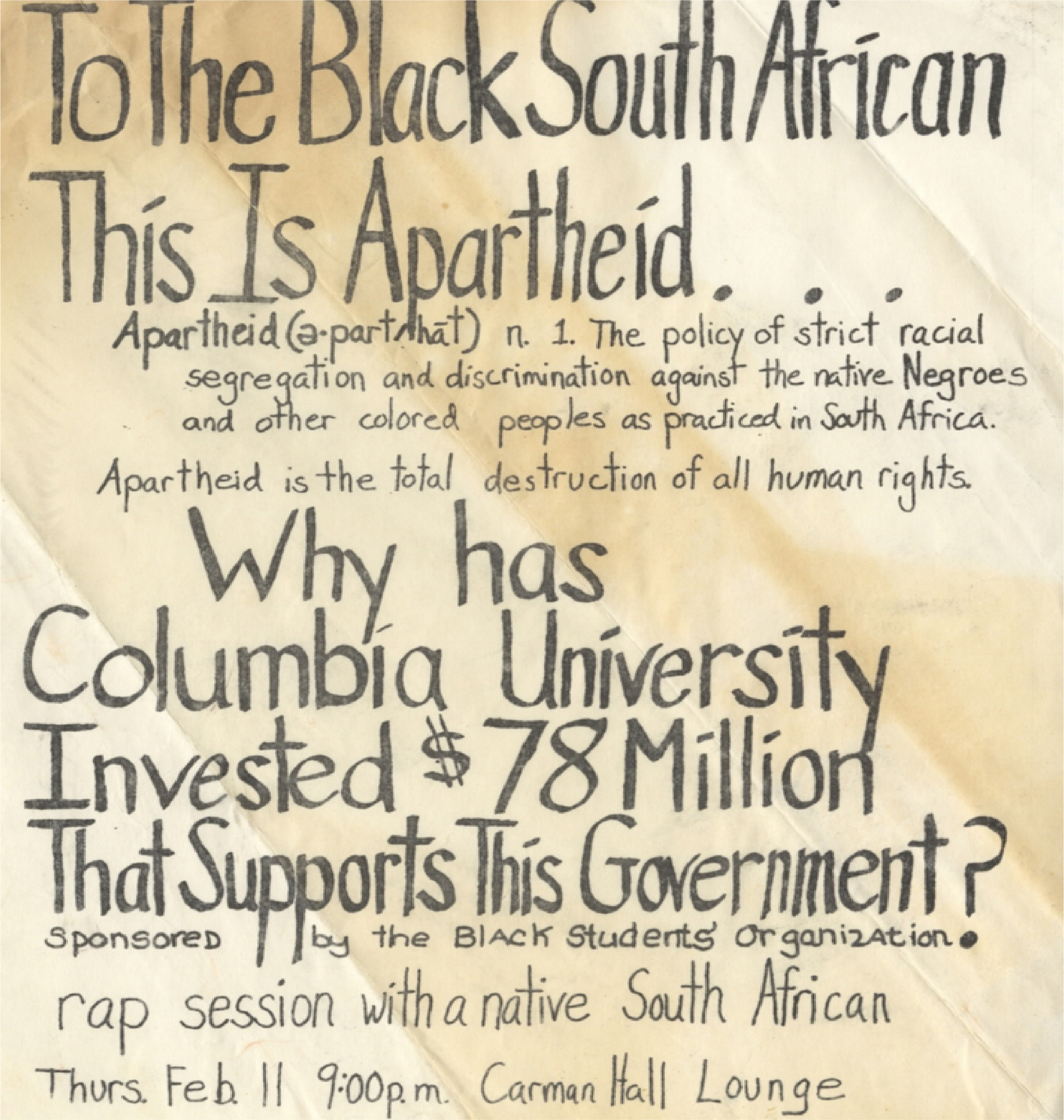
This was the first event Daniel organized to raise awareness on campus about apartheid in South Africa.
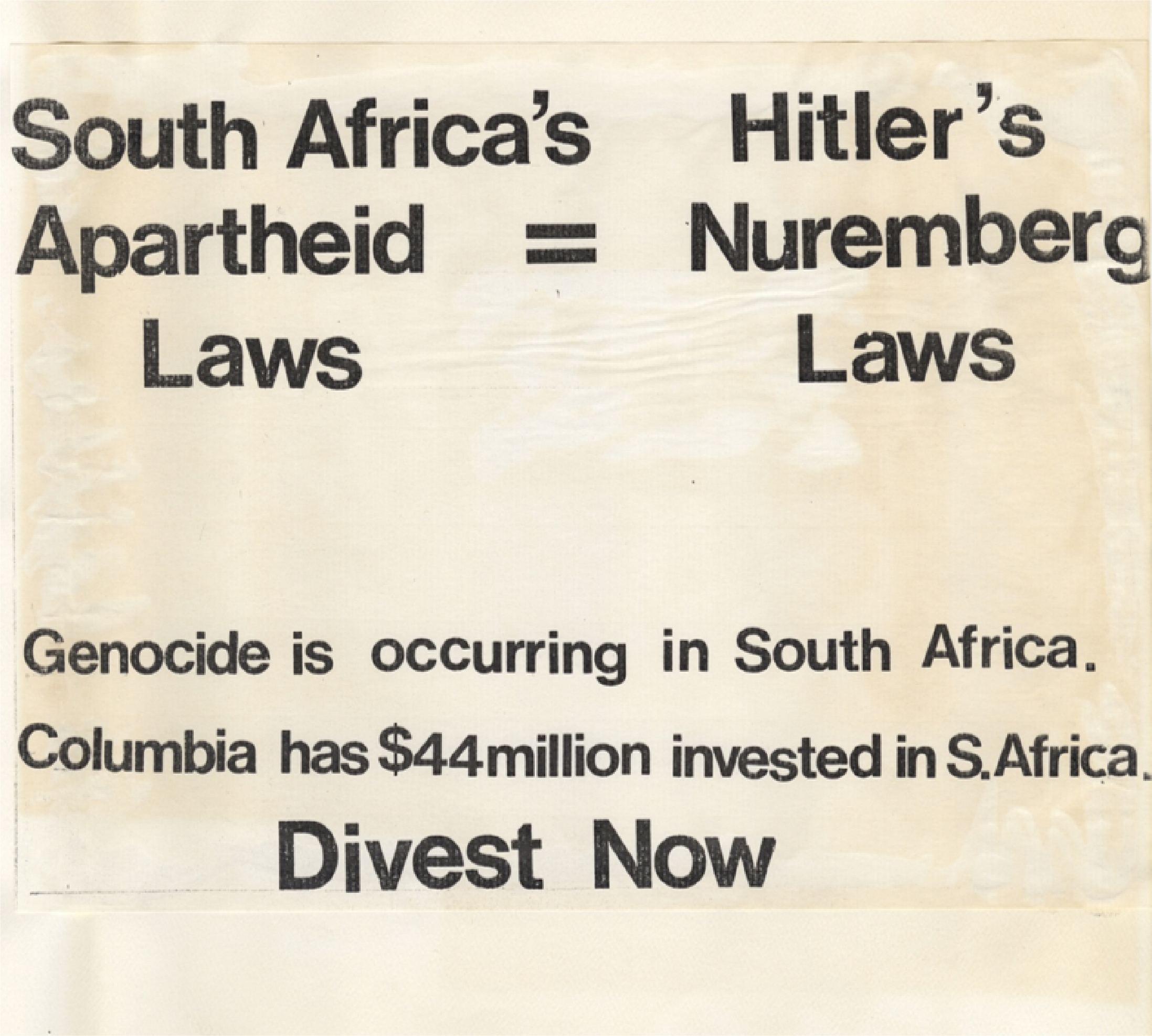
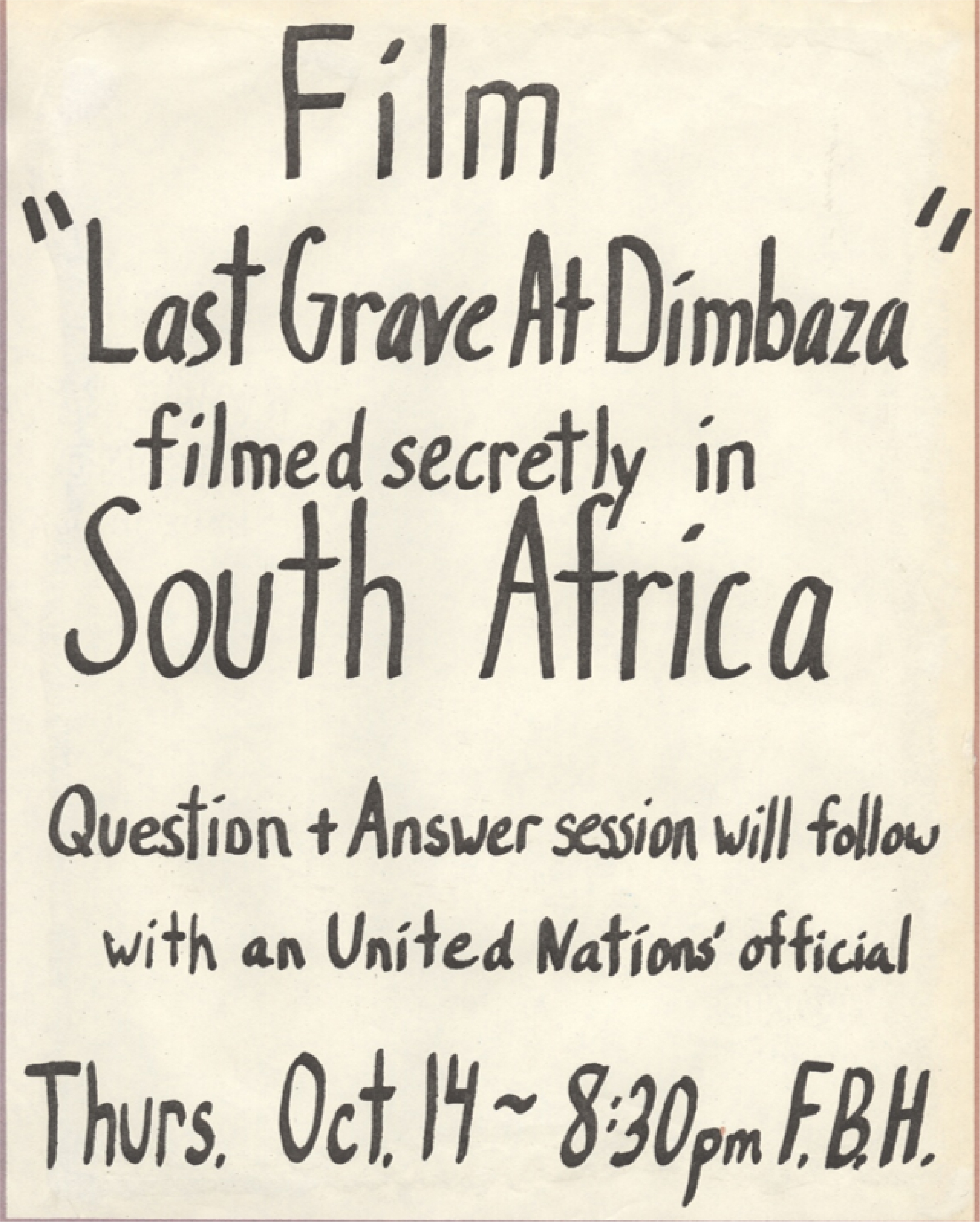
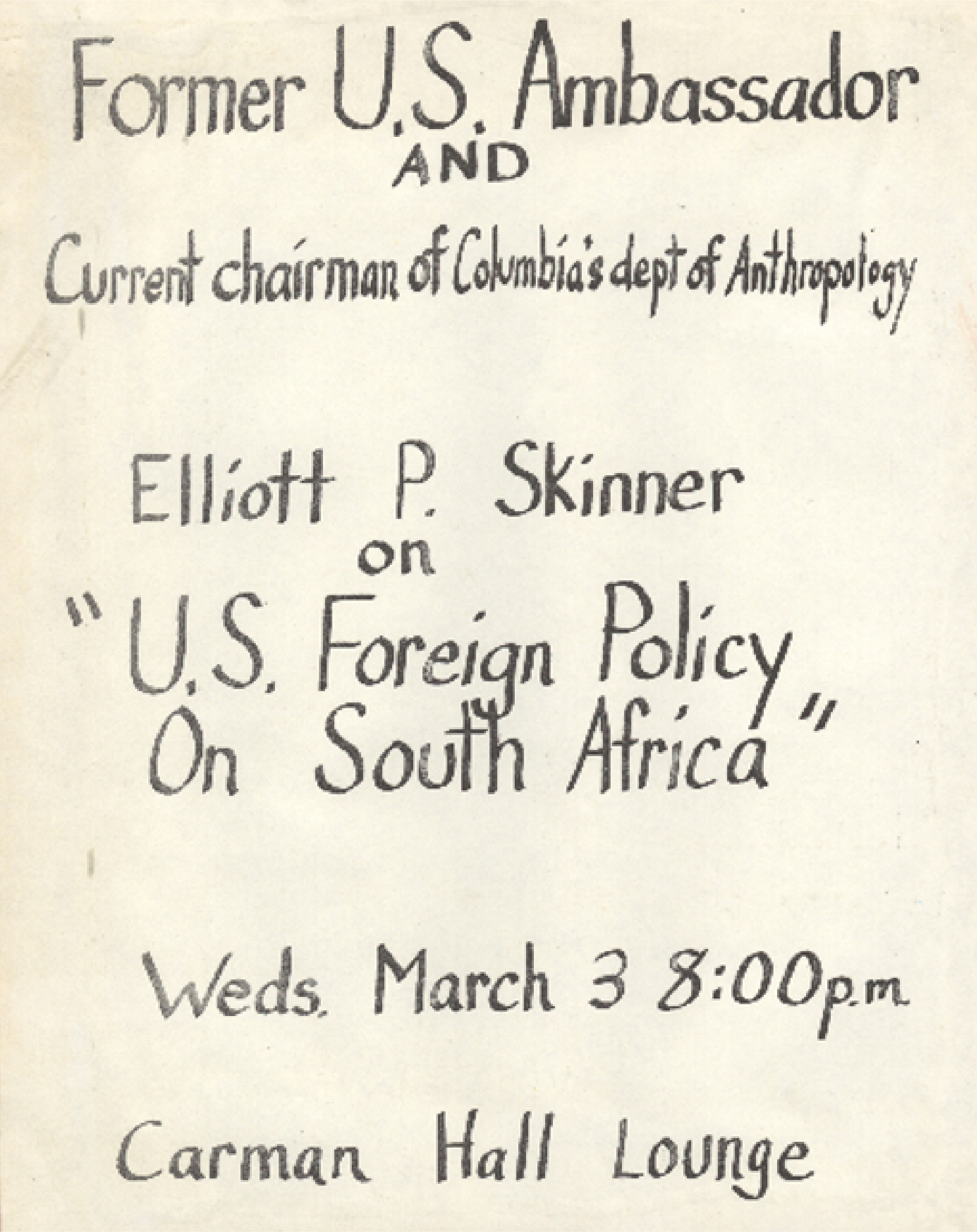
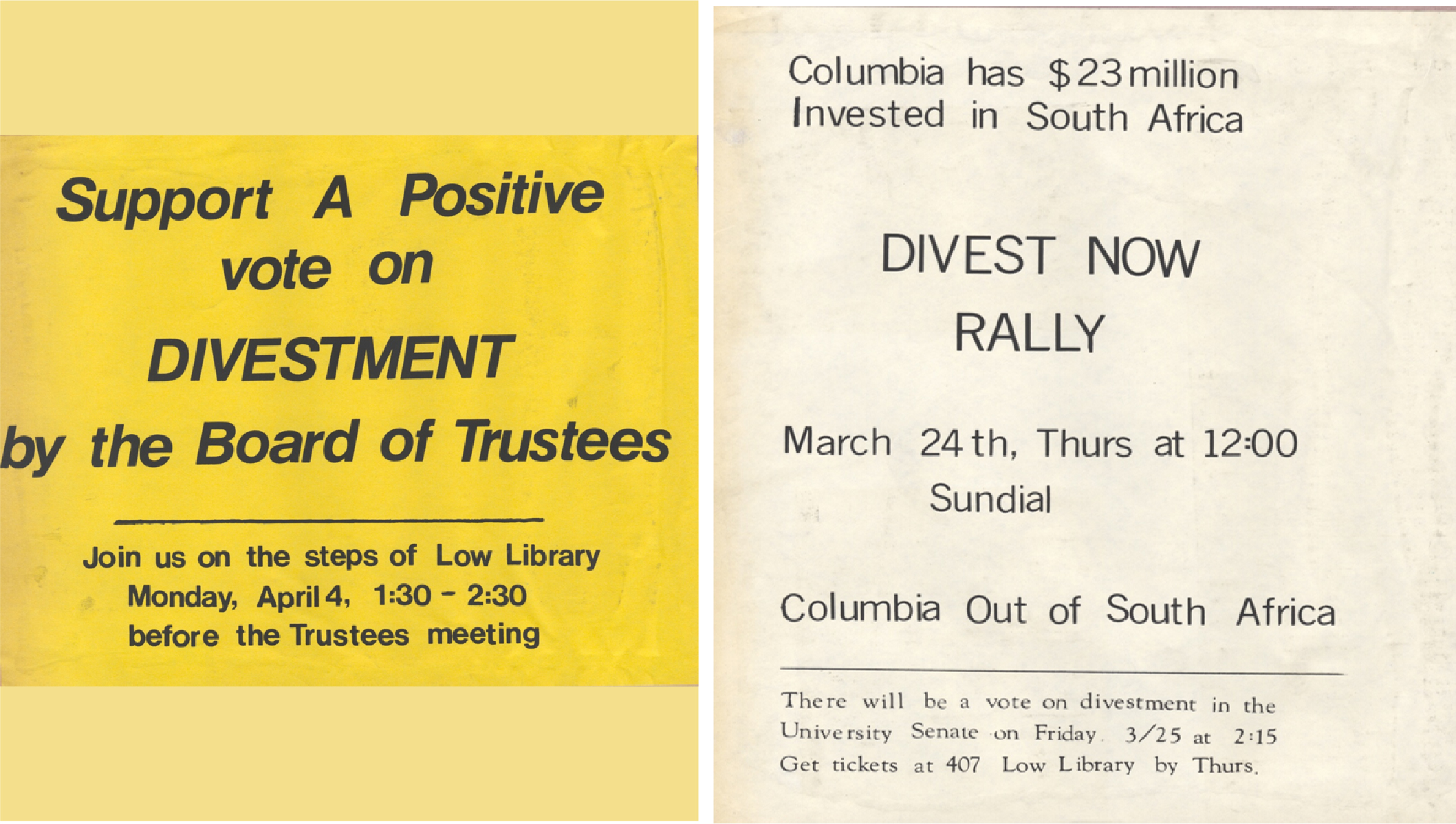
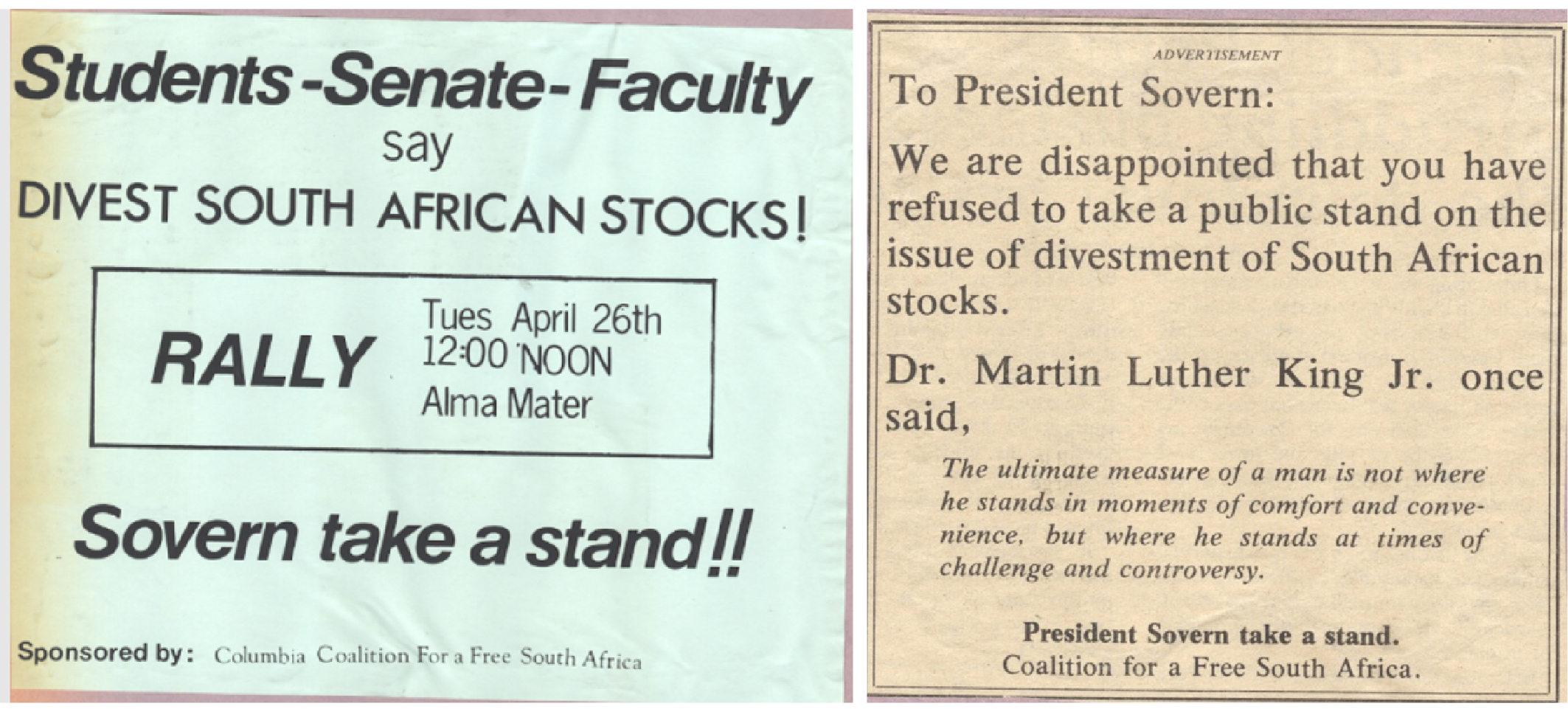
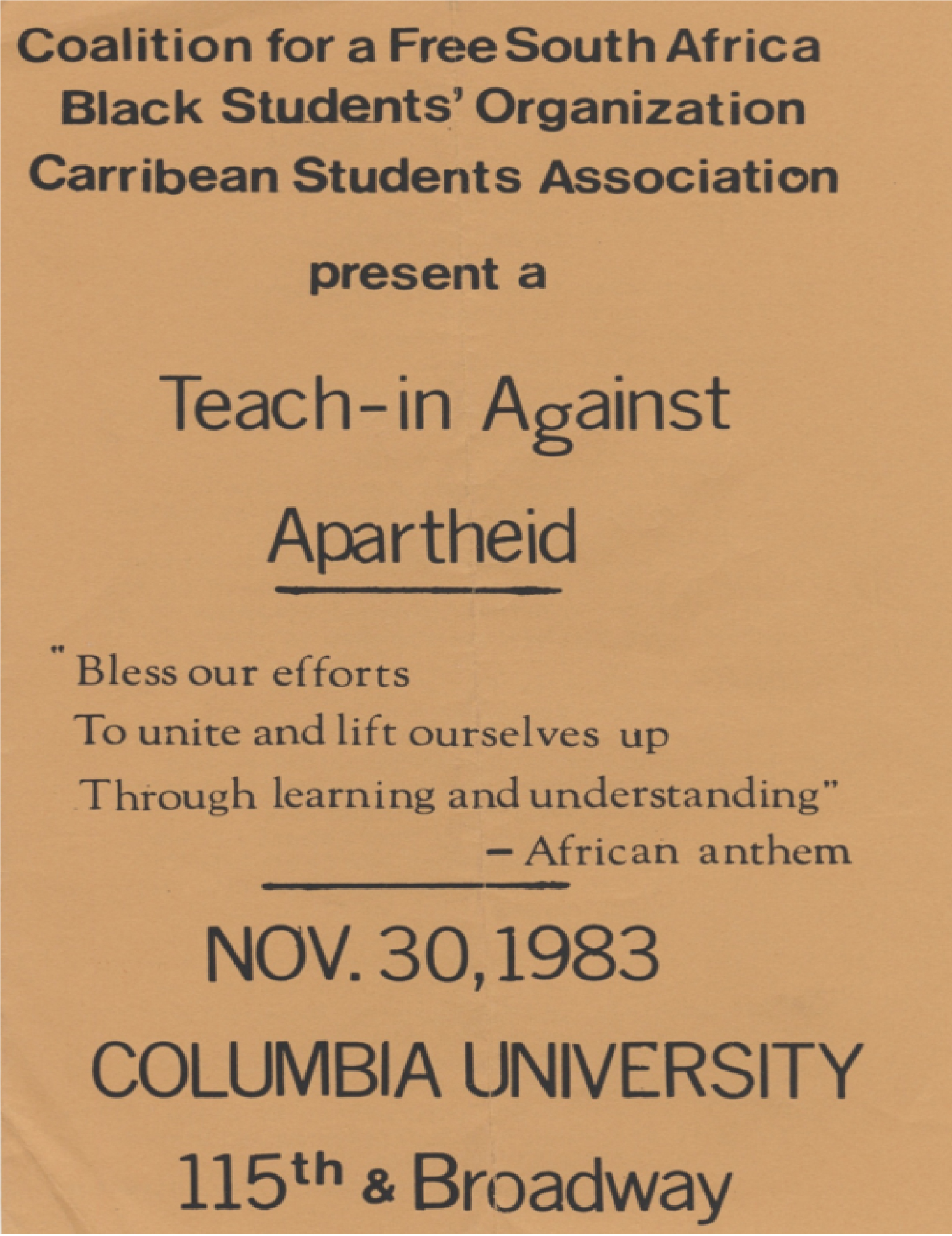
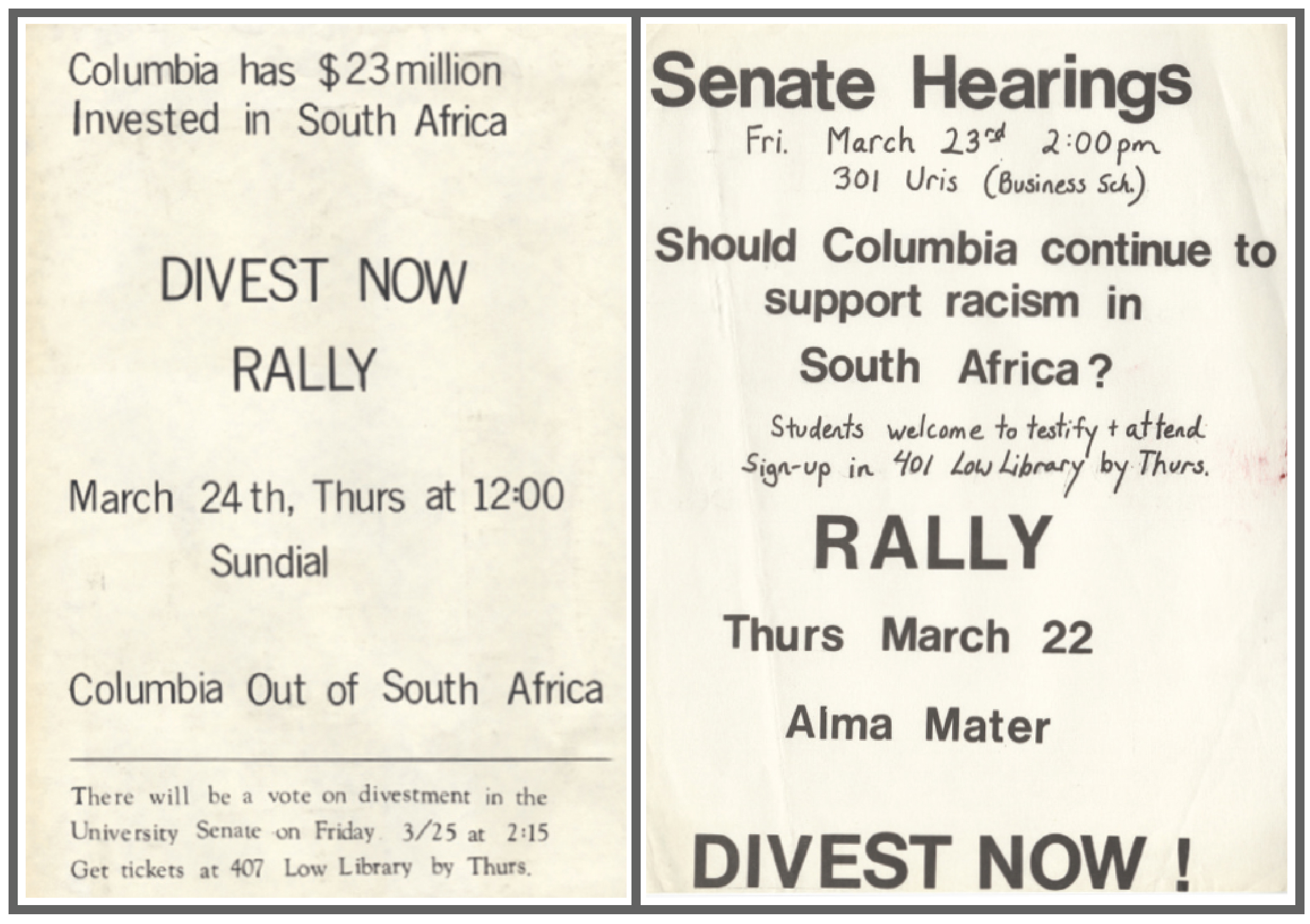
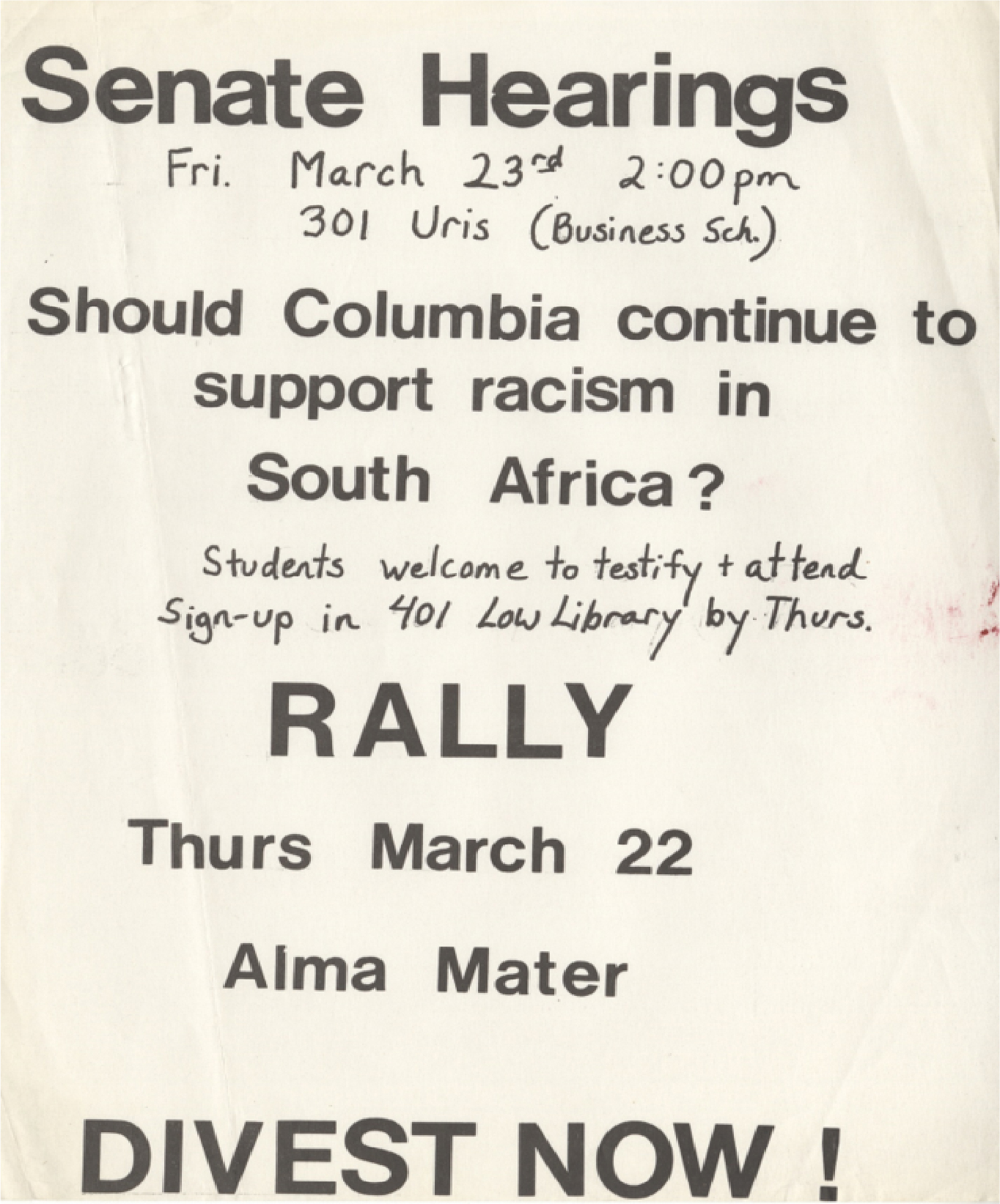
Flyers were regularly posted across Columbia’s campus.
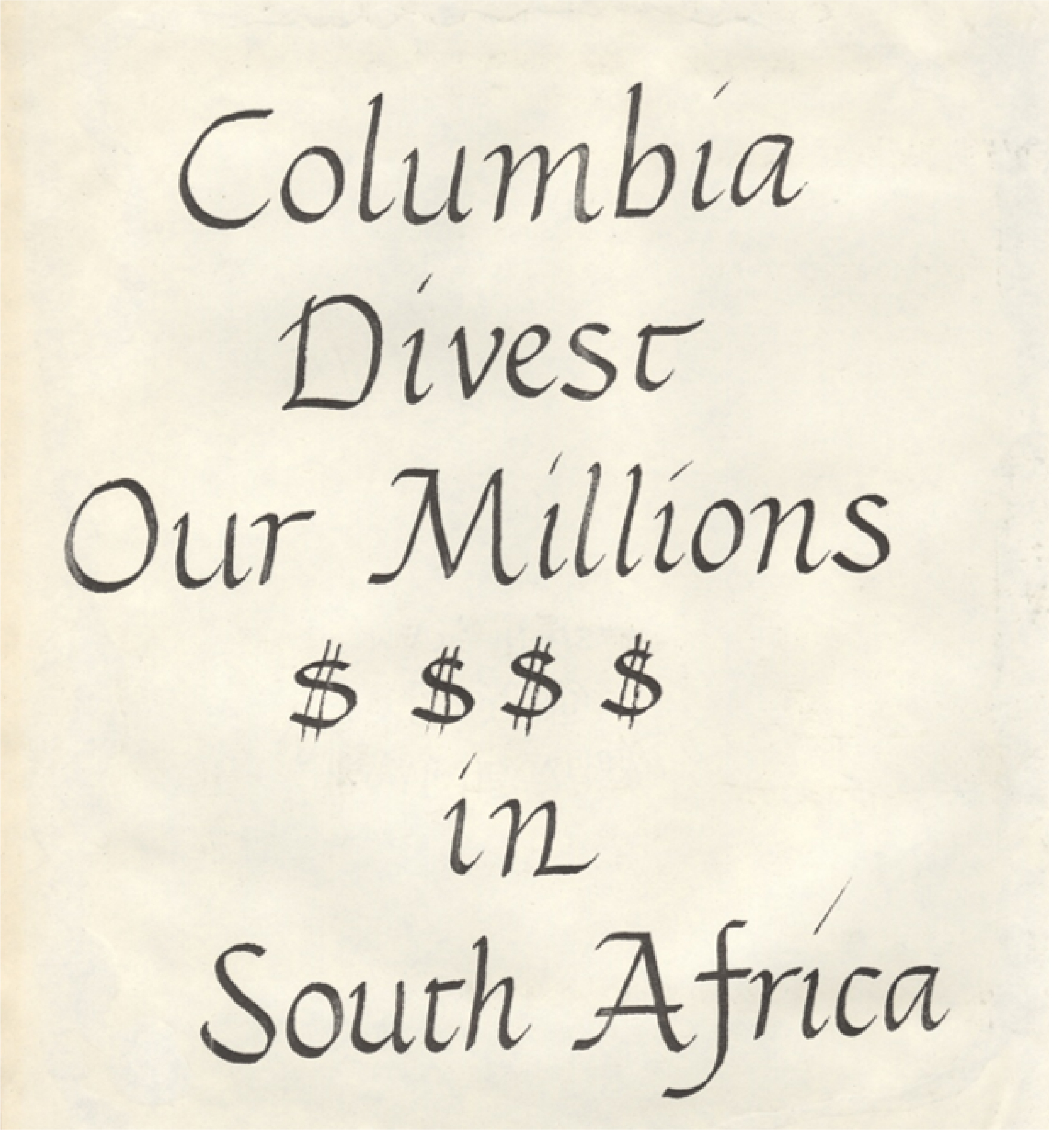
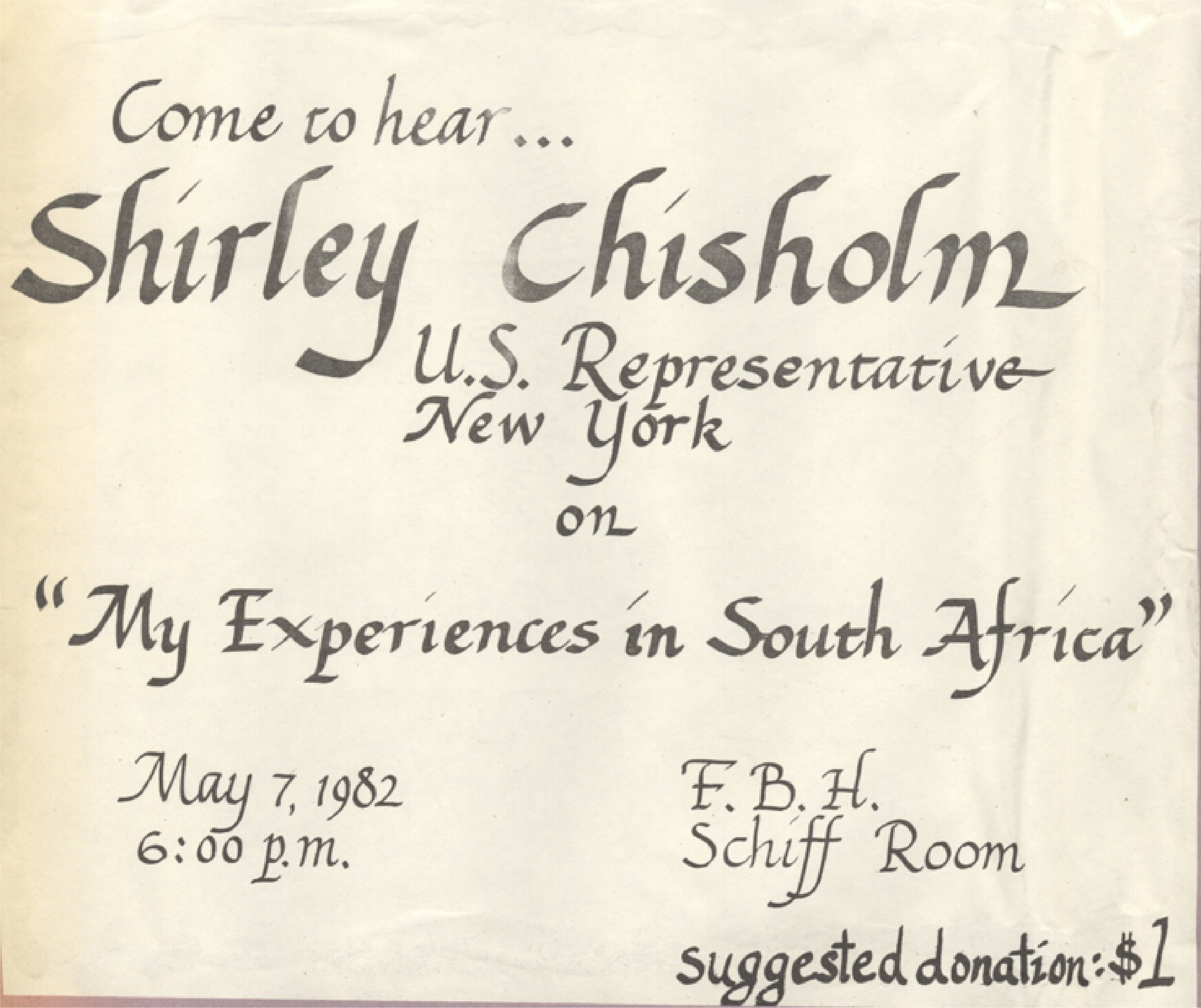
Daniel would dictate the wording for flyers to his mother, a calligrapher, who would then mail him the master copy for duplication.
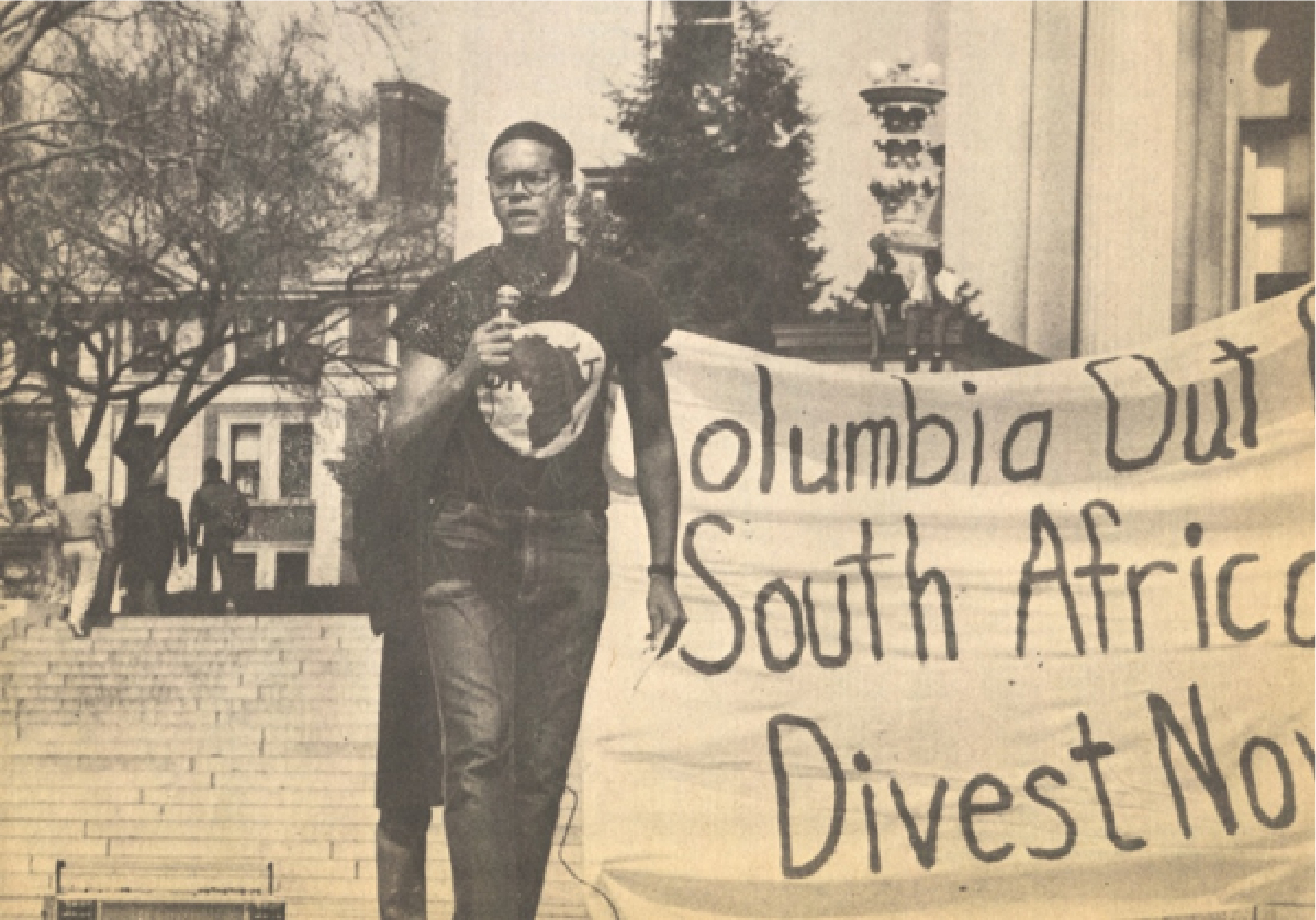
Daniel speaks at a rally on the steps of Low Library, Columbia University’s main administration building.
(New York, New York)
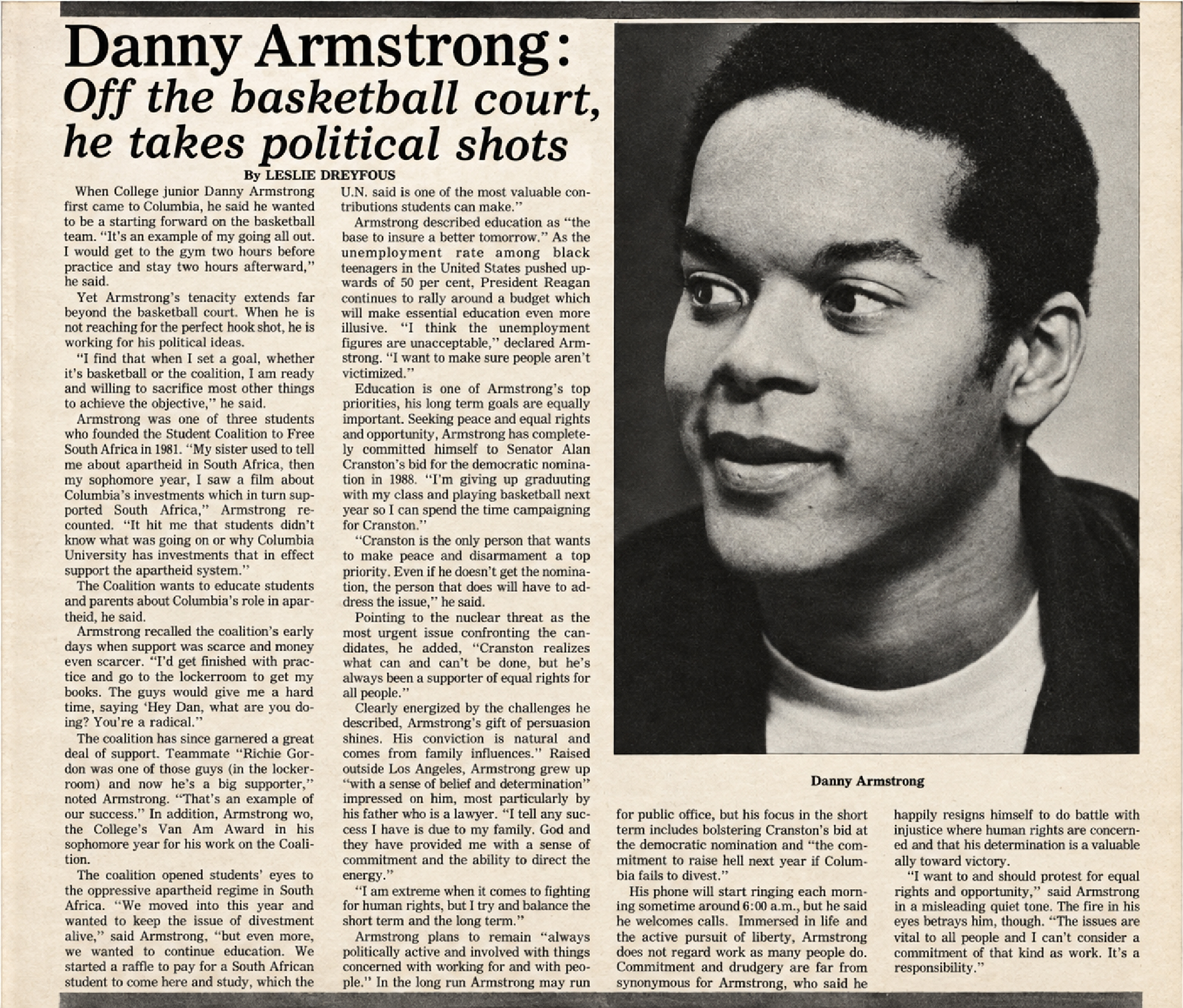
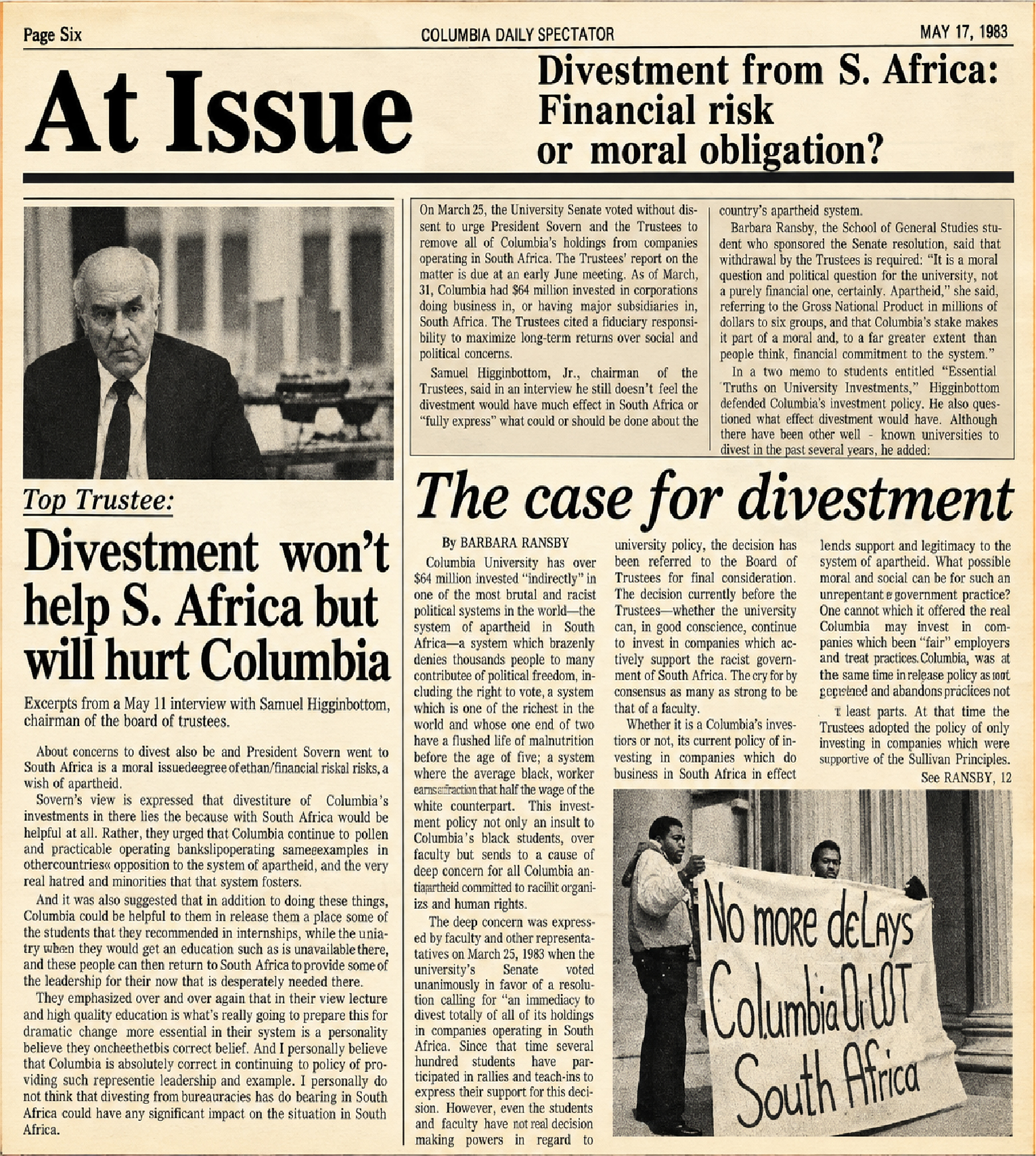
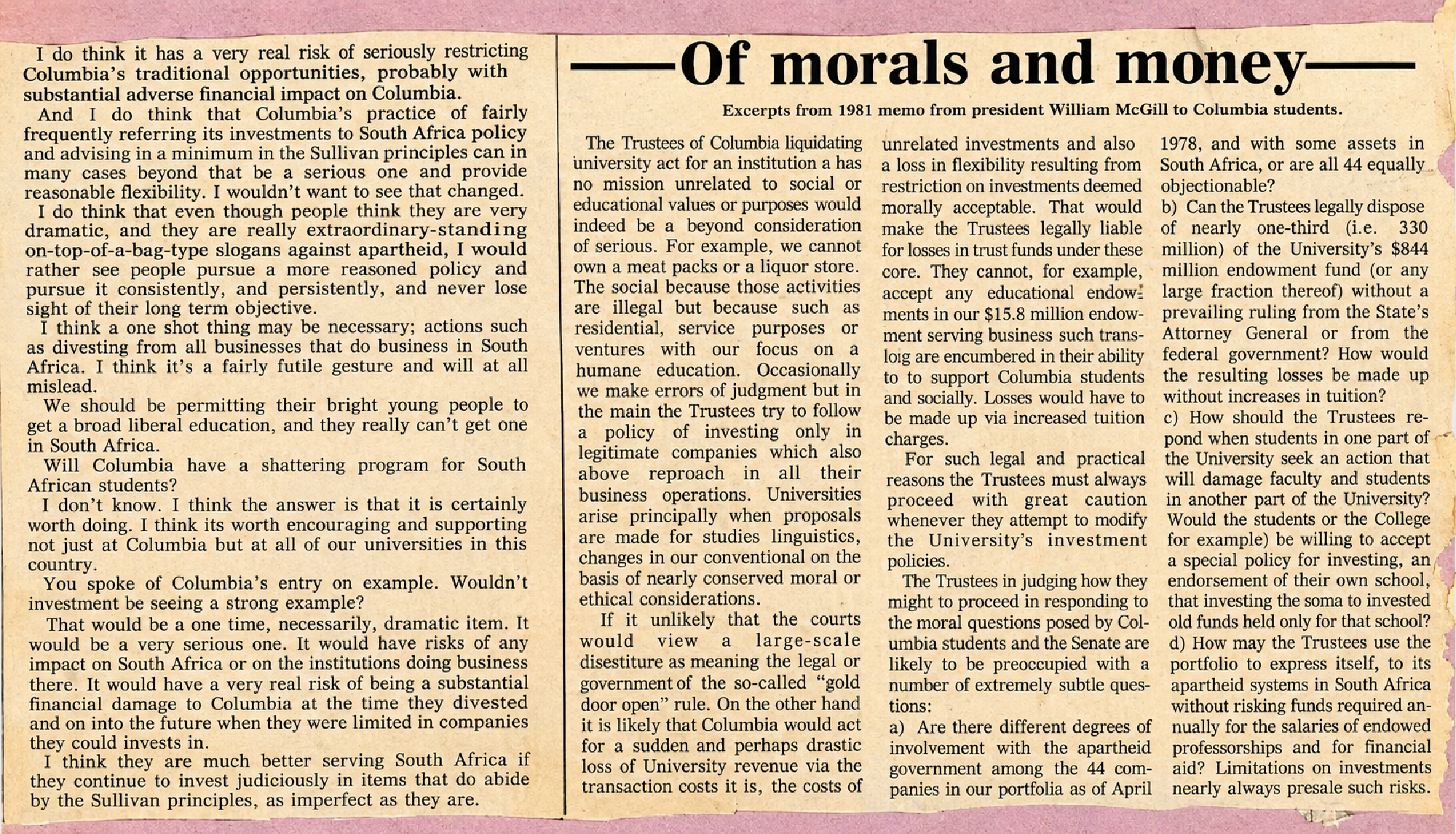
Columbia Daily Spectator – May 17, 1983
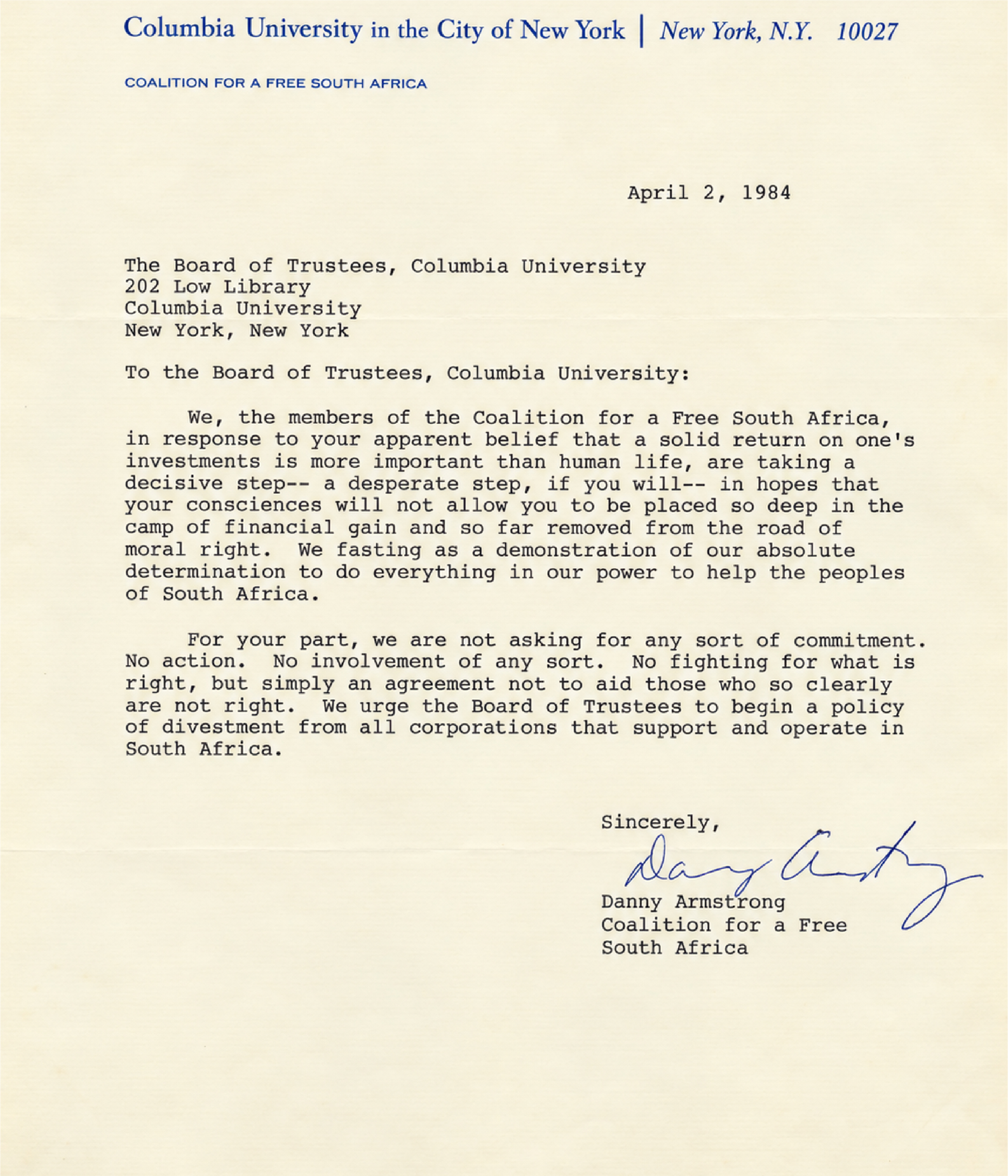
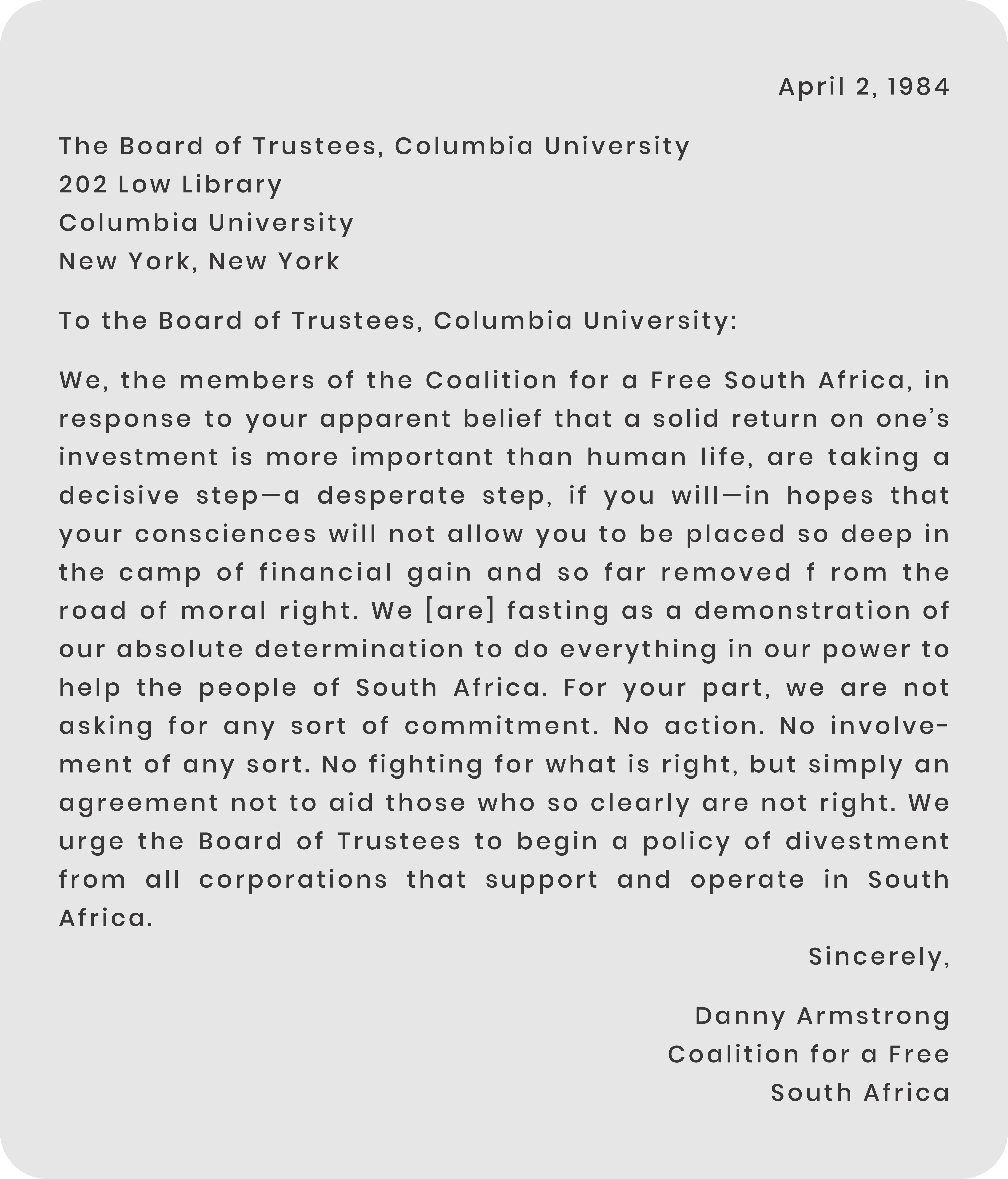
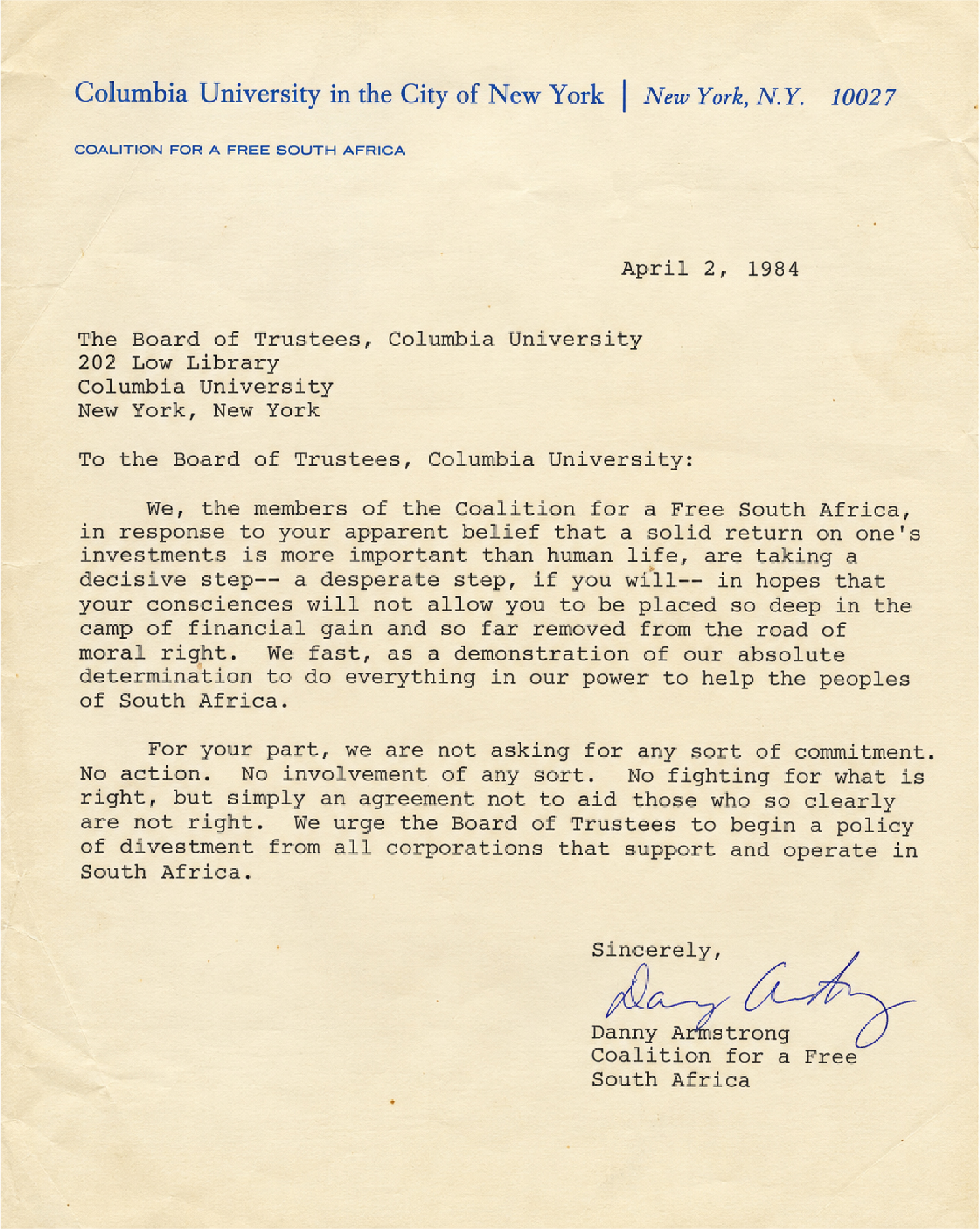
Daniel’s letter to Columbia’s Board of Trustees before beginning a week-long fast in solidarity with the people of South Africa
(April 2, 1984)
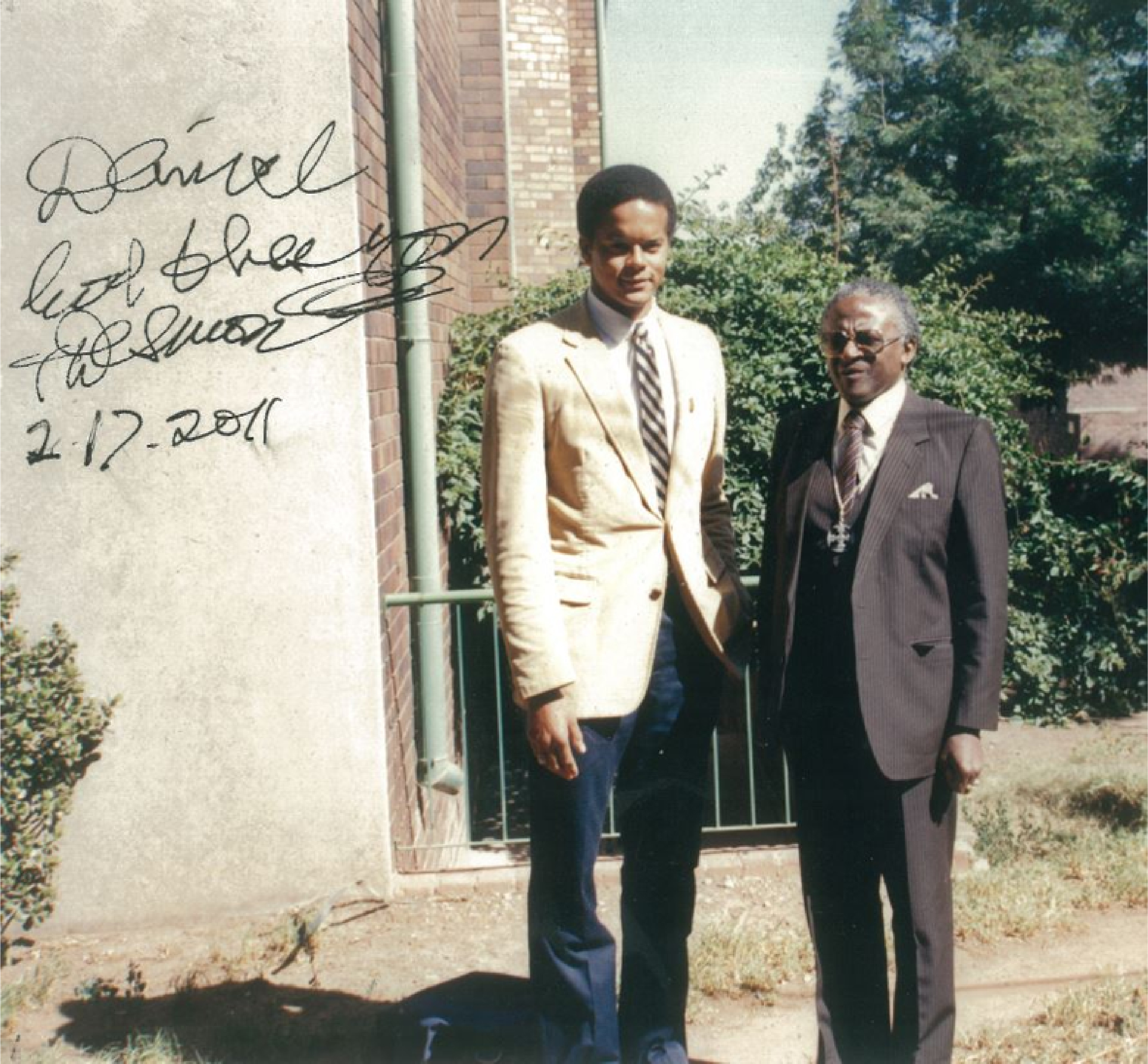
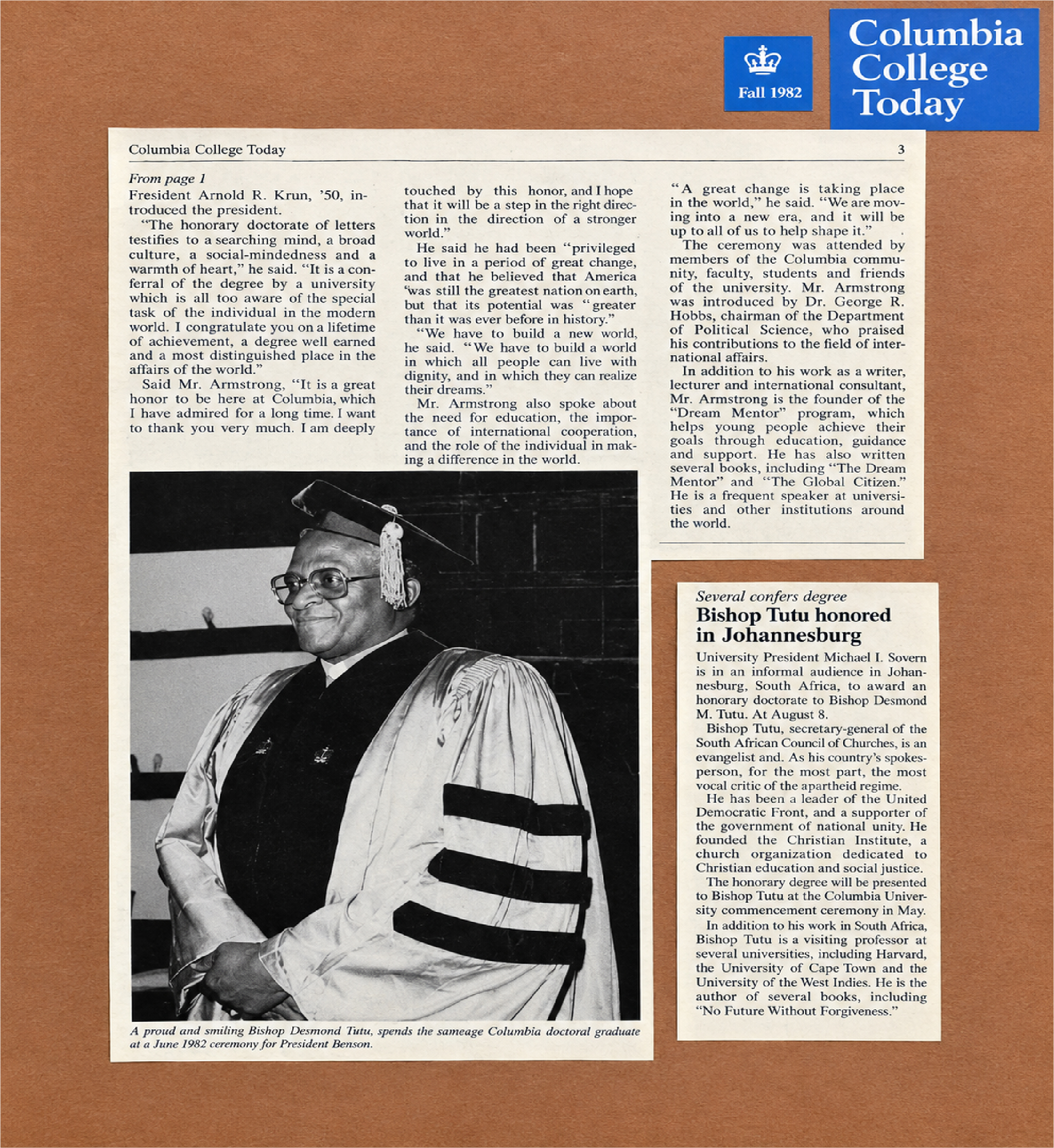
Nobel laureate Desmond Tutu endorsed Columbia University’s divestment campaign following his meeting with Daniel.
(April 1985 - Johannesburg, South Africa)
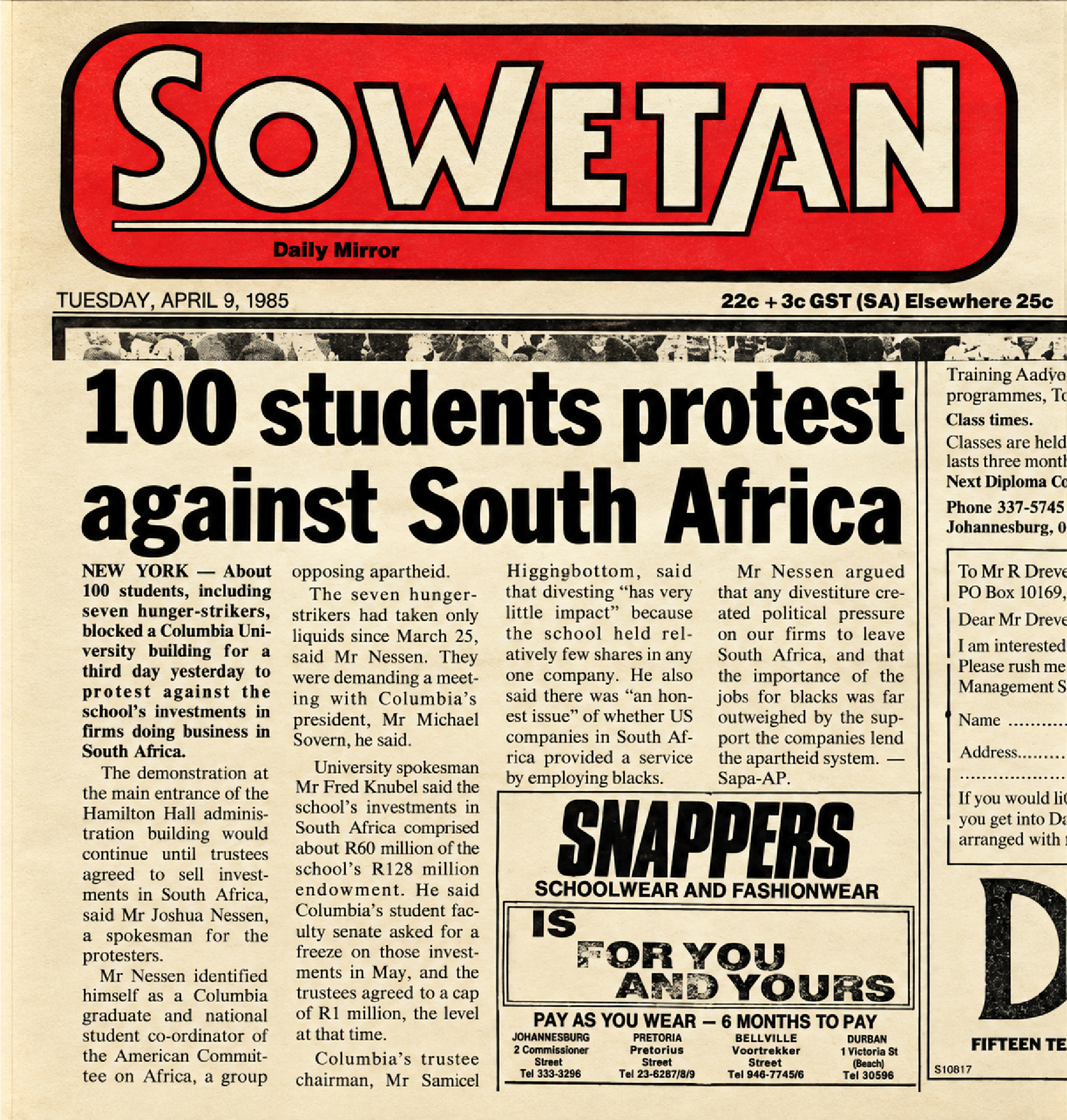
Sowetan - South African newspaper
(Johannesburg, South Africa - April 9, 1985)
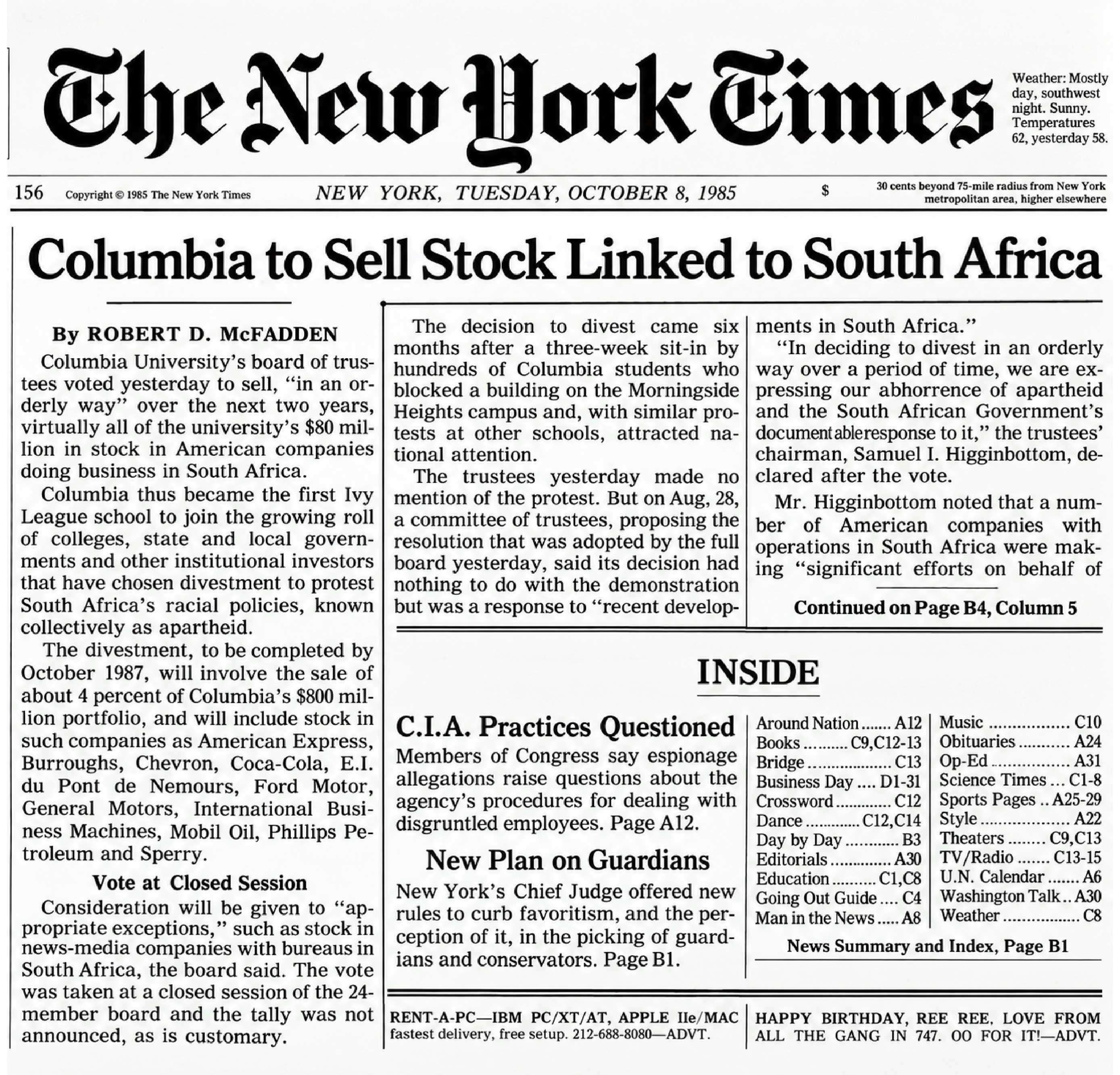
On October 7, 1985, Columbia’s board of trustees voted to divest from companies operating in apartheid South Africa.
(The New York Times – October 8, 1985)
On October 7, 1985, Columbia’s board of trustees voted to divest from companies operating in apartheid South Africa.
(The New York Times – October 8, 1985)

1981 | The Beginning
Daniel in His Own Words
For me, the origin of the Coalition for a Free South Africa, which was initially called The Coalition for the Liberation of South Africa, began on a backyard basketball court in Compton, California, as it was there the seed was planted that apartheid had to end.
Growing up, my obsession was basketball. My dream was to play in the NBA. I spent as many waking hours as possible practicing on my backyard court. By age thirteen, my sister, Donna, was a student at Stanford University. On her weekend trips home, she often felt it was her duty to lecture me about what she had learned about apartheid in South Africa. My focus was on basketball and my jump shot. Rolling my eyes never seemed to deter my sister or discourage her from delivering one of her many lectures about apartheid. I soon realized it would be easier if I just listened. She was determined to deliver her message. My sister planted a seed.
In the fall of my sophomore year, I came across a flyer advertising a film on apartheid to be shown at Barnard College, Columbia’s sister school, in their Altschul Hall on October 11, 1981. The flyer sparked a memory of what my sister had lectured me about years before. I attended the event. (Later, I learned that President Barack Obama, a Columbia junior at that time, also attended this event.) Following the film, David Ndaba of the African National Congress (ANC) spoke about living under apartheid and Josh Nessen of the American Committee on Africa discussed Columbia’s investments and announced an off-campus demonstration. Nessen invited audience members to meet him the following night at the law school to pick up flyers.
The next night, I joined three other students who met with Nessen to collect flyers for distribution on campus. At that point, a light had been lit in my mind—apartheid and Columbia’s investments. What could be done? Something, I determined.
I began in the fall of 1981 by going to Low Library, the administrative center of the university, and reading through files regarding the anti-apartheid protests that occurred on campus during the 1970s. Additionally, I researched the realities of living under apartheid and the role divestment could play to bring about its end.
Raising Awareness
October 11, 1981 to March 24, 1983
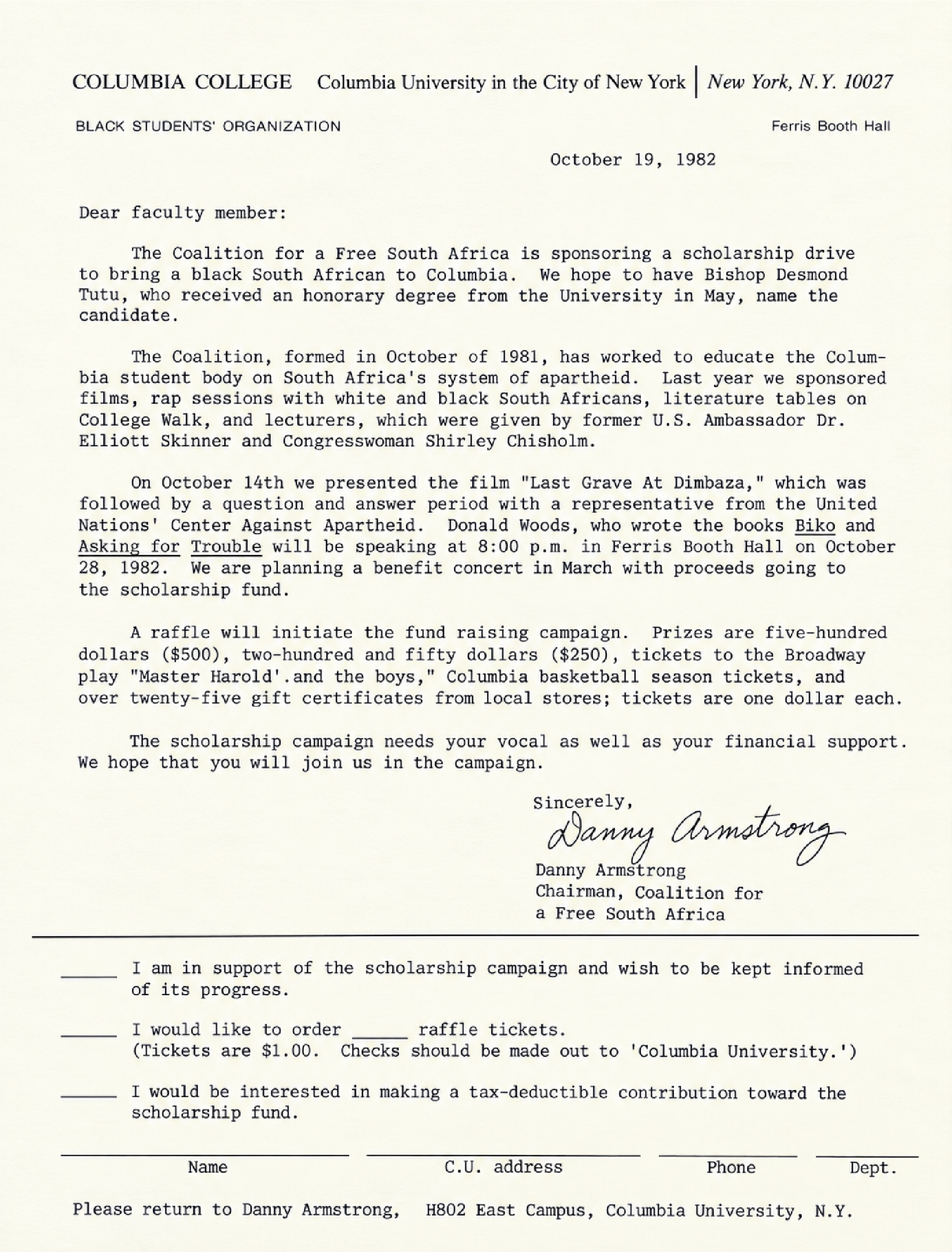
The first event I organized to raise awareness on campus about apartheid was a rap session with black and white South Africans, who described their experiences growing up under apartheid. This event was held on February 11, 1982, at 9:00 pm in the Carman Hall Lounge. Approximately twenty-five students attended. This initial program was well received and it encouraged me to continue.
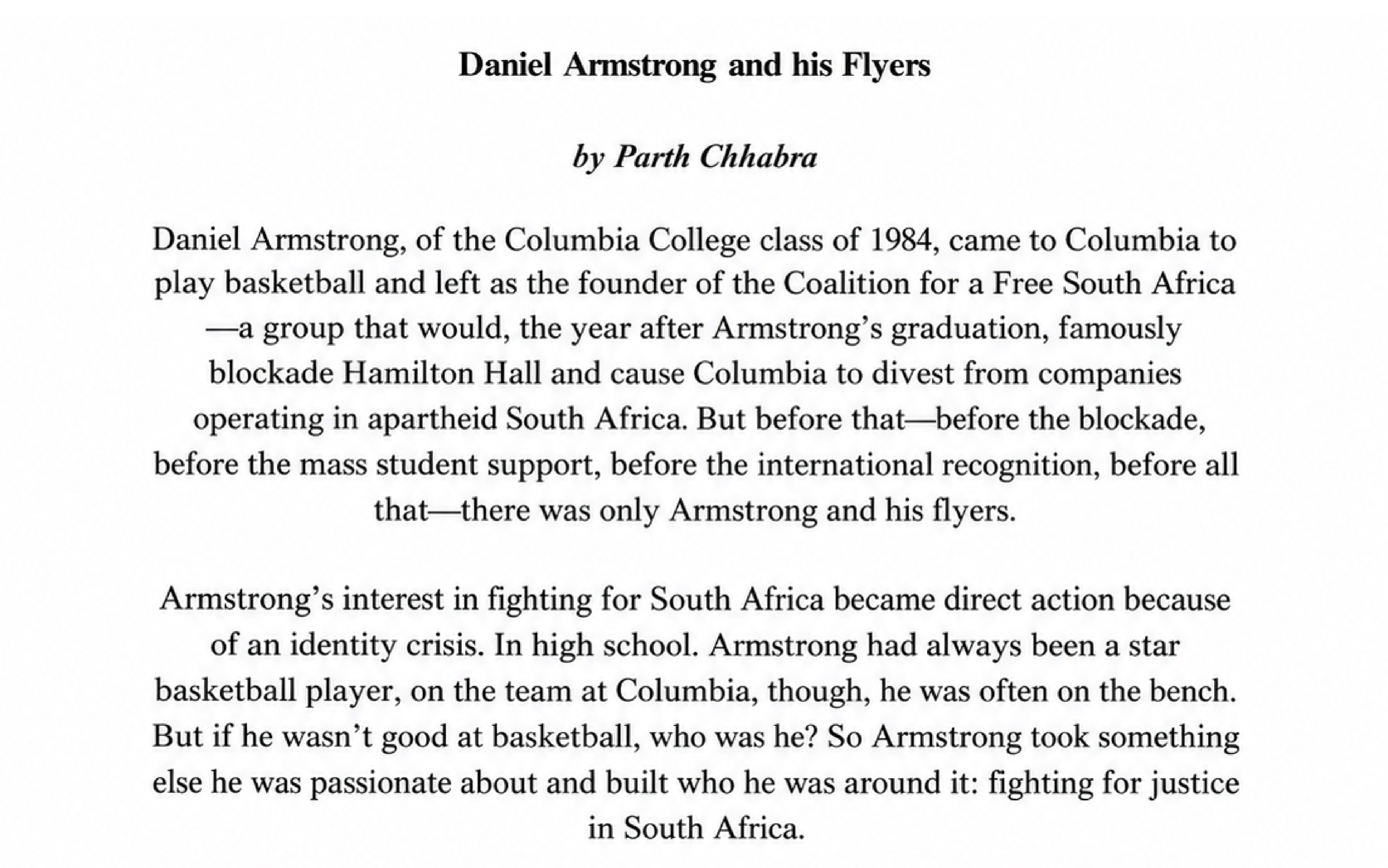
I played varsity basketball, and my teammates would often ridicule me by calling me “a radical” when I entered the locker room with a handful of flyers announcing our next event. Initially, I was self-conscious when people would see me on campus posting flyers. I saw myself as an athlete, not an activist. Students were generally not aware of apartheid and the situation in South Africa. Many had no idea where South Africa was located. I remember one student asking me, “What is the capital of Africa?” Taking a stand against apartheid and calling for divestment was controversial. In fact, taking a stand on any issue was seen as unusual in the early 1980s. The most common locker room conversation my teammates had was about signing bonuses and investment banking jobs with Wall Street firms. “Greed is good” was the classic line from the ’80s film Wall Street. That line epitomized the times.
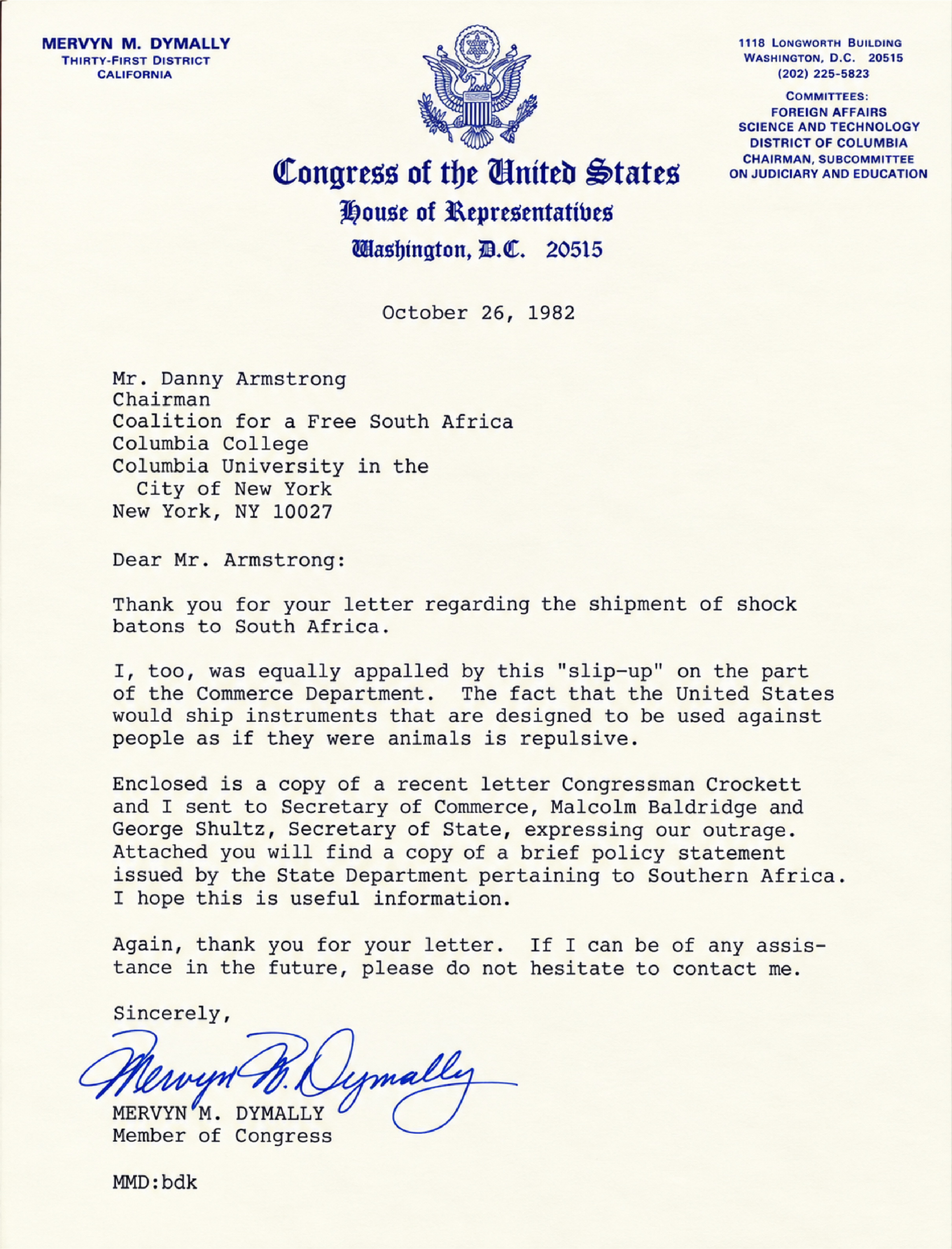
It was the time of Ronald Reagan. The Reagan administration took a direct right turn on President Carter’s emphasis on human rights in foreign policy matters. The Reagan administration had a policy called “constructive engagement” toward South Africa. This policy essentially decreed the U.S. would continue to do business with South Africa. In fact, the Reagan administration “accidentally” sent electronic cattle batons to the South African police to be used on its black citizens. On behalf of the Coalition, I sent a letter of protest to Congressman Mervyn Dymally. America had South Africa’s back. Apartheid was not a problem. This had to change.
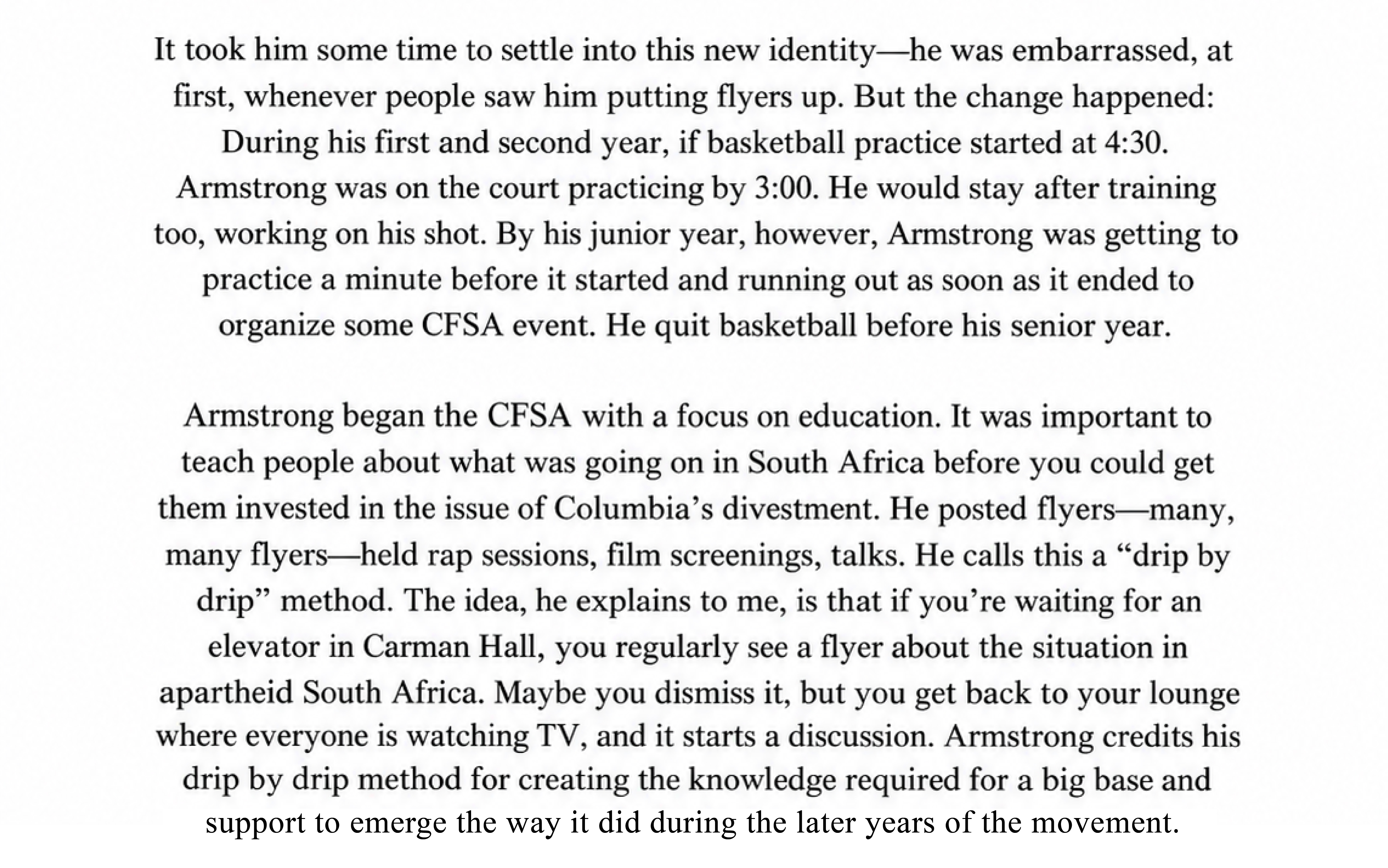
I determined that the best approach would be to educate students on the facts about apartheid and how the role divestment could play to promote change. Informational flyers, prominent guest speakers, films, and leafleting were the central focus to raise awareness on apartheid and Columbia’s investments in corporations with operations in South Africa.
1982 | Shirley Chisholm
U.S. Congresswoman
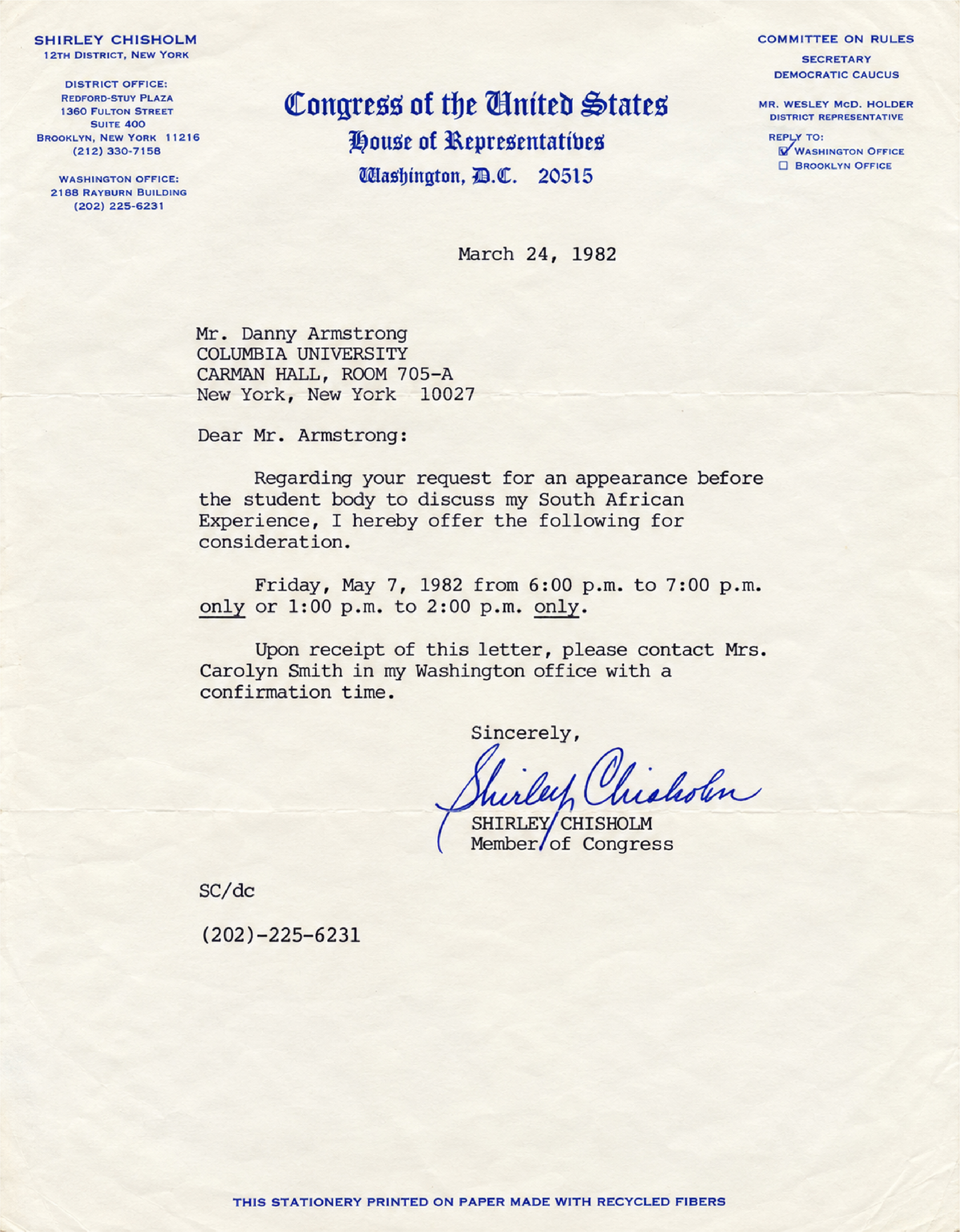
The first year of activity concluded with former Brooklyn Congresswoman and 1972 U.S. presidential candidate Shirley Chisholm speaking in Ferris Booth Hall (FBH) about her experiences in South Africa as a member of a Congressional delegation. She recalled being given the title “honorary white” by the South African government in order to make the trip.
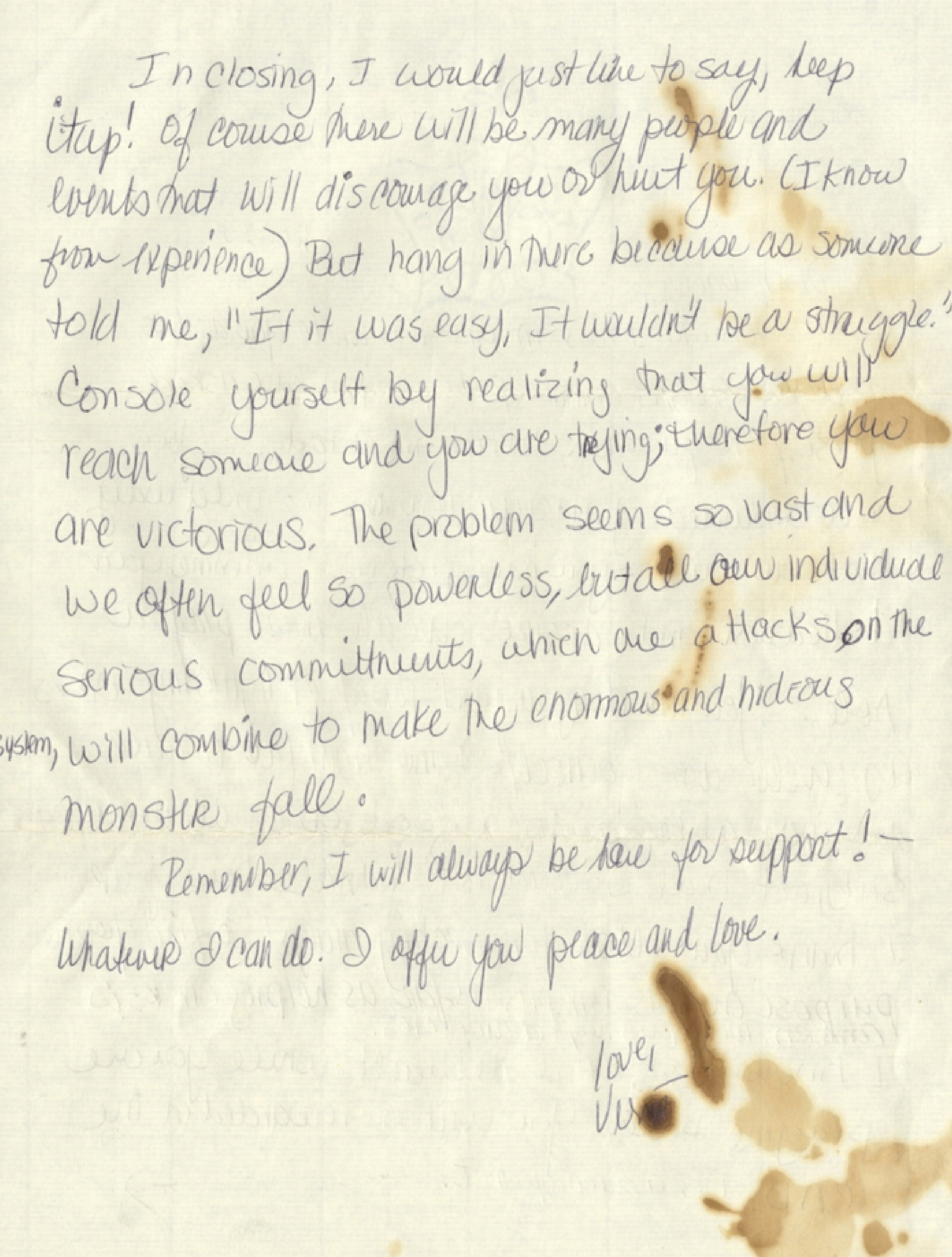
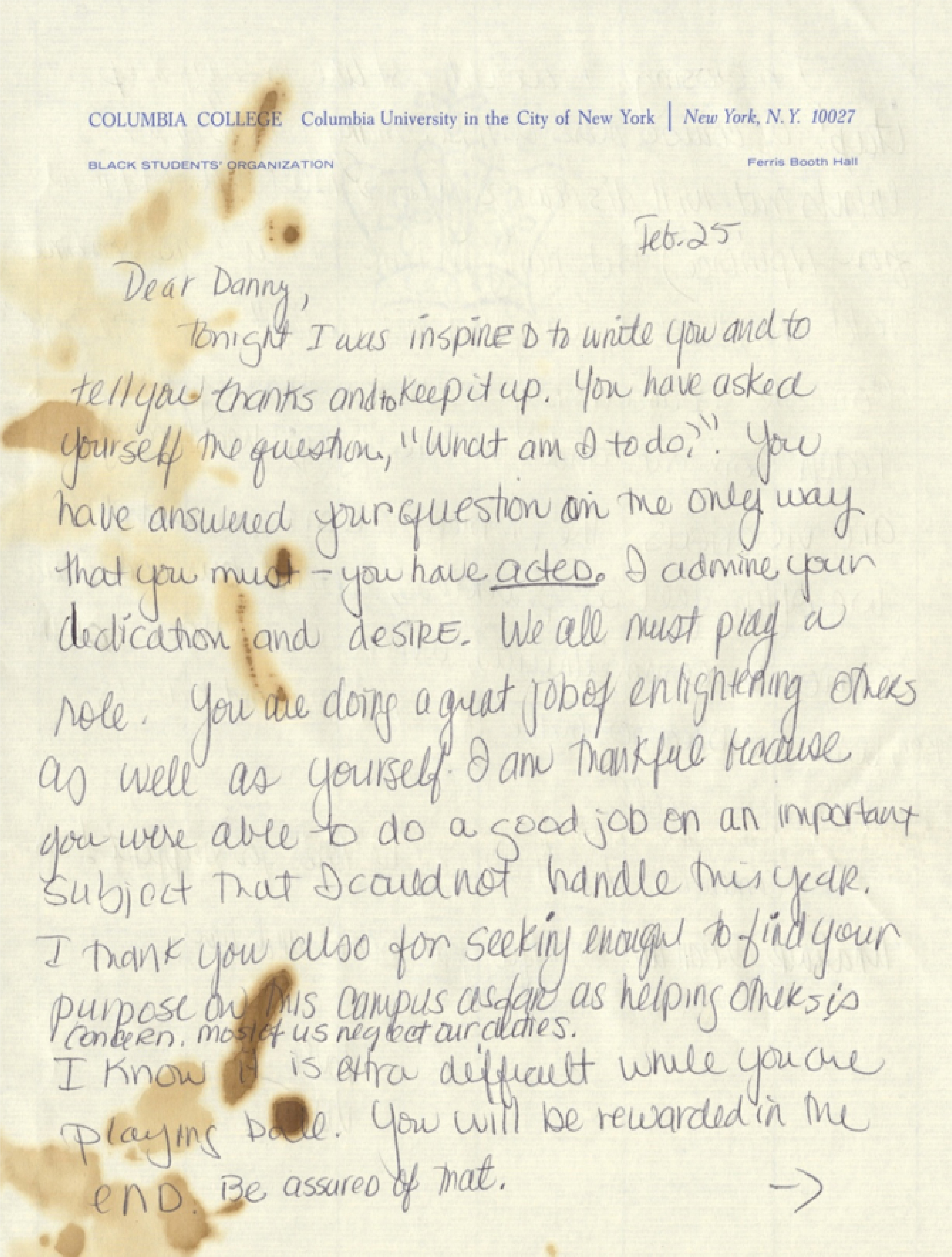
The president of the Black Students’ Organization, Verna Briggs, wrote this letter to Daniel to encourage his efforts
(February 25, 1982).
We did not have personal computers for social media or smartphones to text in the early ’80s. Our flyers were often handmade and posted throughout campus and on every dorm floor. My mother, a calligrapher, would write out flyers and mail them to me, after I told her what to write. Other students would offer to help hand out flyers, but my colleagues would often drift away after an event or two. I had to be the one to post flyers, reserve rooms, and organize programs. My father sent me money for necessities—books, toothpaste, and an occasional subway ride—but not for political organizing. My father insisted that I send him a monthly financial account of my expenses. I found myself adding numerous tubes of toothpaste or an extra book or two, to hide the expenses of printing flyers and other costs.
In order to use campus facilities, the Black Students Organization sponsored or was a co-sponsor of our events. Black students knew as much about what was going on in South Africa, it seemed, as our white counterparts. I had to start with the basics in educating all students about apartheid, just as my sister had done with me years before on a basketball court in Compton.
Initially, I felt alone in moving the campaign forward. Students attended events, which was heartening. The president of the Black Students Organization (BSO), Verna Briggs, sent me a handwritten letter urging me to continue the work of raising awareness on campus. I once saw the official in charge of managing the university’s investment portfolio quietly purchase a “Columbia out of South Africa” divestment T-shirt. I was the last person she wanted to see. As our eyes met, she smiled and pleaded with me not to tell that she supported divestment.
Every time I felt like giving up, a stranger would approach and implore me to continue, or someone would offer to make flyers for the organization. Like undercover CIA agents conveying secret information for a clandestine operation, university staff members would discreetly tell me to come to a certain building and room at an appointed time. There, they explained, would be a box with Coalition event flyers. Staff would use university copying machines and make additional flyers. These experiences encouraged me to continue to organize. Awareness was growing on campus.
April 3, 1982 Rally
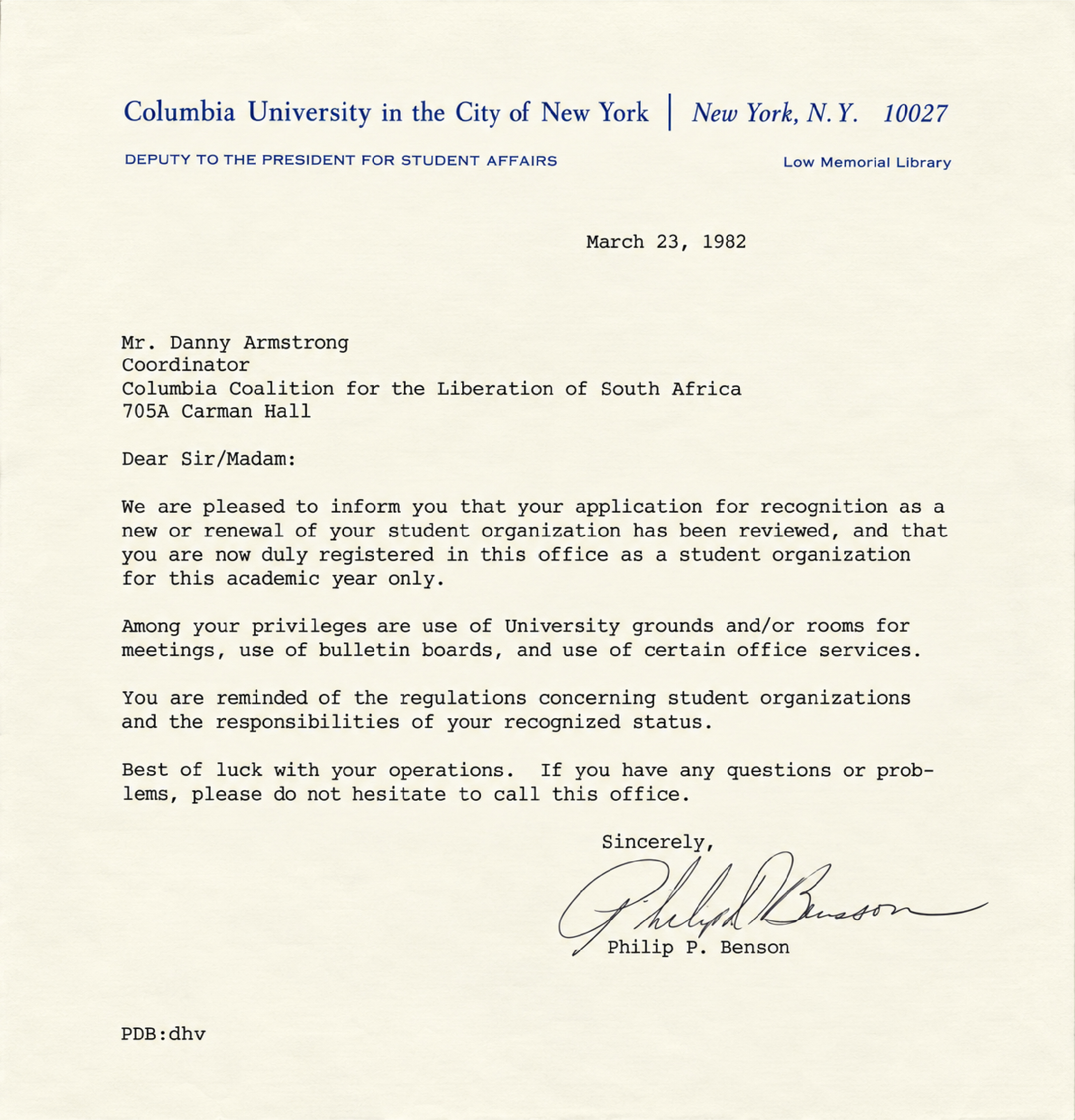
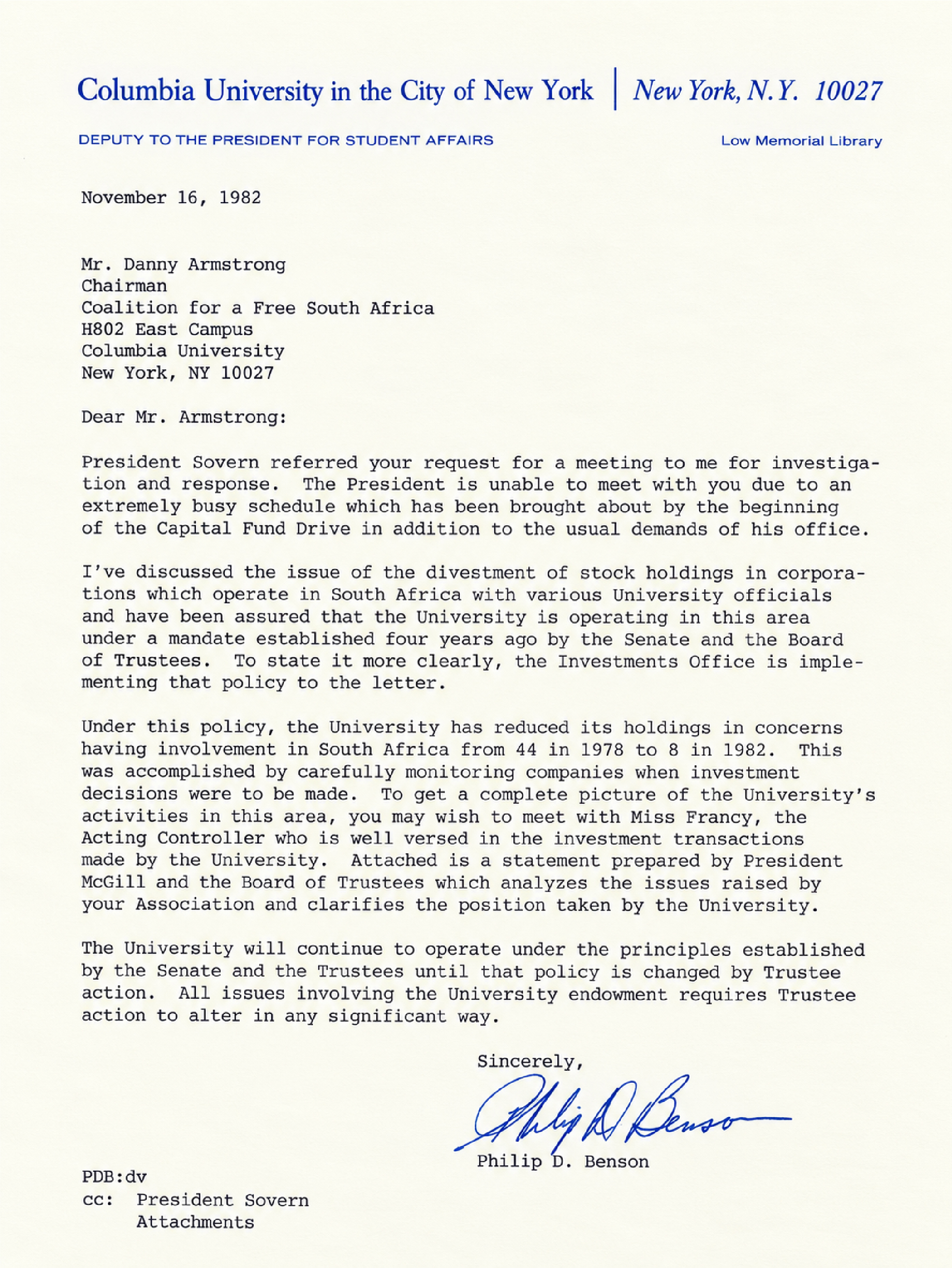
The first Coalition rally was scheduled for April 3, 1982, on College Walk. I submitted the necessary paperwork on March 15. Days before the rally, I was contacted by Phillip Benson, Vice President for Student Services, and he proposed the rally date being changed given that April 3 was Dean’s Day and alumni who would be solicited for donations would be visiting campus. I refused. According to the Spectator (April 2, 1982), “A Columbia official Wednesday asked student organizers of Saturday’s rally protesting university investments in South Africa to move the demonstration away from College Walk so alumni who are visiting the campus for the College’s Dean’s Day would not be deterred from giving donations. ‘It could have an impact,’ Phillip Benson, Vice President for Student Services, said when asked if the demonstrations might dampen the generosity of the alumni. ‘These particular alumni are not involved in demonstrations all the time and we don’t want to make it unpleasant for them,’ Benson explained.”
Ultimately, the rally was held on April 3, 1982, in Uris Plaza behind Low Library. It was a cold, rainy day. Five people attended—my cousin, who was visiting from Los Angeles, three students, and me. I gave a short speech. Despite our minuscule numbers, it seemed like the administration feared the Coalition and our message: Columbia out of South Africa. Divest now.
Sandro Pertini
PRESIDENT OF ITALY
On March 31, 1982, the president of Italy, Sandro Pertini, spoke at Low Library. He called on Columbia to act on the issue of human rights in South Africa as he said, “Our condemnation extends therefore to the dictatorial regimes of Latin America [and] Southern Africa...Let us register our protest from this free university.” (Spectator, April 2, 1982)
Fall of 1982
The name of the organization was officially changed from The Coalition for the Liberation of South Africa to the Coalition for a Free South Africa and later became a registered campus organization. I had been elected director of political affairs for the Black Students Organization (BSO) the previous spring, so now I merged the political focus of BSO with the mission of the Coalition. Soon the Coalition began attracting a diverse following and became more independent of the BSO.
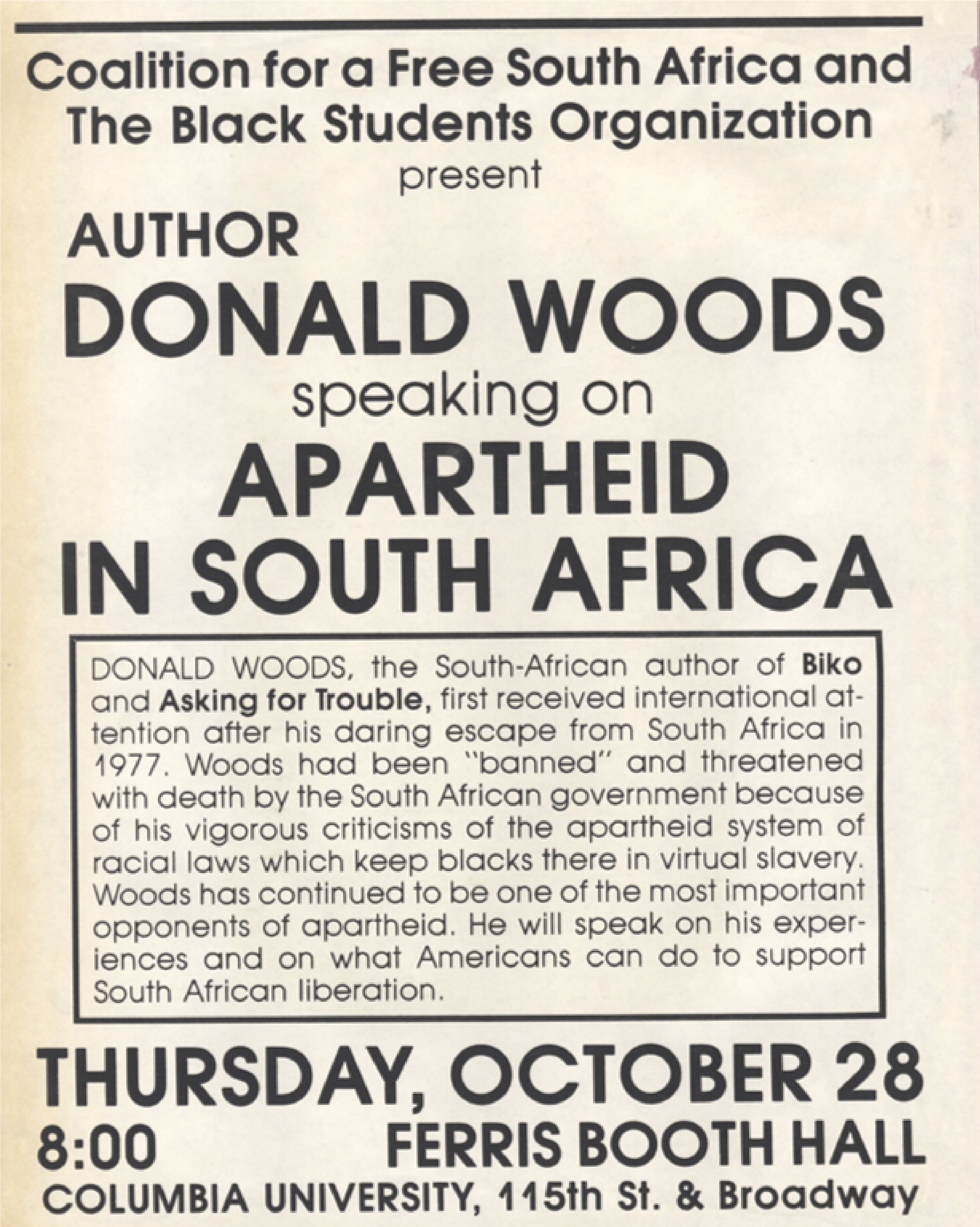
Donald Woods
AUTHOR
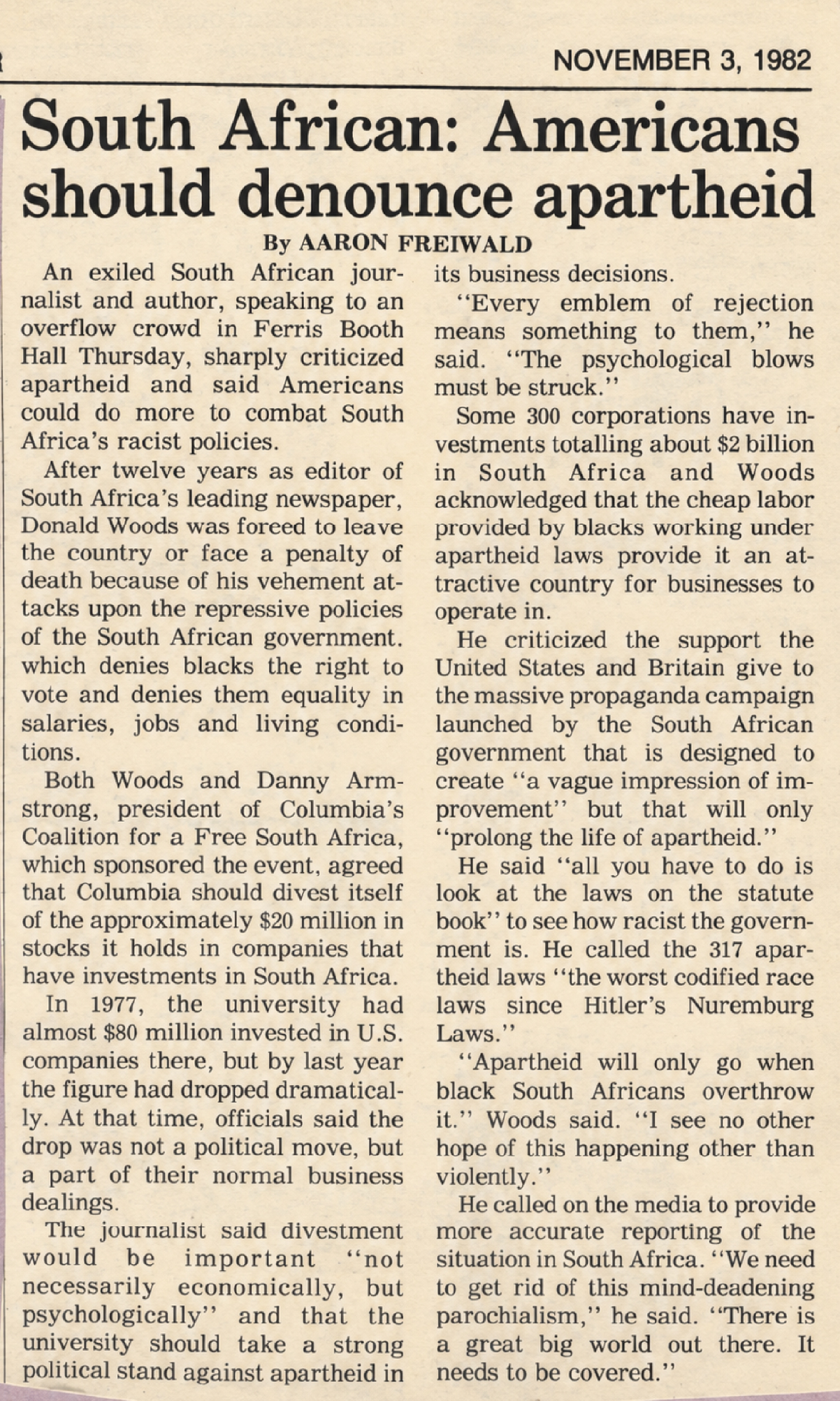
Donald Woods, who wrote the books Biko, about black South African anti-apartheid activist Stephen Biko, and Asking for Trouble, spoke to an overflow crowd in Ferris Booth Hall on October 28, 1982. Woods, who is white, escaped from South Africa in 1977. He had been “banned” and threatened with death by the South African government because of his vigorous criticisms of the apartheid system. Woods spoke about his experiences and what Americans could do to support change in South Africa.
Following this event, I recall thinking how my priorities had changed. In my freshman year, I would have stayed an hour after basketball practice to continue to work on my shot. On the day of the Woods event, I could not wait to get out of practice, as I had a small window of time to shower, dress, and meet Mr. Woods prior to the event. The divestment campaign was becoming my priority.
Scholarship Drive
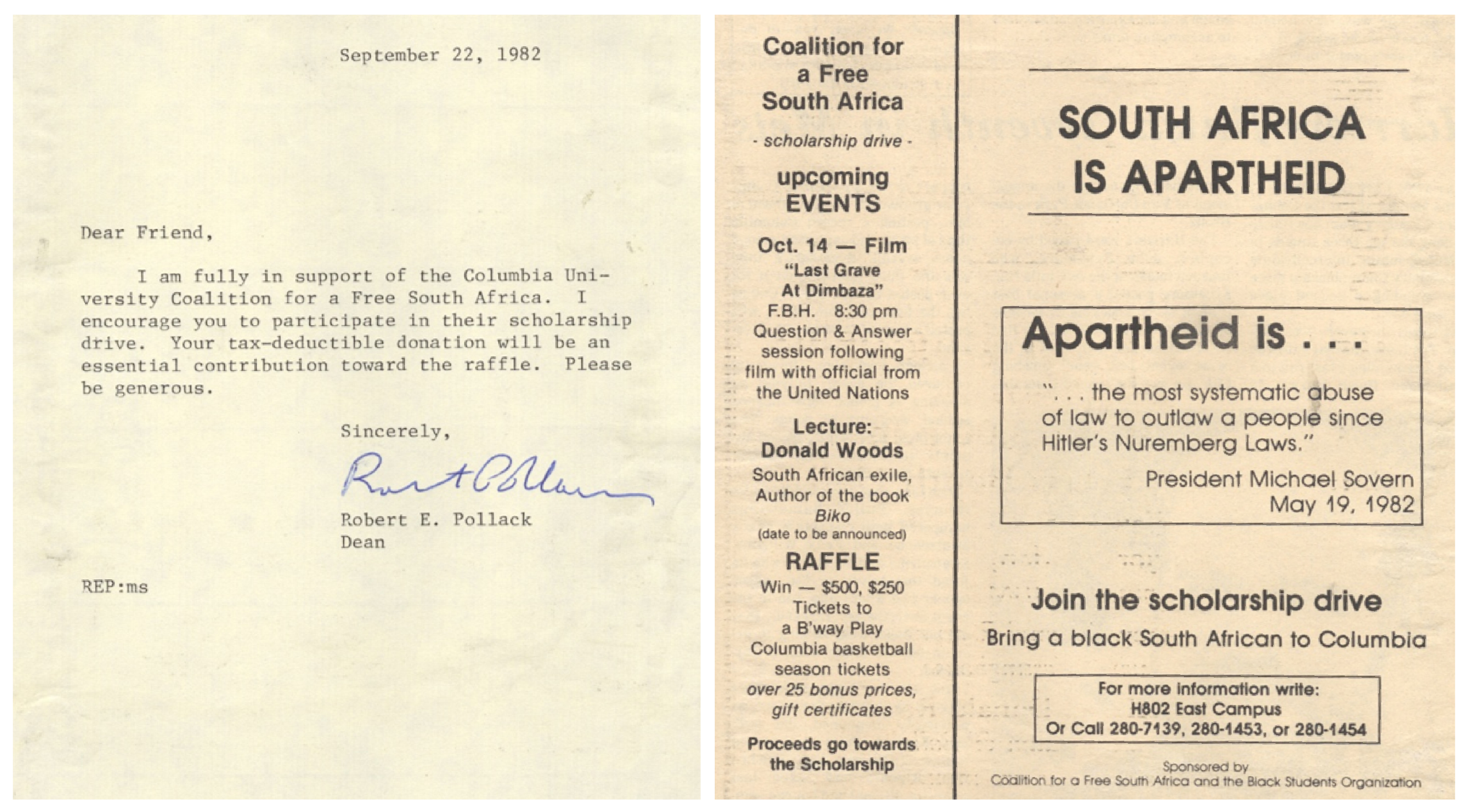
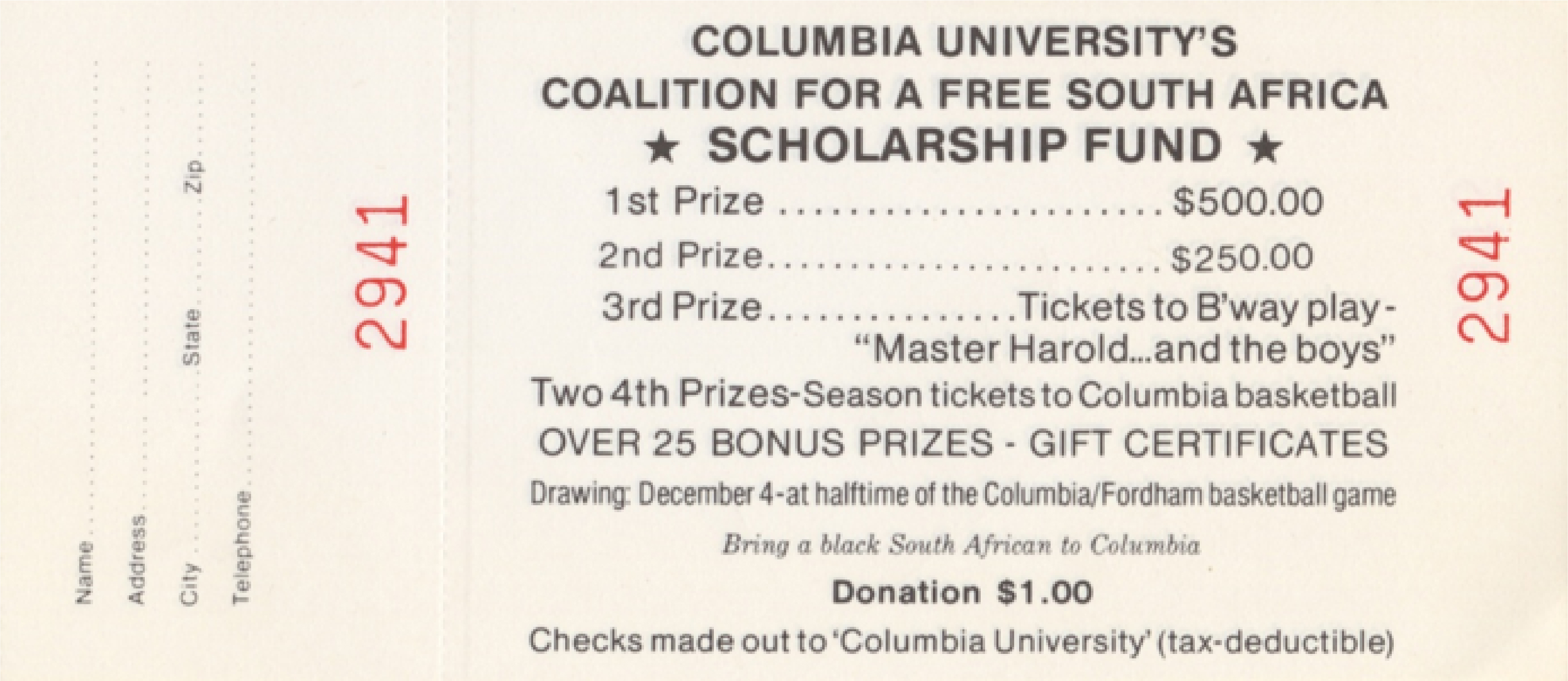
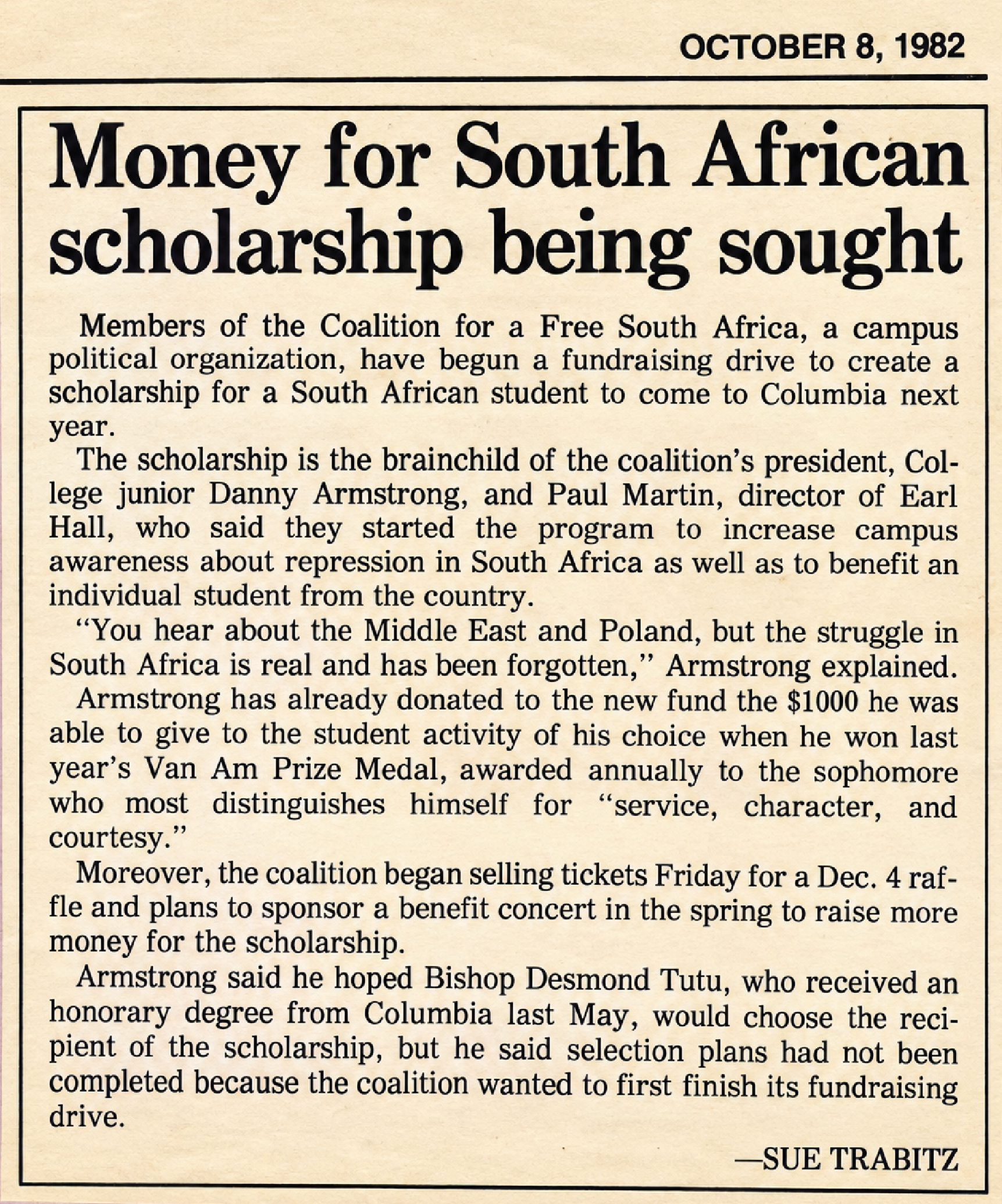
In the fall of 1982, we launched a drive to raise funds for a black South African student. I was able to give $1,000 from an award the College had given me the previous spring for campus leadership. College Dean Robert Pollack also made a donation. We had a raffle to raise funds and awarded the money to a Black South African student who was enrolled at the university at that time.
University Senate Resolution
and After the Senate Vote
March 25, 1983 – April 3, 1985
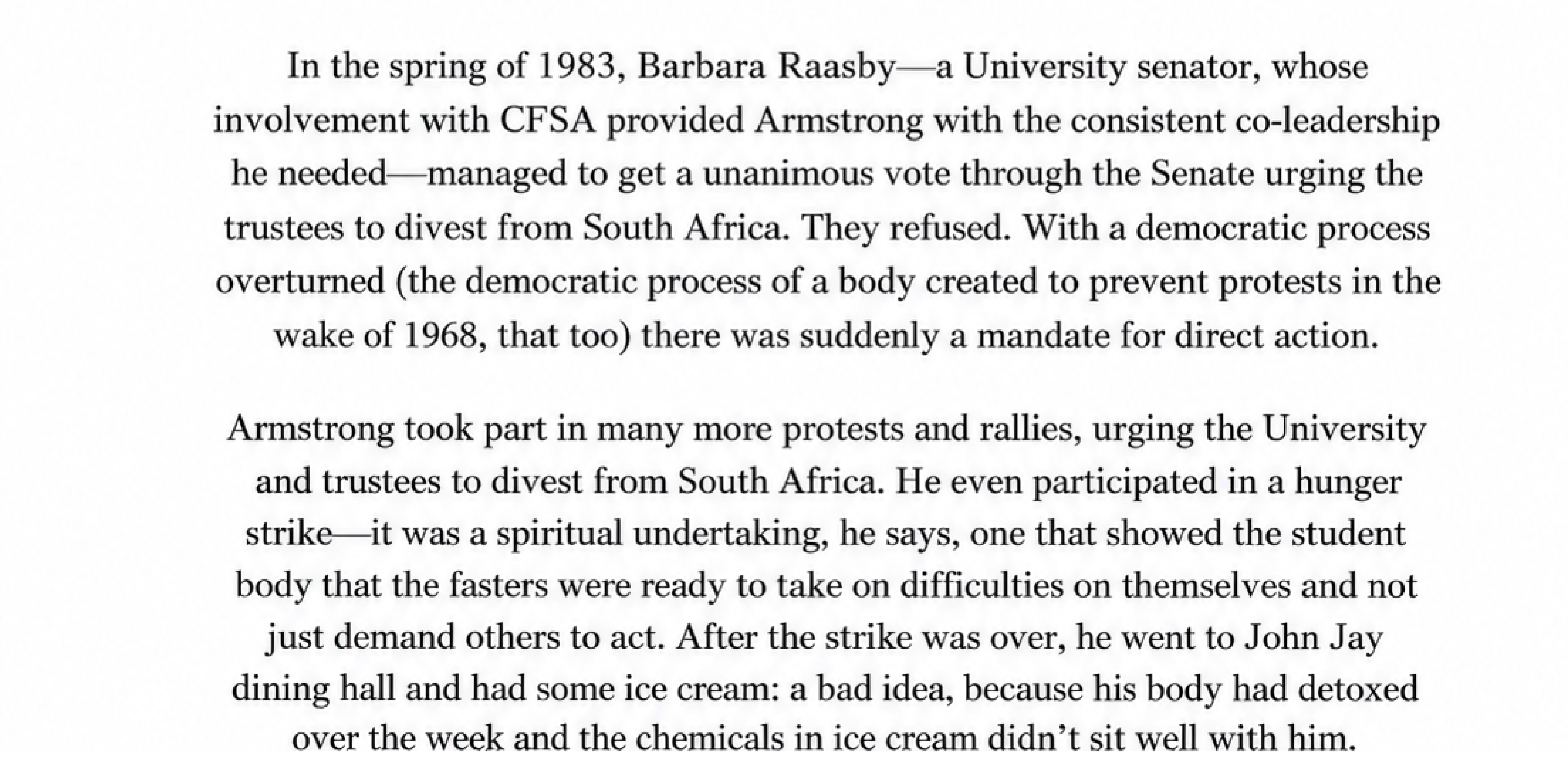
The University Senate resolution was spearheaded by Senator Barbara Ransby, who attended the School of General Studies. I first met Barbara in January of 1983. I did not know much about the Senate, but she explained that this was the official channel to move a formal resolution committing the university to divest before the Board of Trustees.
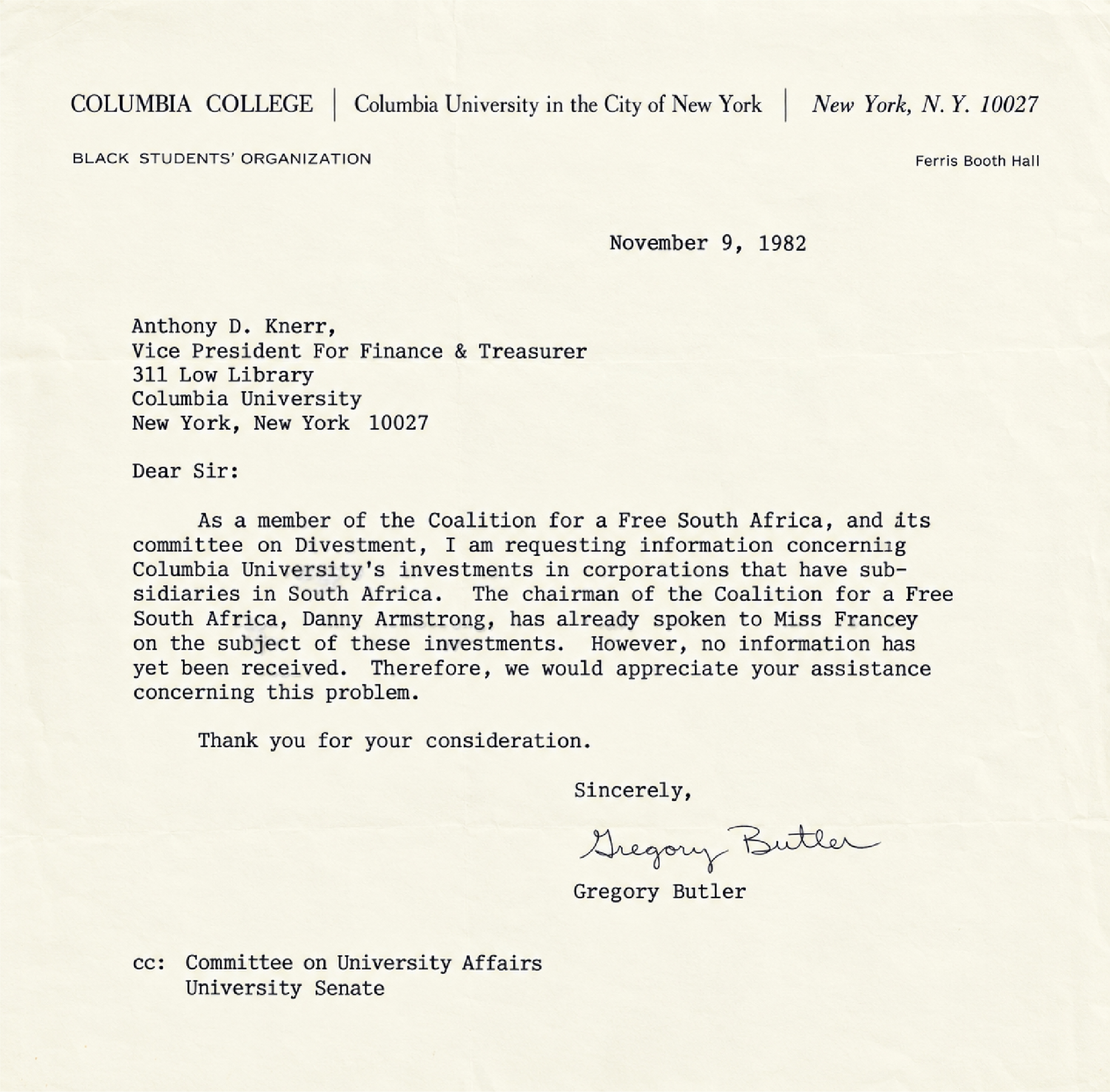
Over the previous year and a half of organizing, I had grown accustomed to people coming forward with suggestions or strategies or offering their help. After a week or month, most drifted away. While there was a small nucleus of committed students who stayed, such as Greg Butler and Greg Smith, whom we called “The Gregs,” student participation was often a revolving door. After a while, I had grown accustomed to and had come to expect a regular turnover in those willing to do the work of posting flyers, standing at tables, and attending meetings. When midterms came, or other pressing matters, I realized that manywould leave. Barbara was very serious and thoughtful. It was apparent that divestment was not an emotional whim or a “cause-of-the-day” for her. A month after meeting her, I remember watching her from afar at one event, and thinking, “Hmmm... she’s still here.” Barbara stayed and never left.
At rallies, Barbara had a way of speaking without great emotion, but with great conviction, as she presented the facts of our case. She was like our lawyer. When Barbara joined the Coalition, it was like an adult was in the room.
University Senate Resolution
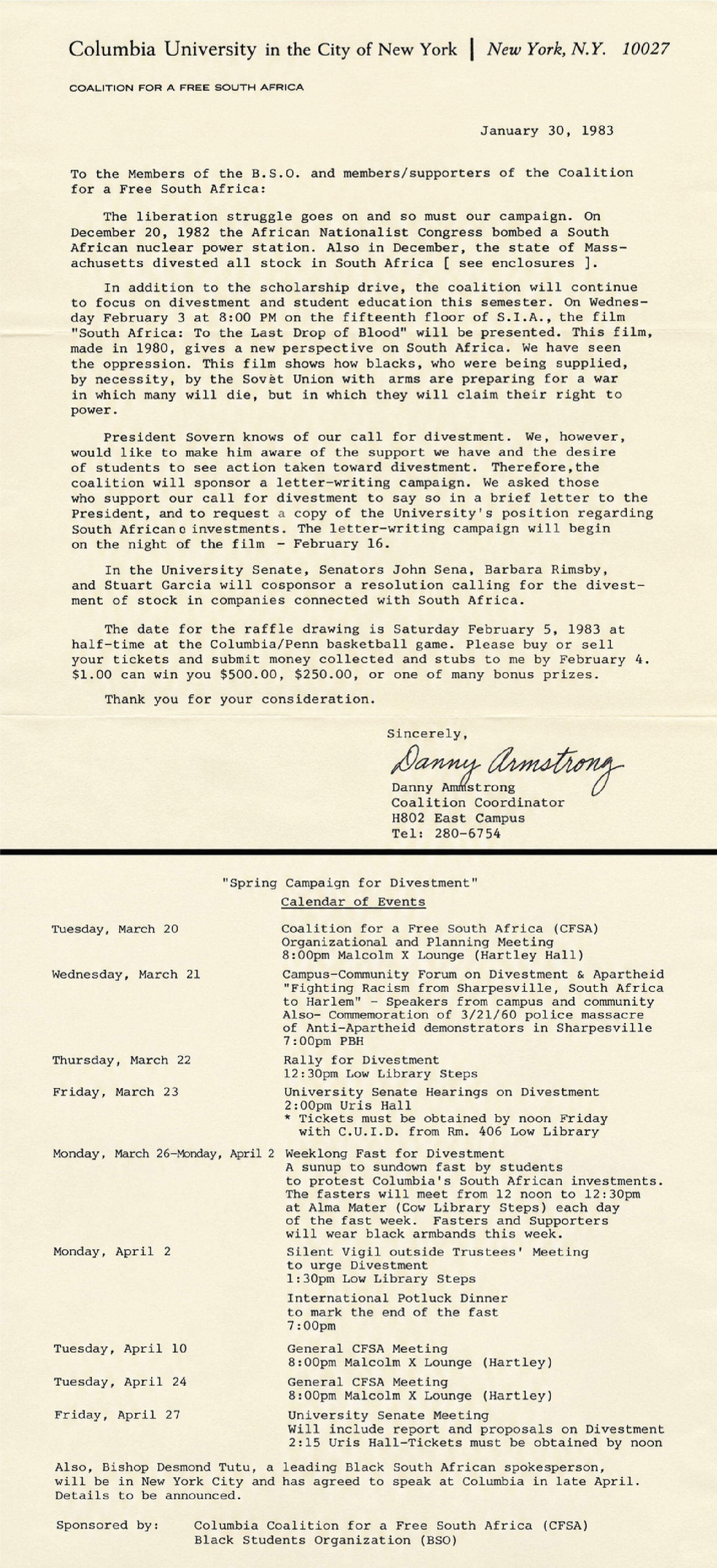
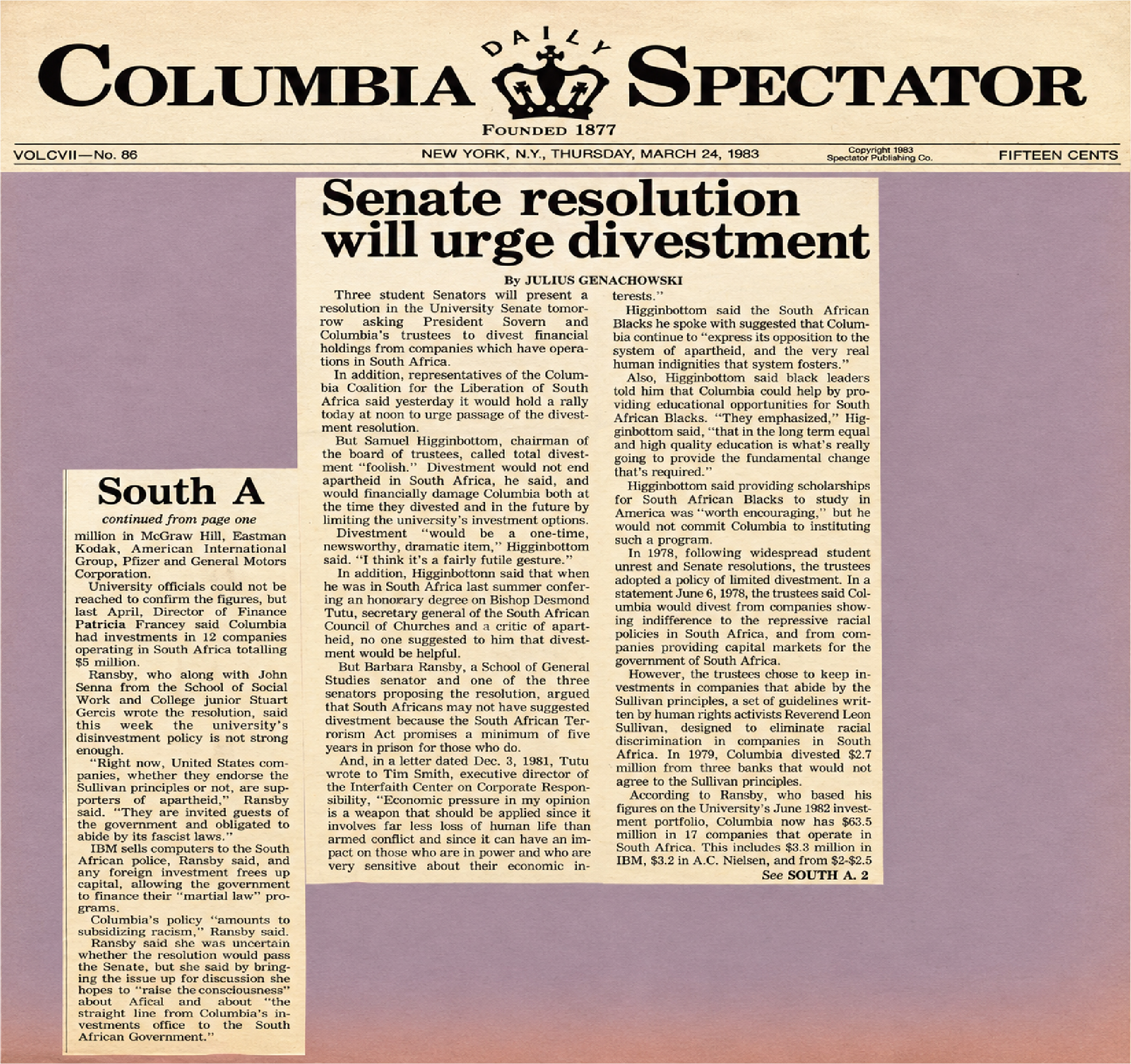
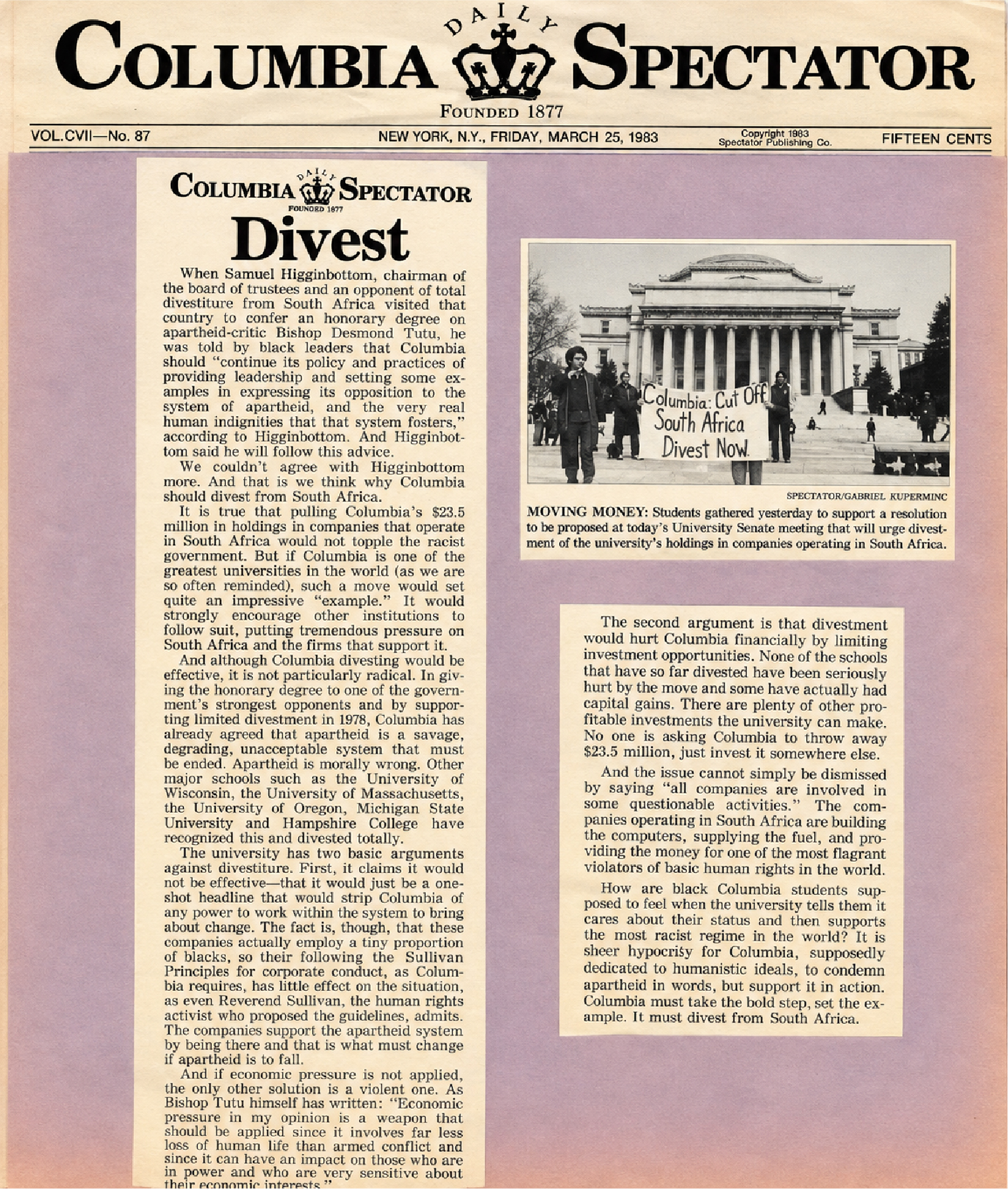
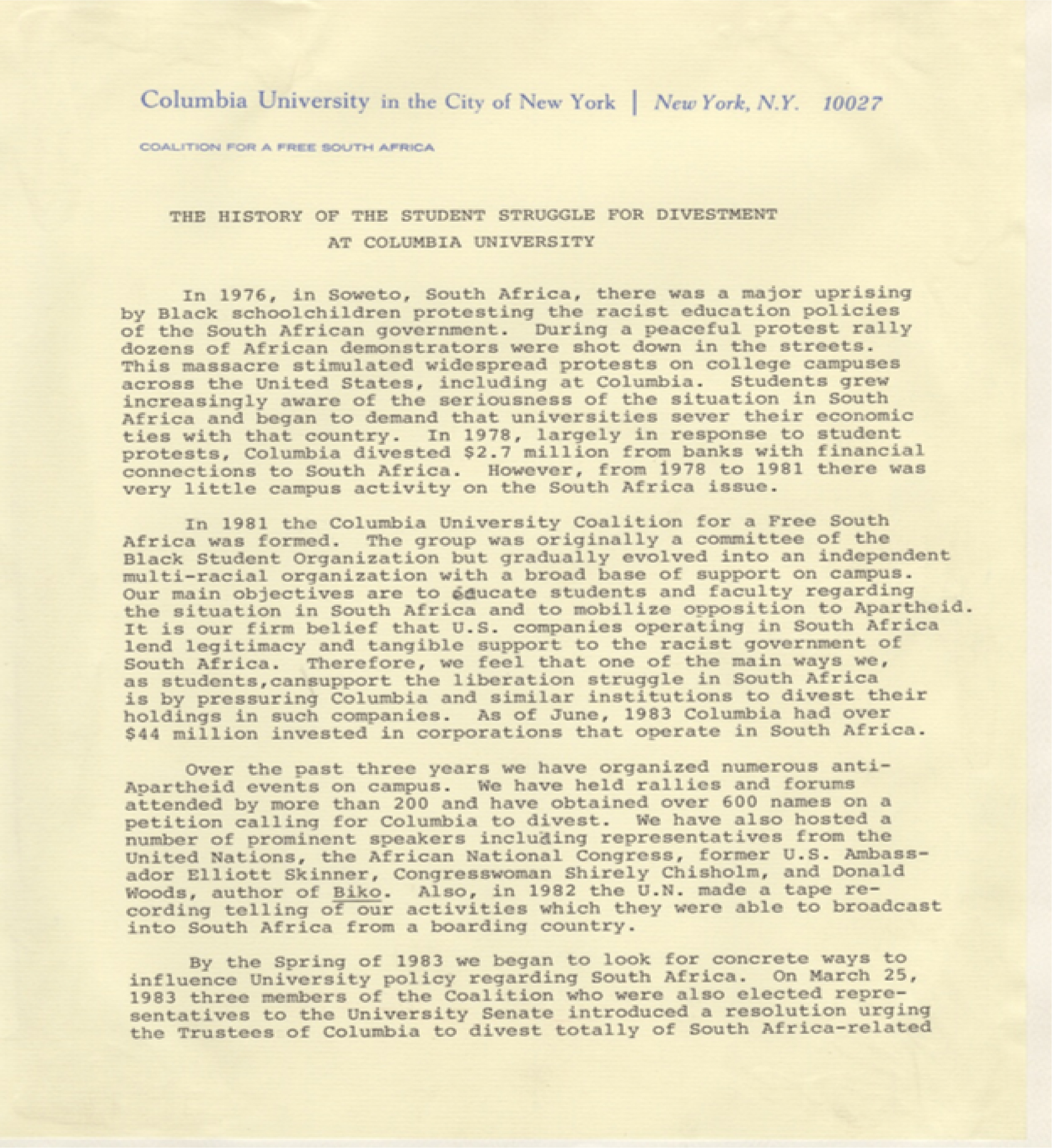
On March 25, 1983, University Senator Ransby, along with two colleagues, John Senna from the School of Social Work and Stuart Garcia from the College, co-sponsored the resolution in support of divestment from companies doing business in South Africa. A Coalition-sponsored rally preceded the introduction of the resolution.
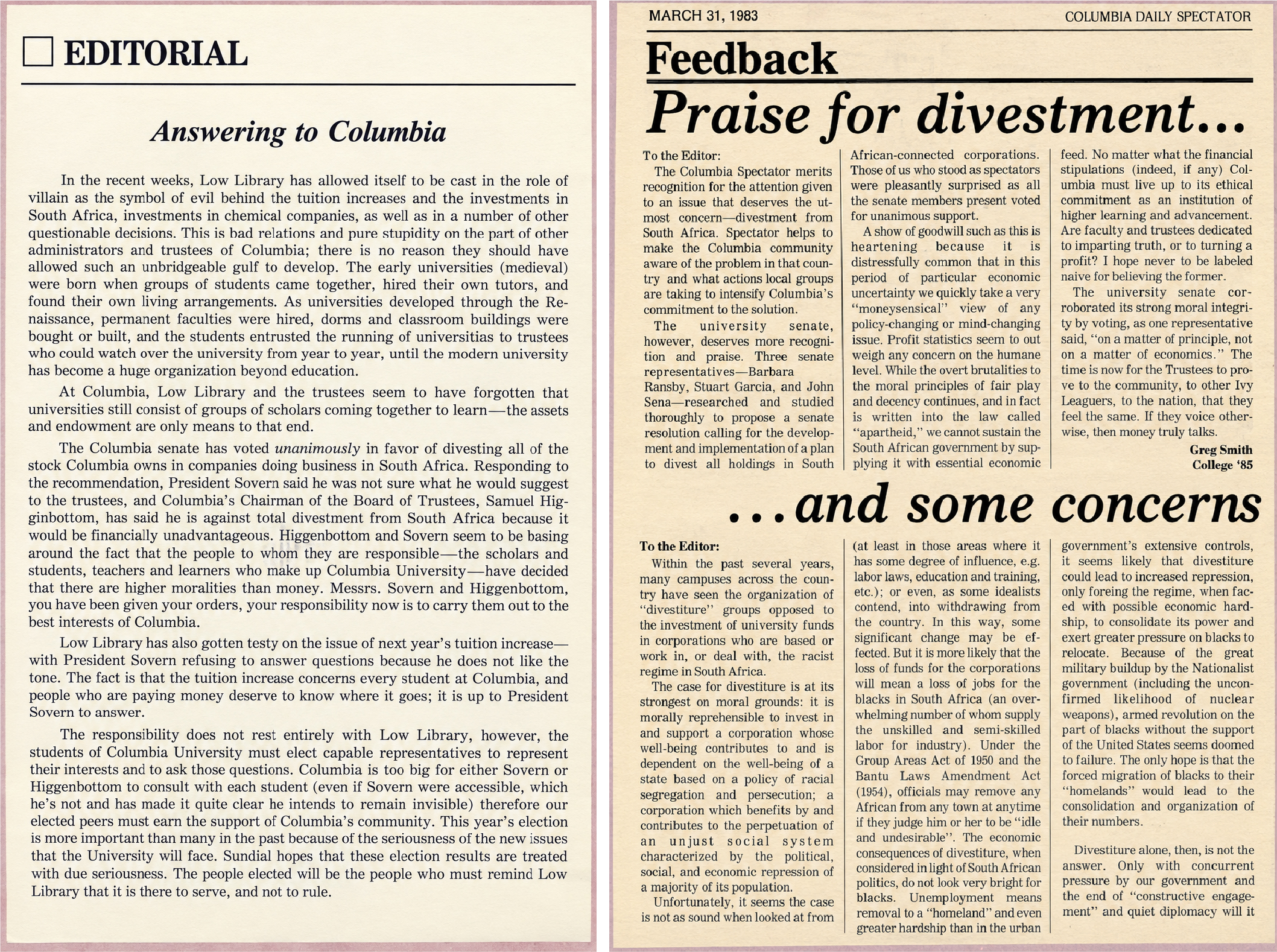
On the same day as the resolution was introduced, the Columbia Daily Spectator endorsed the resolution with the following editorial, in part:
If Columbia is one of the greatest universities in the world (as we are so often reminded), such a move would set quite an impressive ‘example.’ It would strongly encourage other institutions to follow suit, putting tremendous pressures on South Africa and the firms that support it.
How are black Columbia students supposed to feel when the university tells them it cares about their status and then supports the most racist regime in the world? It is sheer hypocrisy for Columbia, supposedly dedicated [to] humanistic ideals, to condemn apartheid in words, but support it in action. Columbia must take the bold step, set the example. It must divest from South Africa.
—Columbia Daily Spectator
March 25, 1983
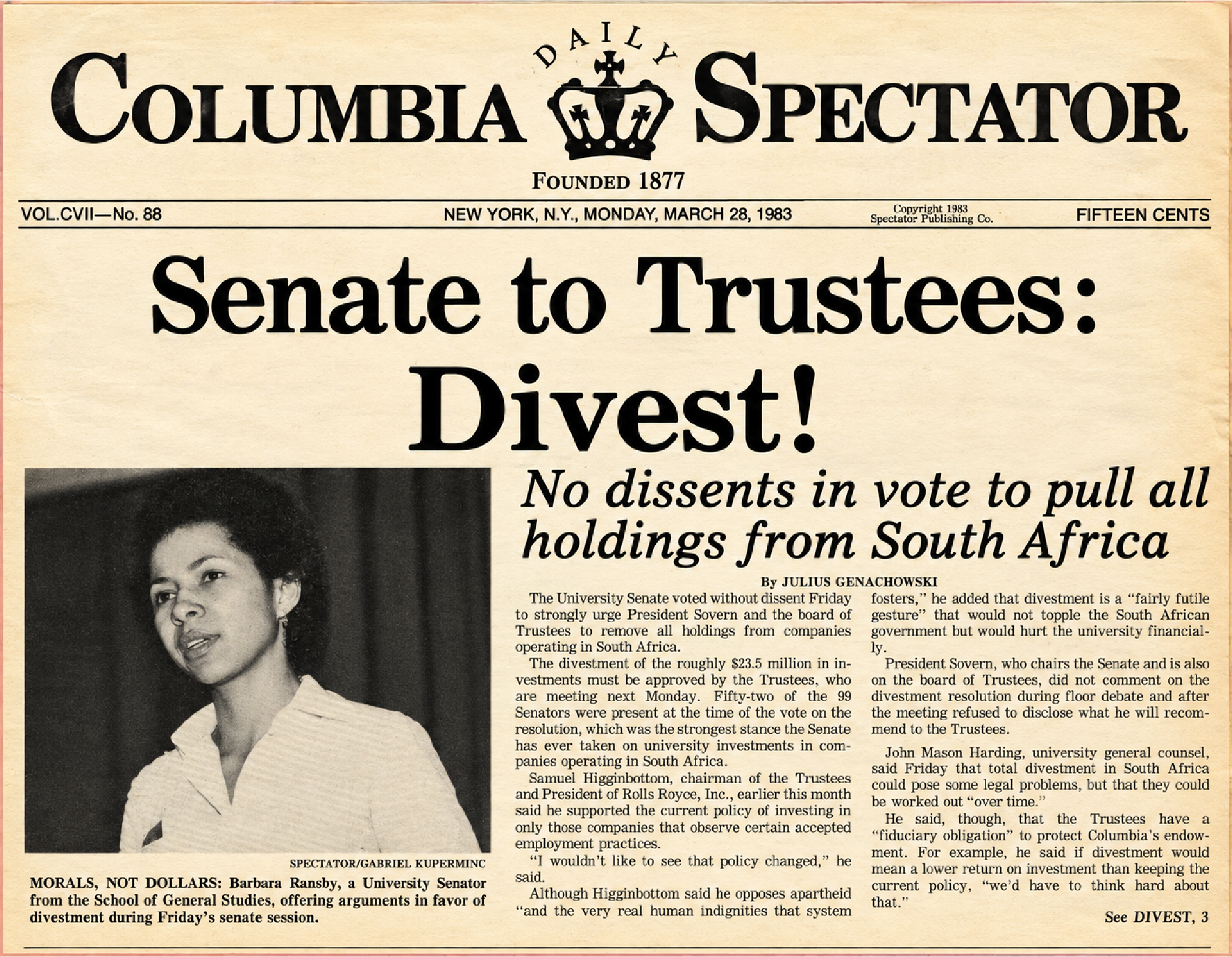
The resolution asked the trustees to “develop and implement a specific plan for the divestment of all its holdings in corporations which have operations in South Africa.” The resolution passed with no dissenting votes. According to the Spectator, fifty-two of the ninety-nine Senators were present for the vote. “In a speech interrupted three times by applause, Ransby said Columbia’s policy of investing in some companies in South Africa ‘whether we intend it to or not, lends support and legitimacy to the system of apartheid,’” according to the Spectator. The Spectator article continued, “Ransby echoed this argument, saying Columbia, as a ‘humane’ institution, must divest from companies operating in South Africa.
She quoted Bishop Desmond Tutu, a Black leader who last summer received an honorary degree from Columbia, as saying “Foreign investors must not kid themselves. Their investments maintain the apartheid system.” We had won. The resolution passed, but what did it mean? Were the trustees required to act based on the Senate’s recommendation? We were unsure.
The Aftermath
With Barbara on board and taking a leadership role in the Coalition, we were growing beyond a one-man-driven campaign to an organization with a broad base of support. Barbara became co-chair of the Coalition with me. It was a natural fit and we worked well together—focused on the mission: Columbia out of South Africa.
The Spectator and other student publications lined up behind divestment. Supporting divestment was no longer the radical position, but the ethical one.
“[Samuel] Higgenbottom [chair of the board of Trustees] and [President] Sovern seem to be skating around the fact that the people to whom they are responsible—and the scholars and learners who make up Columbia University —have decided that there are higher moralities than money. Messrs. Sovern and Higgenbottom, you have been given your orders, your responsibility now is to carry them out to the best interest of Columbia.”
—Sundial editorial
April 22, 1982
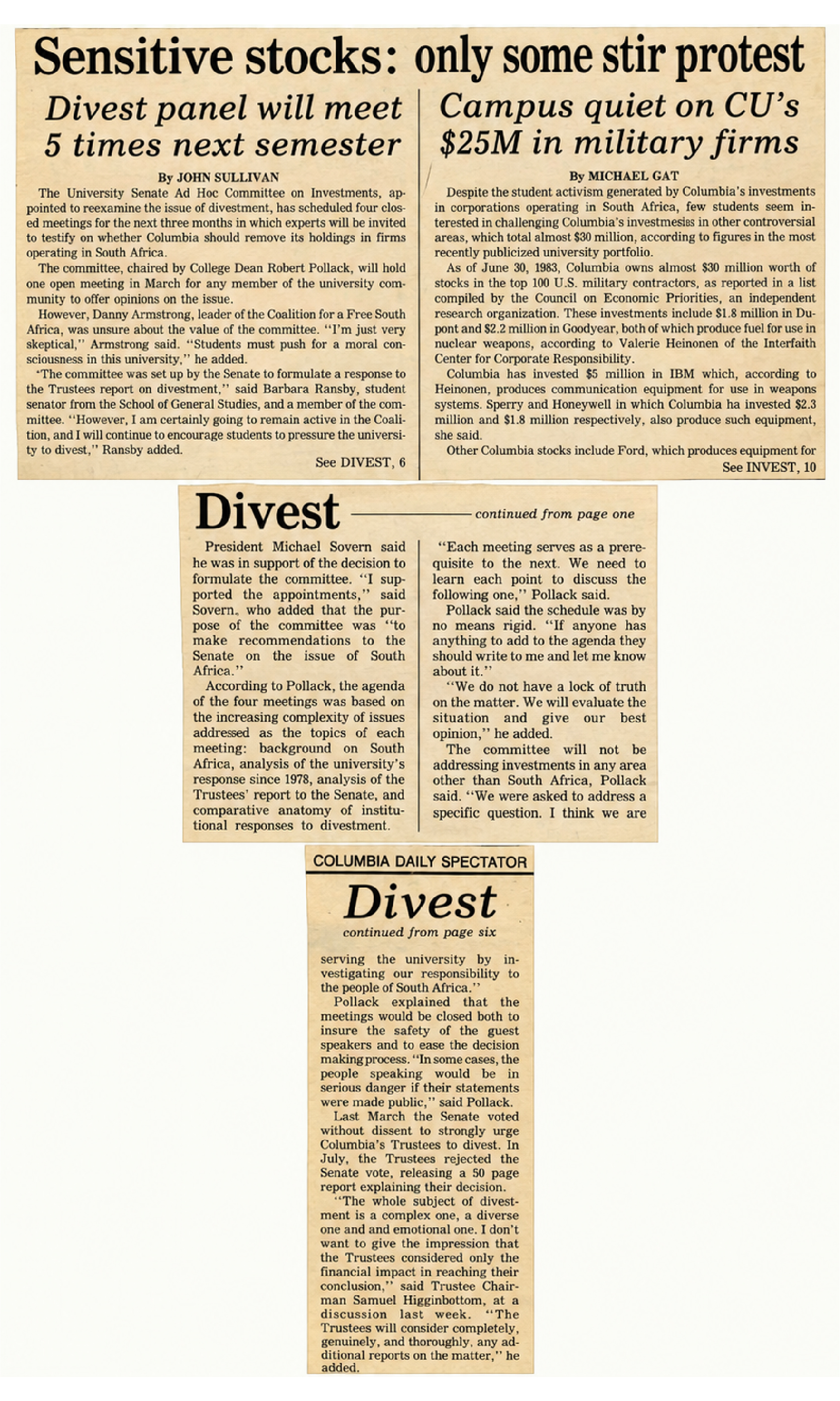
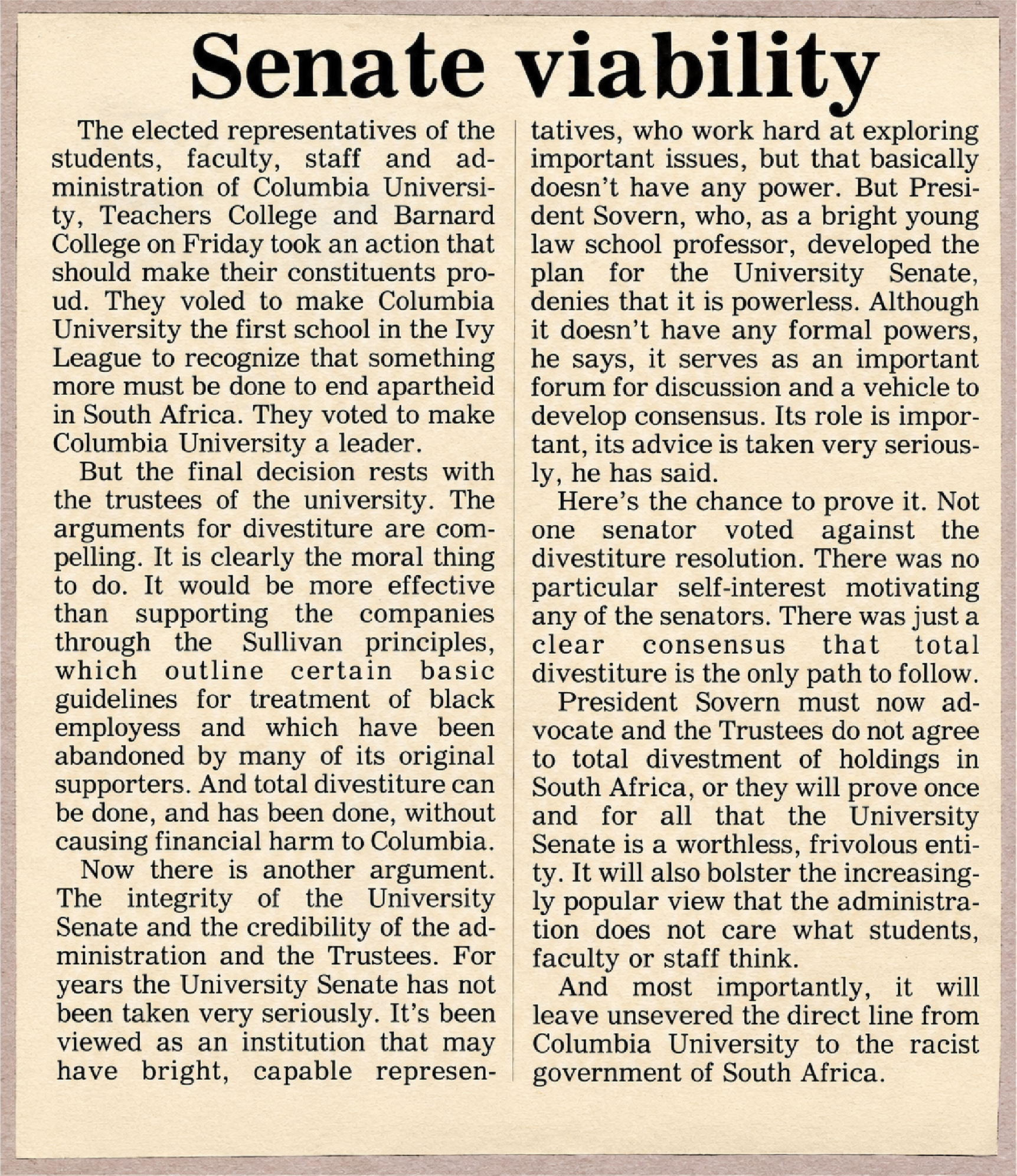
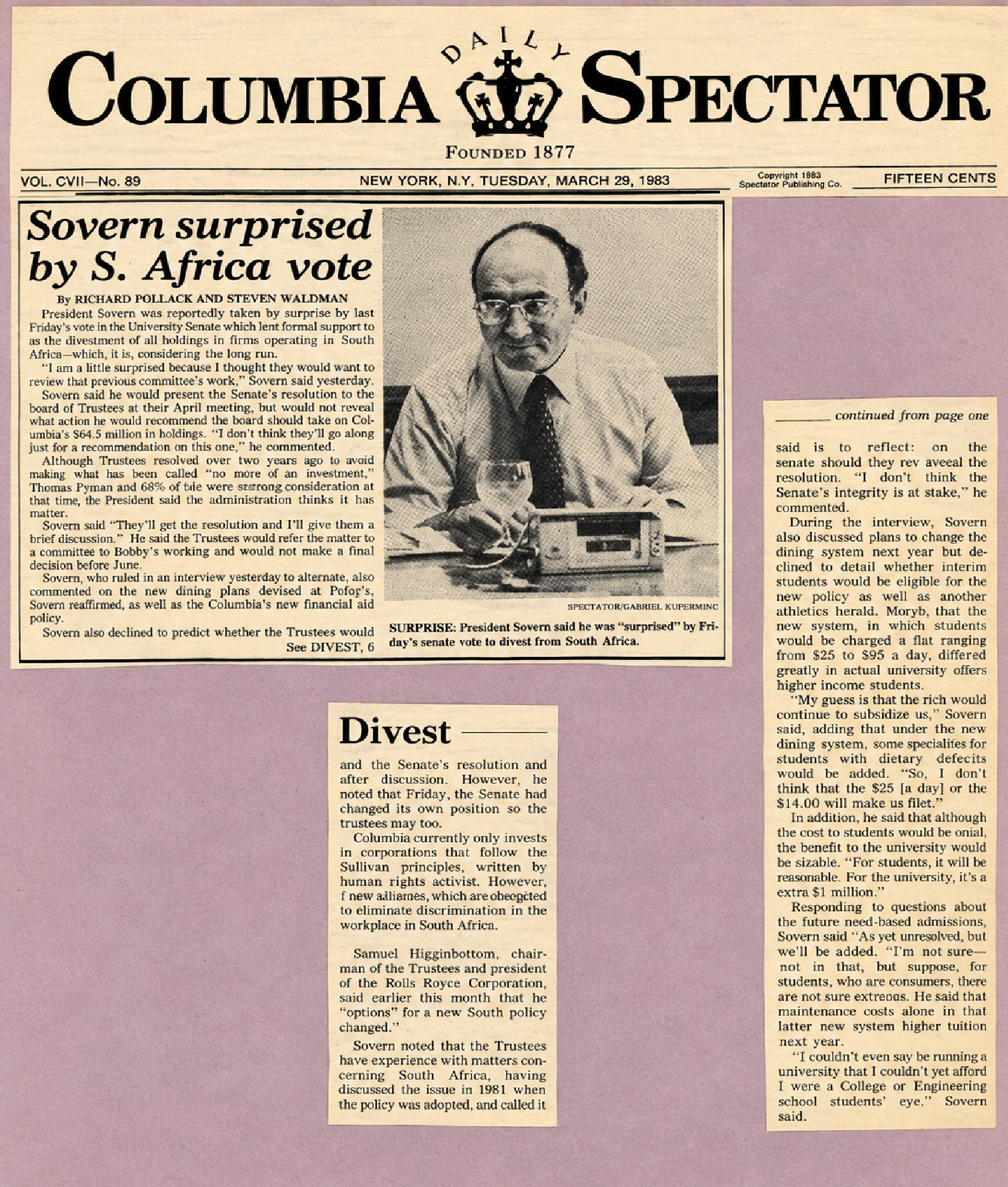
Despite growing support and the Senate’s resolution, President Sovern and the Board were not required to divest. The viability of the University Senate was even called into question by the Spectator, which stated in an editorial that failure to divest following the Senate vote would “prove once and for all that the University Senate is a worthless, frivolous entity.” President Sovern said he was “surprised” by the Senate vote (Spectator March 29, 1983).
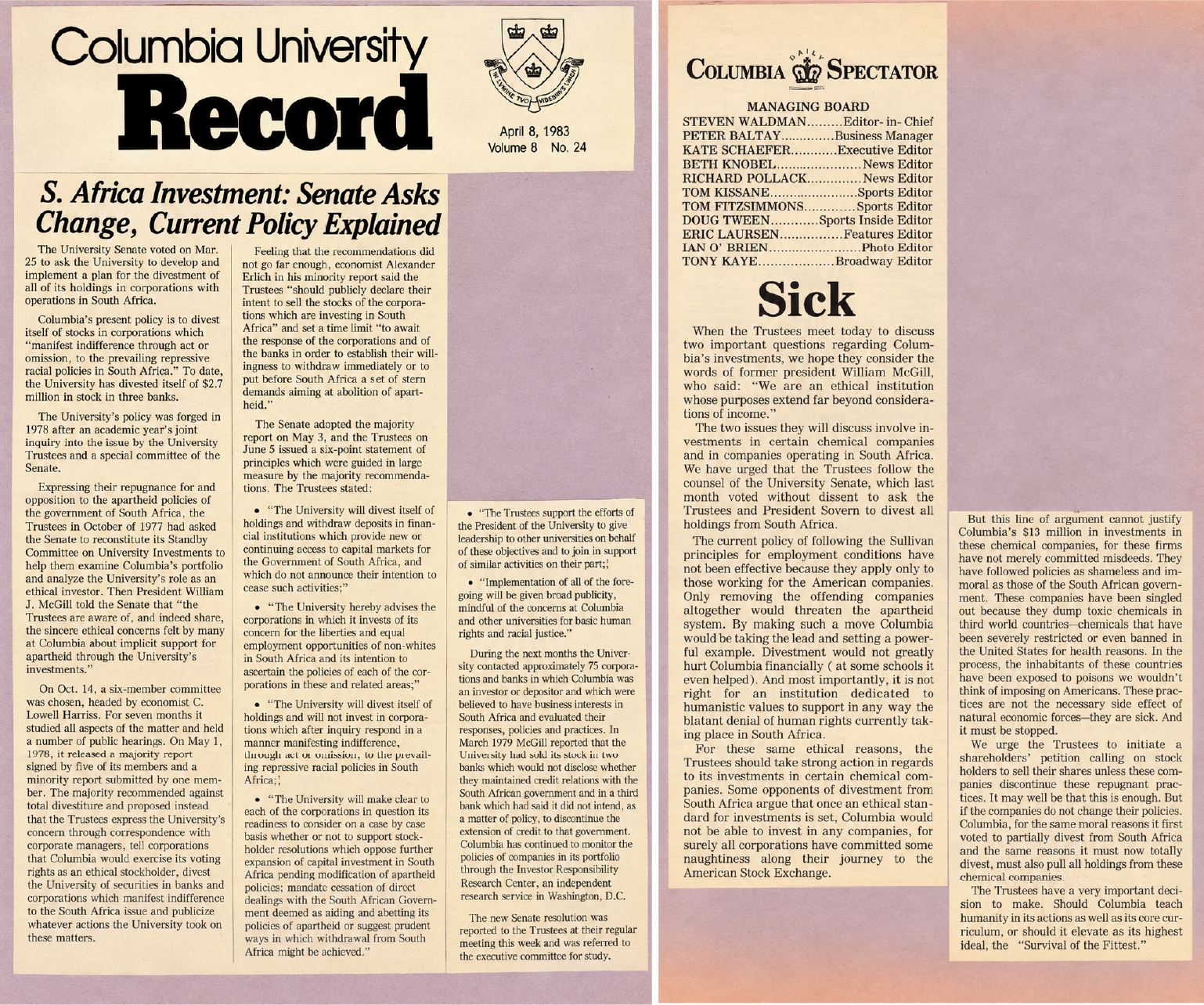
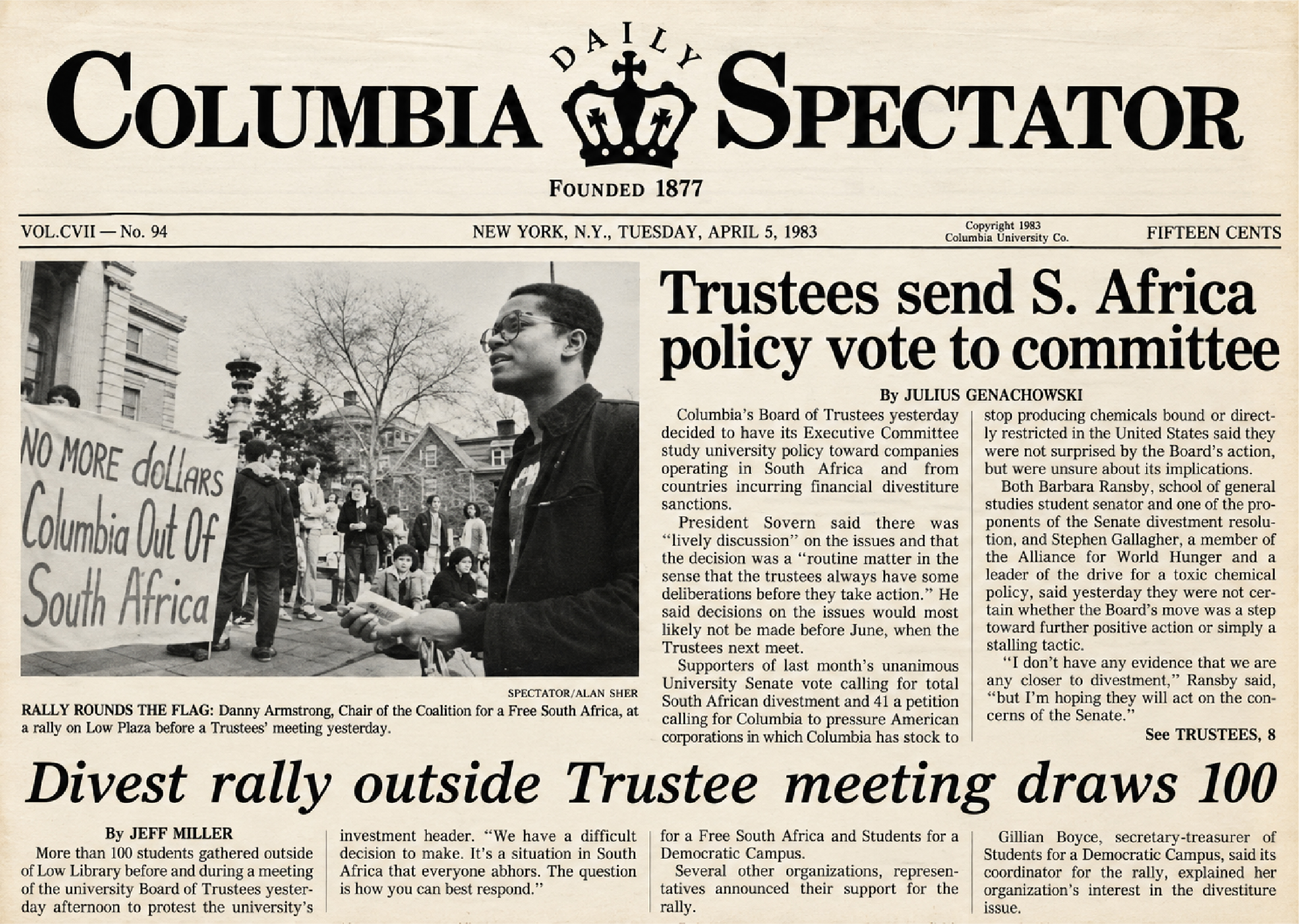
The Trustees met on April 4, 1983, following the passage of the Senate resolution. The Coalition held a rally on the Low Library steps prior to the meeting. Trustee Peter Loweb said, according to the Spectator (April 5, 1983), “The trustees would have to think long and hard before taking a ‘violent economic step.’” The trustees chose to refer divestment to their Executive Committee.
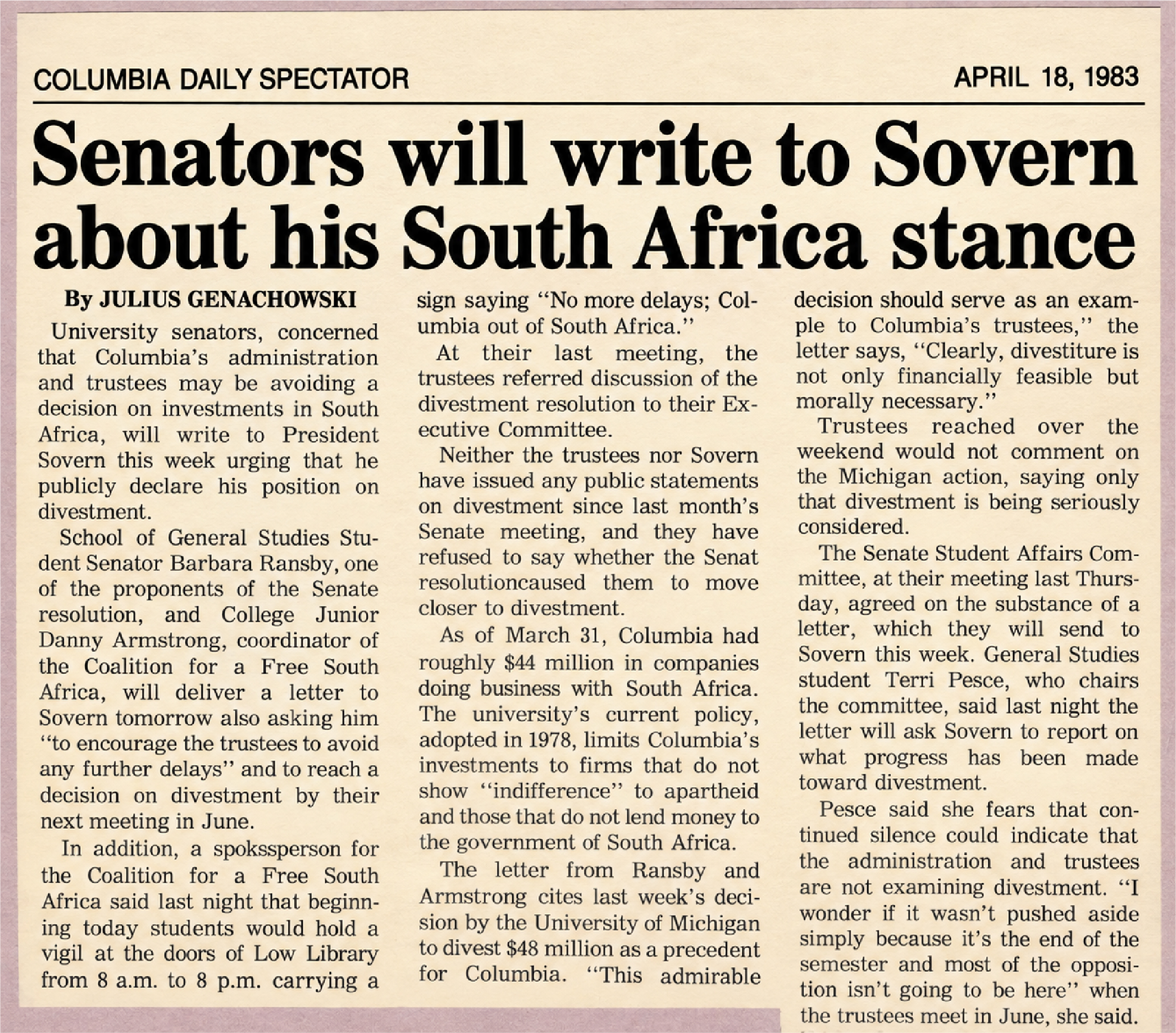
The Coalition responded by calling on President Sovern to take a public stand on the issue. On April 26 we rallied again. This time the focus was President Sovern. “Sovern take a stand!” we shouted. Barbara and I sent a letter to President Sovern asking him “to encourage the Trustees to avoid any further delays.”
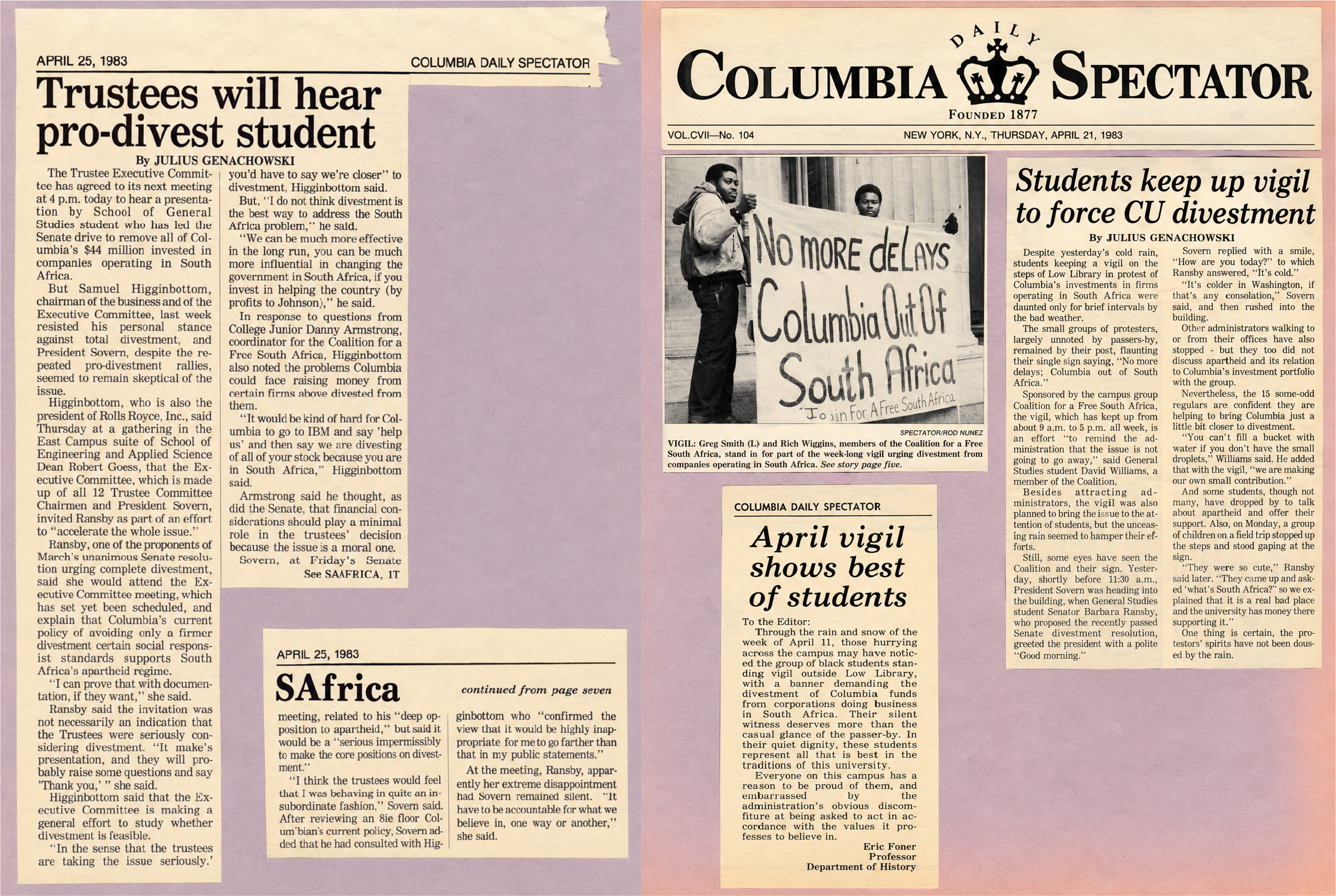
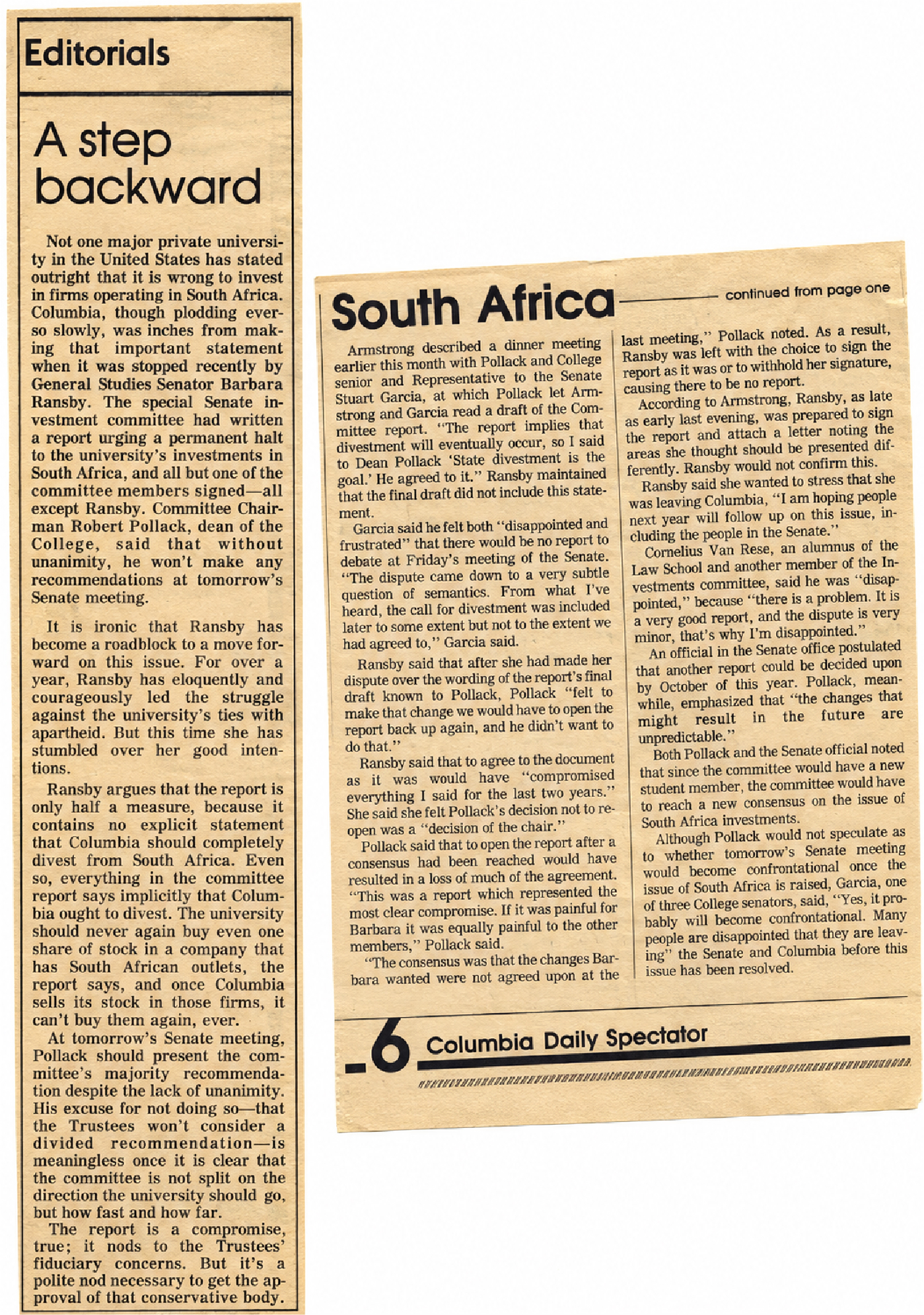
The Coalition organized a week-long vigil outside the doors of Low Library from 8:00 am to 8:00 pm with a banner made from a white bedsheet and red paint, which read: “No More Delays—Columbia out of South Africa.” It rained and was cold all week. This silent vigil sent a loud message: divestment was not going away.
History professor Eric Foner wrote the following letter to the editor of the Spectator (April 21, 1983):
To the Editor:
Through the rain and snow of the week of April 11, those hurrying across the campus may have noticed the group of black students standing vigil outside of Low Library, with a banner demanding the divestment of Columbia’s funds from corporations doing business in South Africa. Their silent witness deserves more than the casual glance of the passer-by. In their quiet dignity, these students represent all the best in the traditions of the university. Everyone on this campus has reason to be proud of them, and embarrassed by the administration’s obvious discomfiture at being asked to act in accordance with the values it professes to believe in.
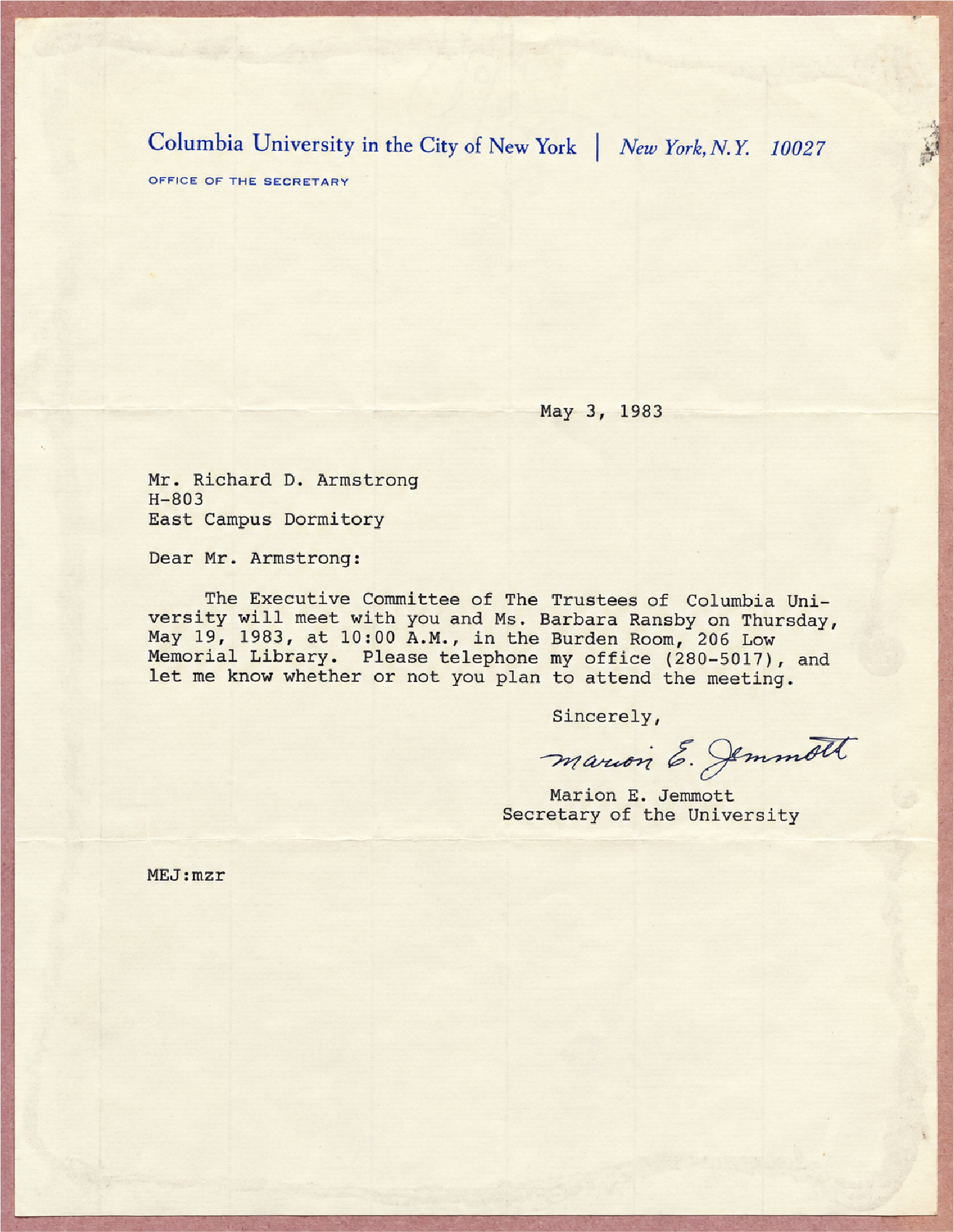
I attended a gathering of students with the Board of Trustees’ chairman, Samuel Higgenbottom, which was held in East Campus. I shared with him the students’ disappointment in the Trustees’ failure to commit to divestment. The University Trustees’ Executive Committee invited Barbara Ransby and me to make a presentation. They listened politely. We spoke politely and left.
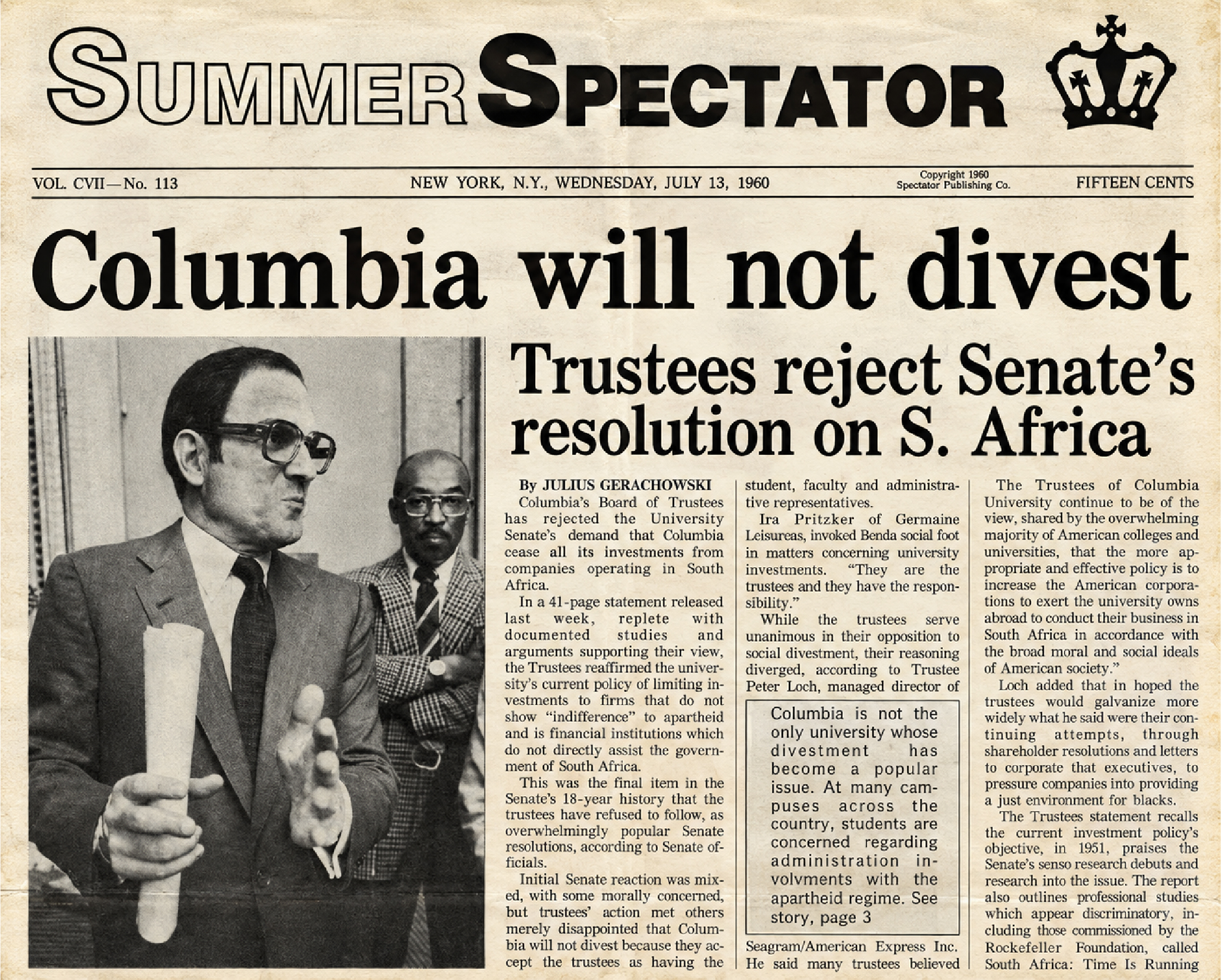
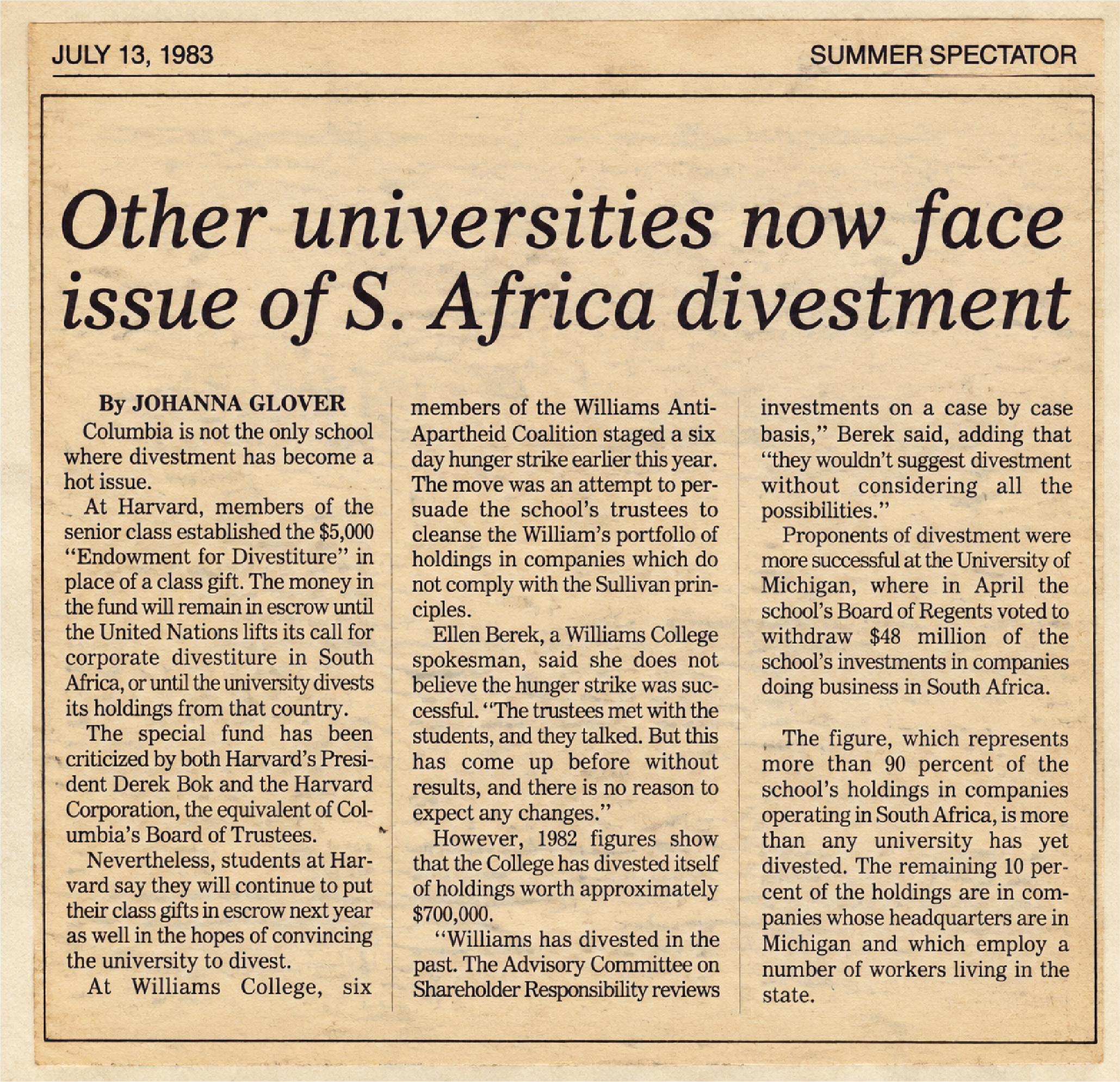
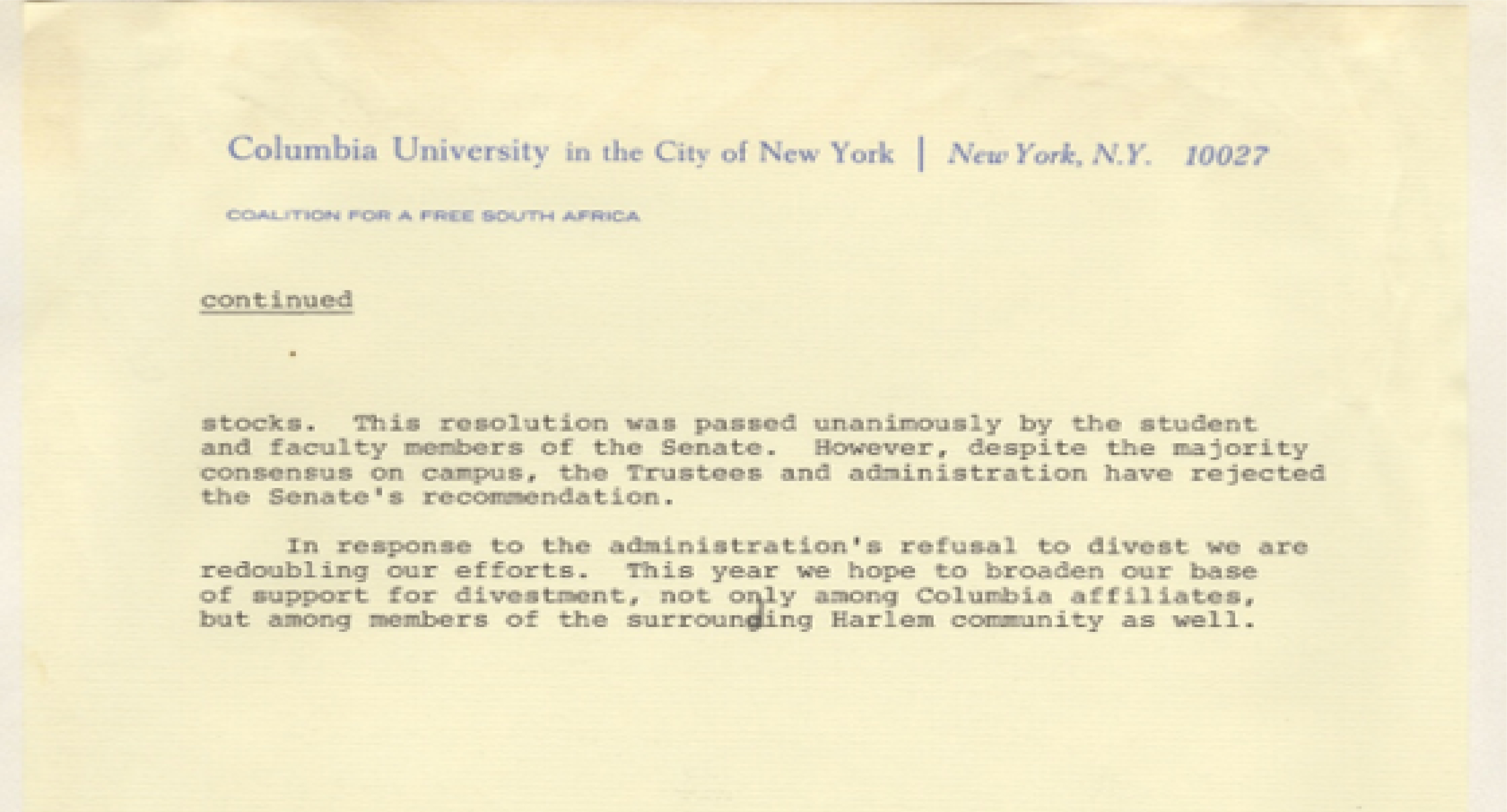
On July 13, 1983, the Spectator headline announced: “Columbia will not divest—Trustees reject Senate’s resolution on S. Africa.” The Trustees issued a 41-page statement defending their position. Ransby was quoted in the Spectator article as saying, “By refusing to follow the Senate’s directive, the Trustees ‘insulted’ the assembly, which counts among its members student, faculty and administration representatives.
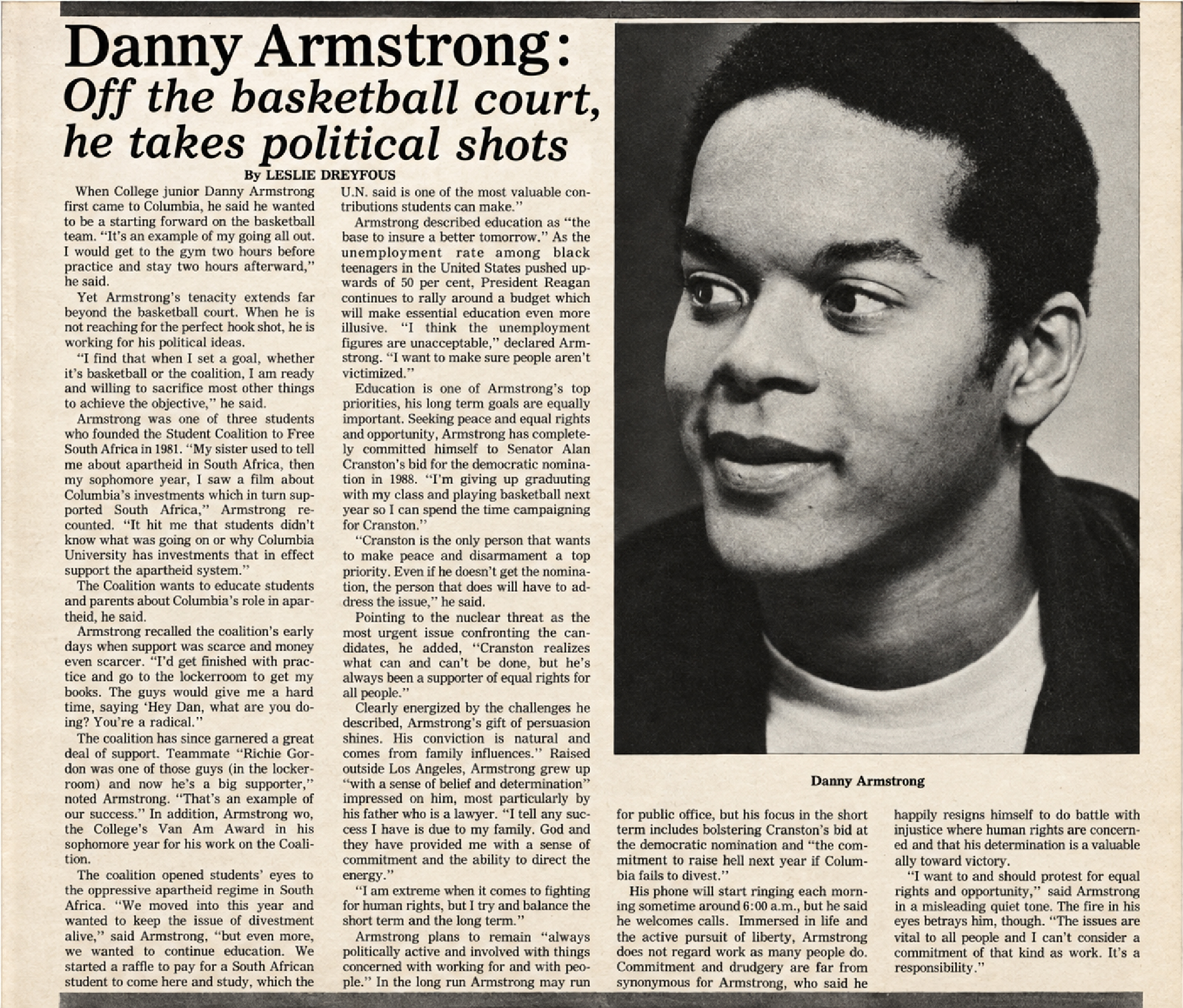
Columbia Daily Spectator – May 17, 1983
Ransby concluded by saying, “The Trustees have not heard the last of the divestment issue…supporters of divestment would make it an issue again in the fall by publicizing and popularizing the issue on campus.” The Spectator editorial: “The university’s Trustees made the wrong decision on divestment, and the Columbia community must not quietly accept this outrage.”
Fall of 1983
I had decided to leave school for my senior year to work on U.S. Senator Alan Cranston’s presidential campaign. After working for his campaign during the summer in Washington, D.C., I decided days before the start of the school year to return to school. Basketball was no longer a priority in my life. I decided not to play my senior year and focus on my academics, the Cranston campaign on campus, and divestment.
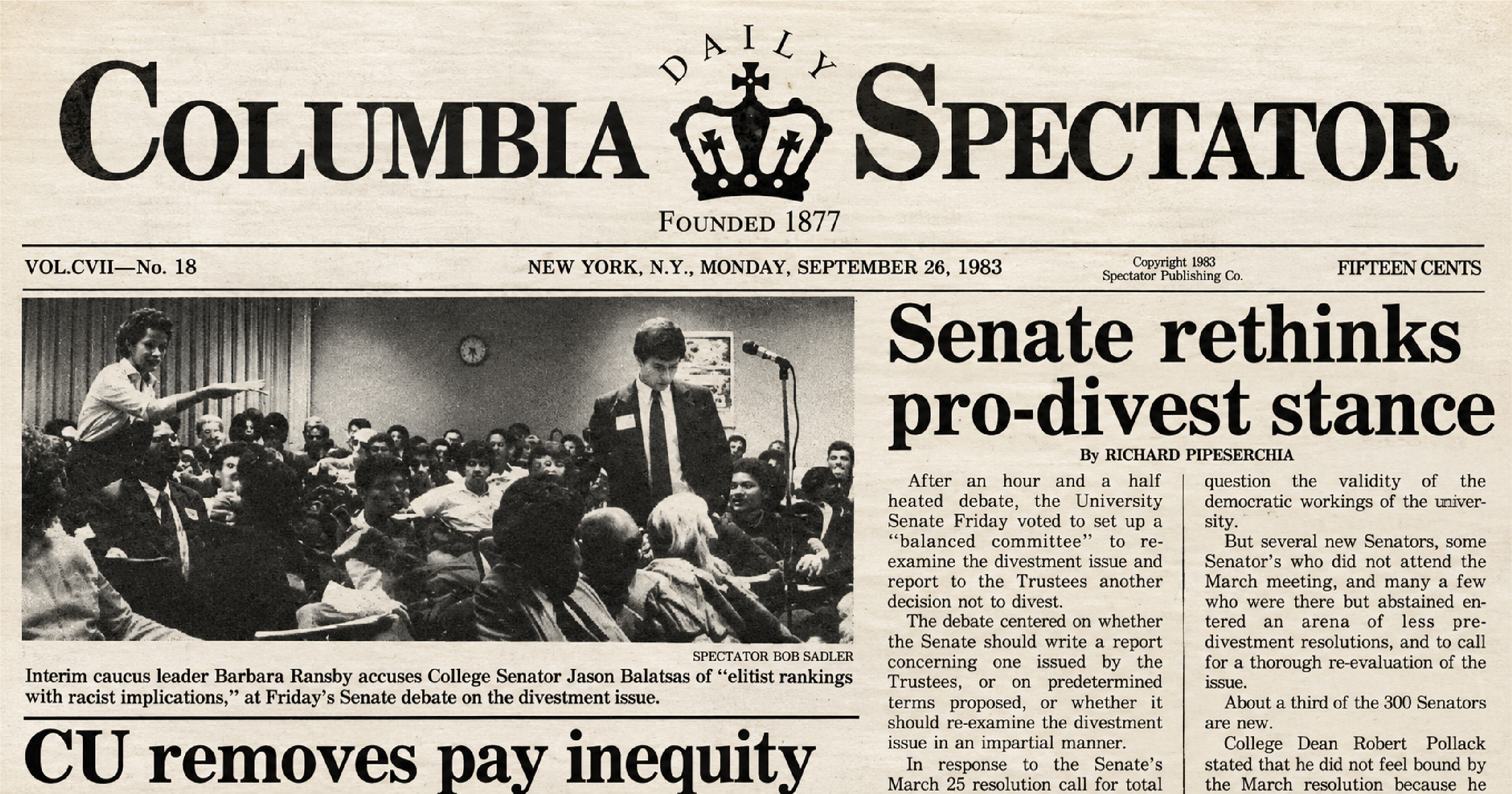
The University Senate resolution had been rejected, and senators argued over the appropriate response. On September 26, 1983, the Spectator reported that the “Senate rethinks pro-divest stance.” The article stated: “After an hour and a half [of] heated debate, the University Senate Friday voted to set up a ‘balanced committee’ to reexamine the divestment issue and reply to the trustees’ summer decision not to divest.” The article’s photo caption read, “Student caucus leader Barbara Ransby accuses College Senator James Weinstein of ‘childish ramblings with racist implications’ in Friday’s Senate debate on the divesture issue.” The viability of the Senate was in question as well. The Spectator article quoted professor Sherman Beychock of biological sciences as saying, “An appearance of impotence has been cast over the Senate. The Senate must take a firm stand.”
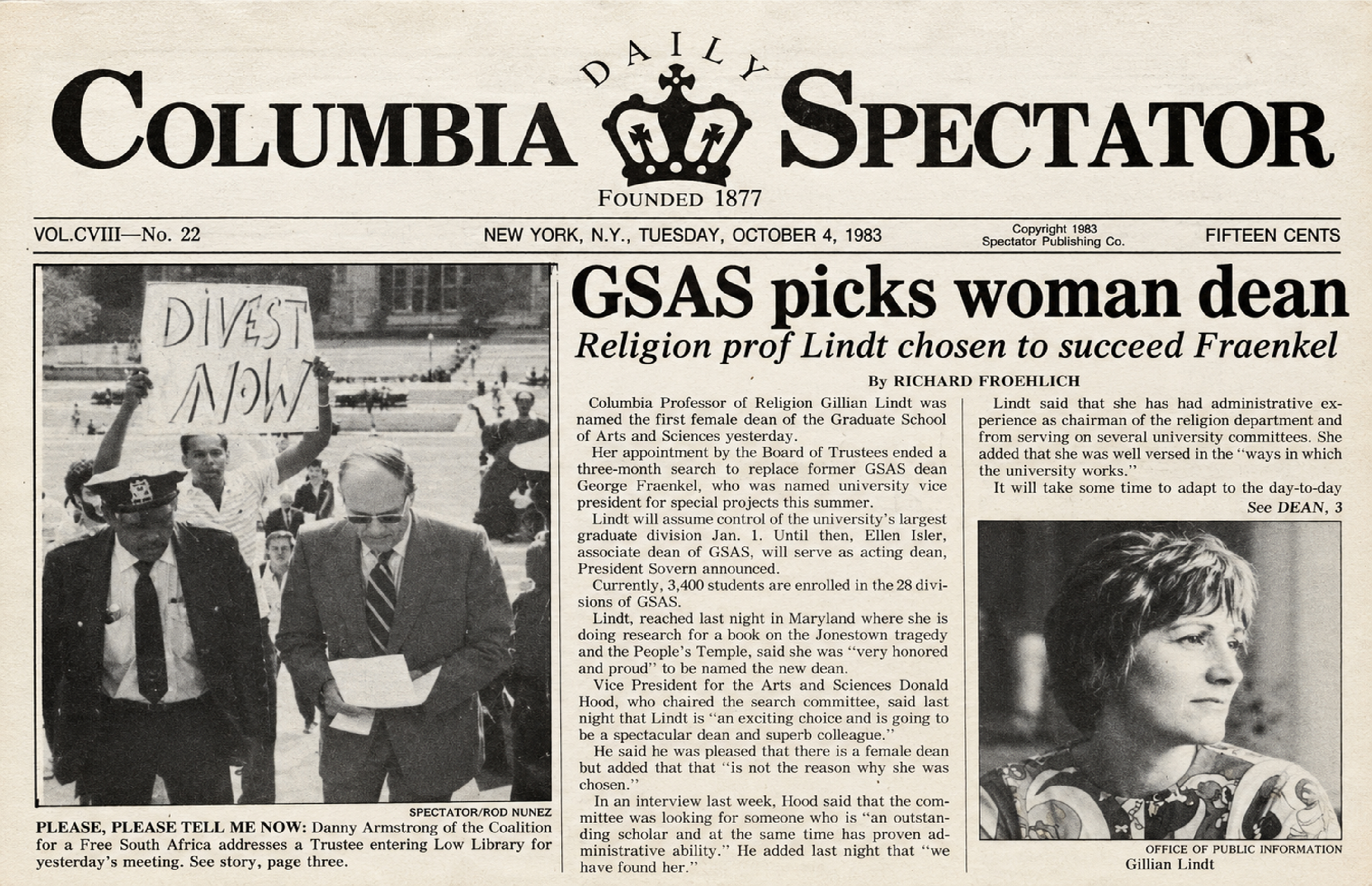
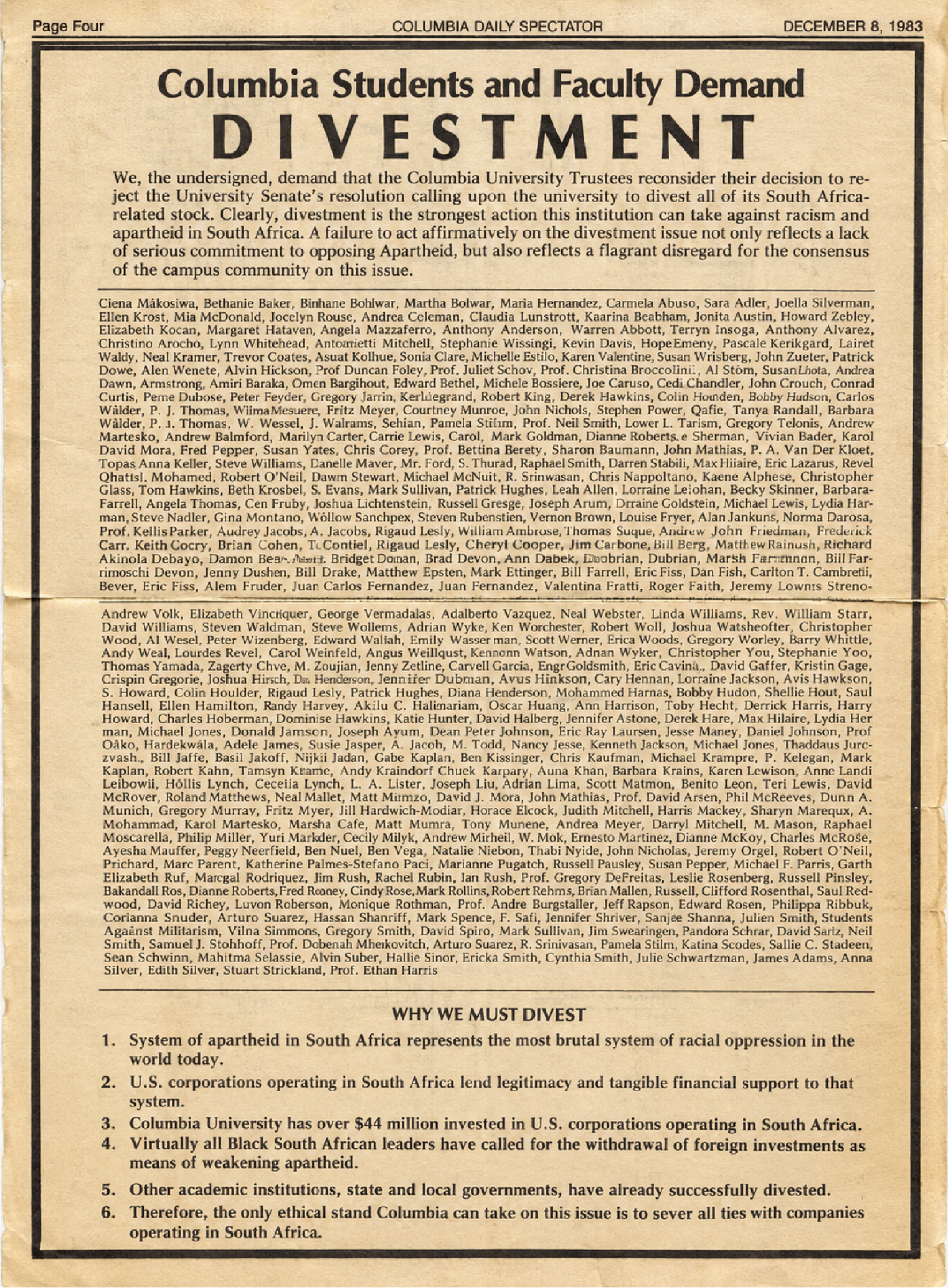
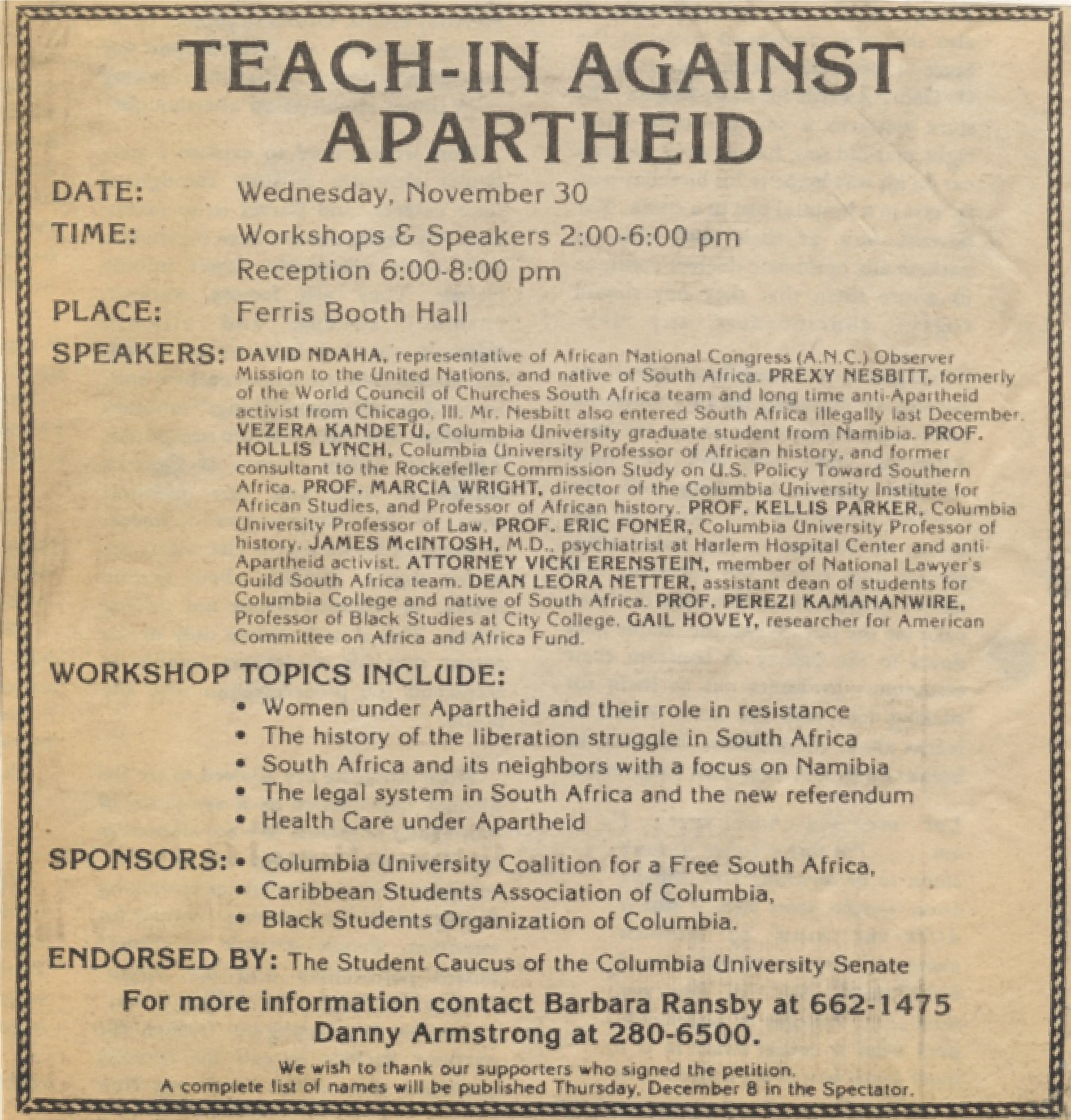
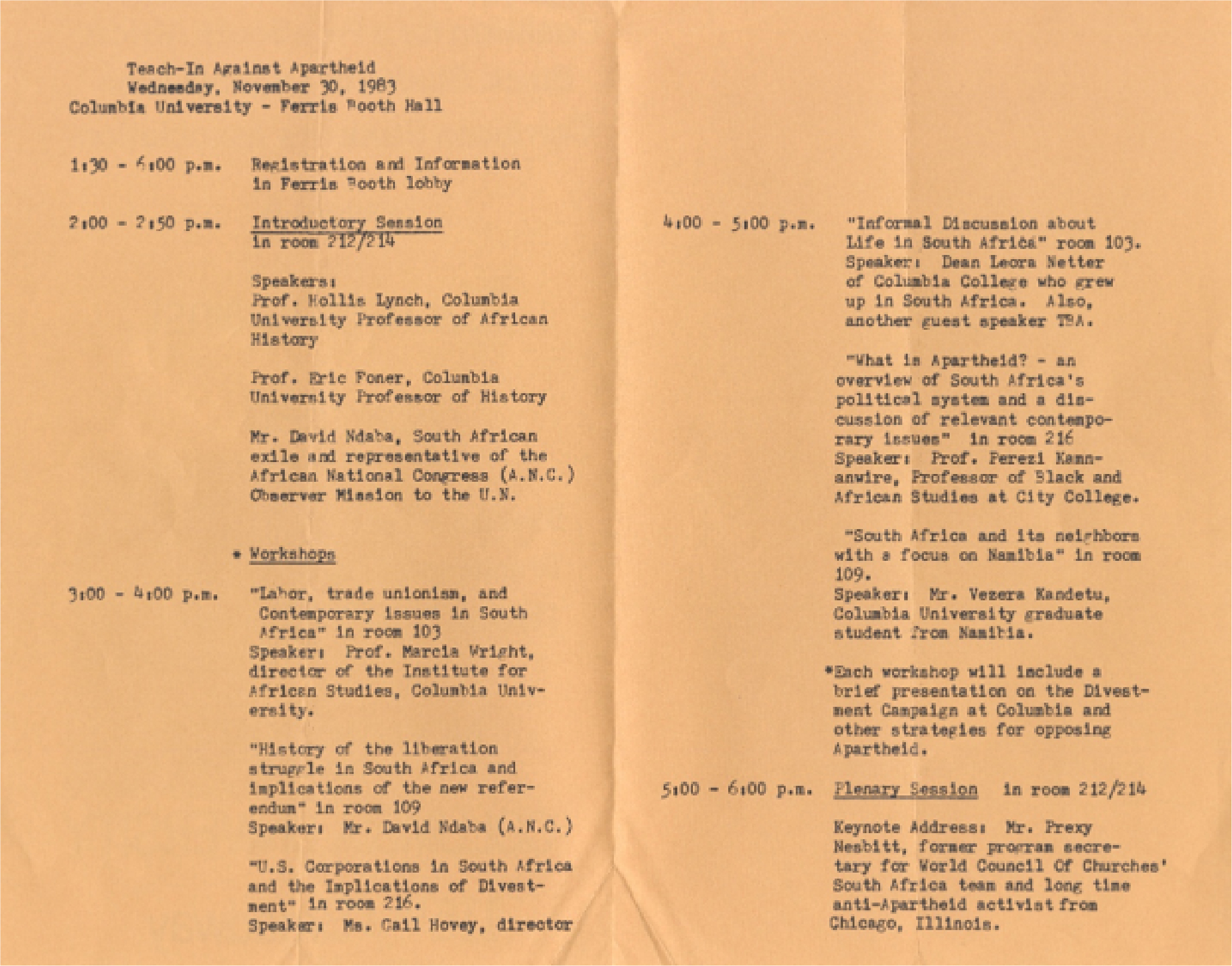
The mood was shifting on campus. The pressure had to be raised in order to move divestment forward. On October 3, 1983, the Trustees met. I was on the front page of the Spectator shouting at a trustee as he entered Low Library. We were no longer talking politely, and we were not leaving. We redoubled our efforts to mobilize and inform the campus with a teach-in on November 30, and on December 8 the Coalition sponsored a full-page ad in the Spectator, which listed the names of members of the Columbia community who supported divestment.
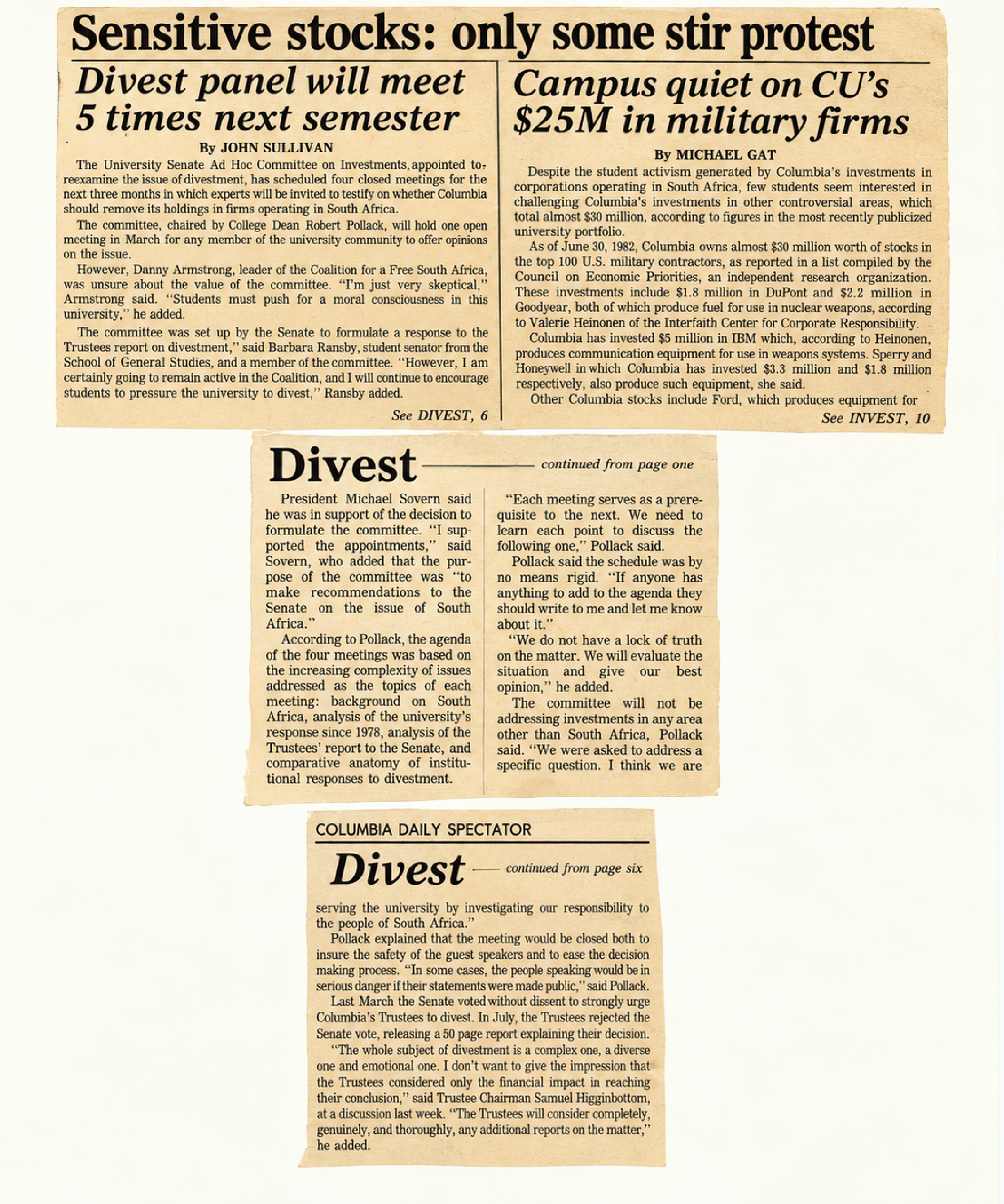
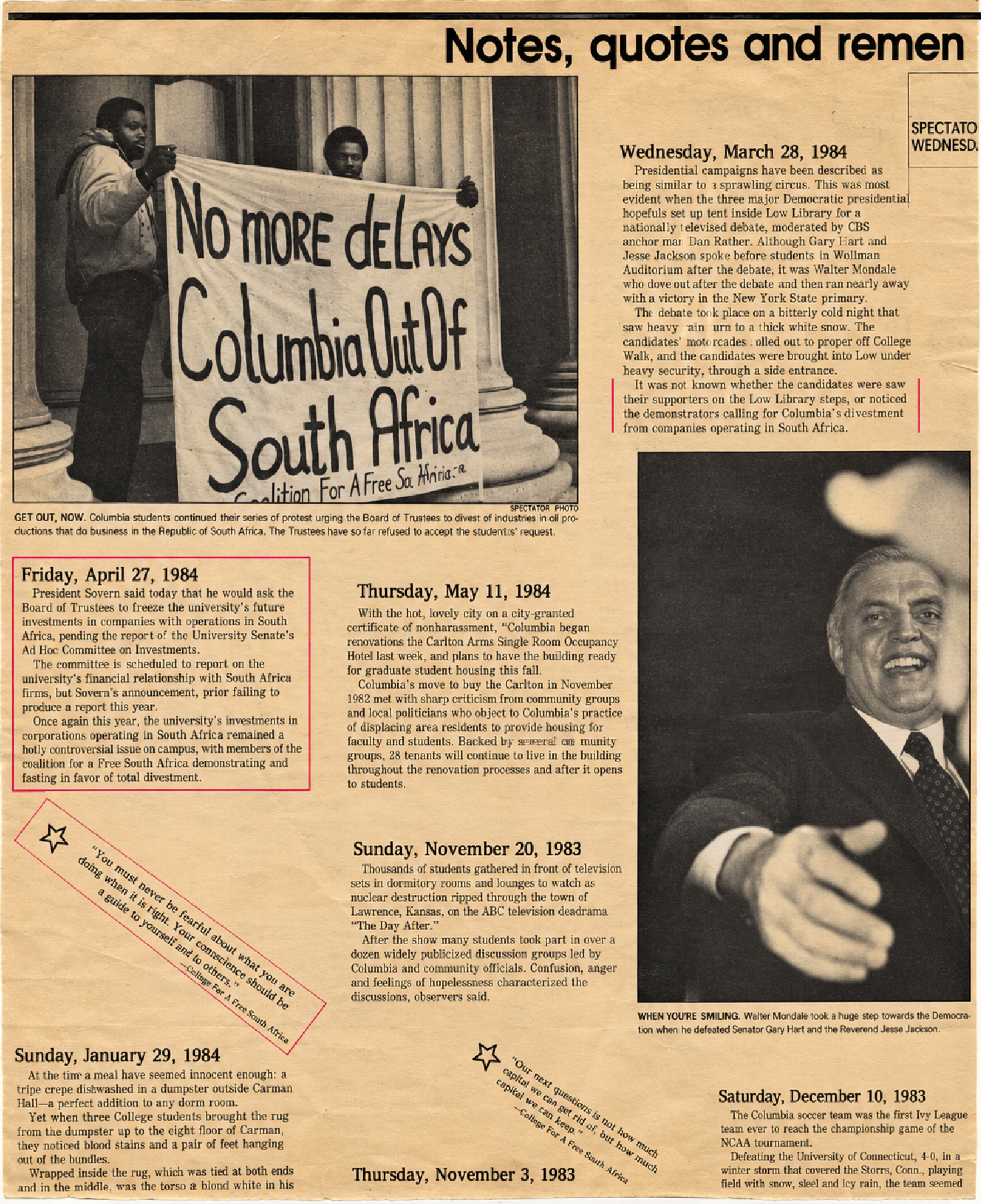
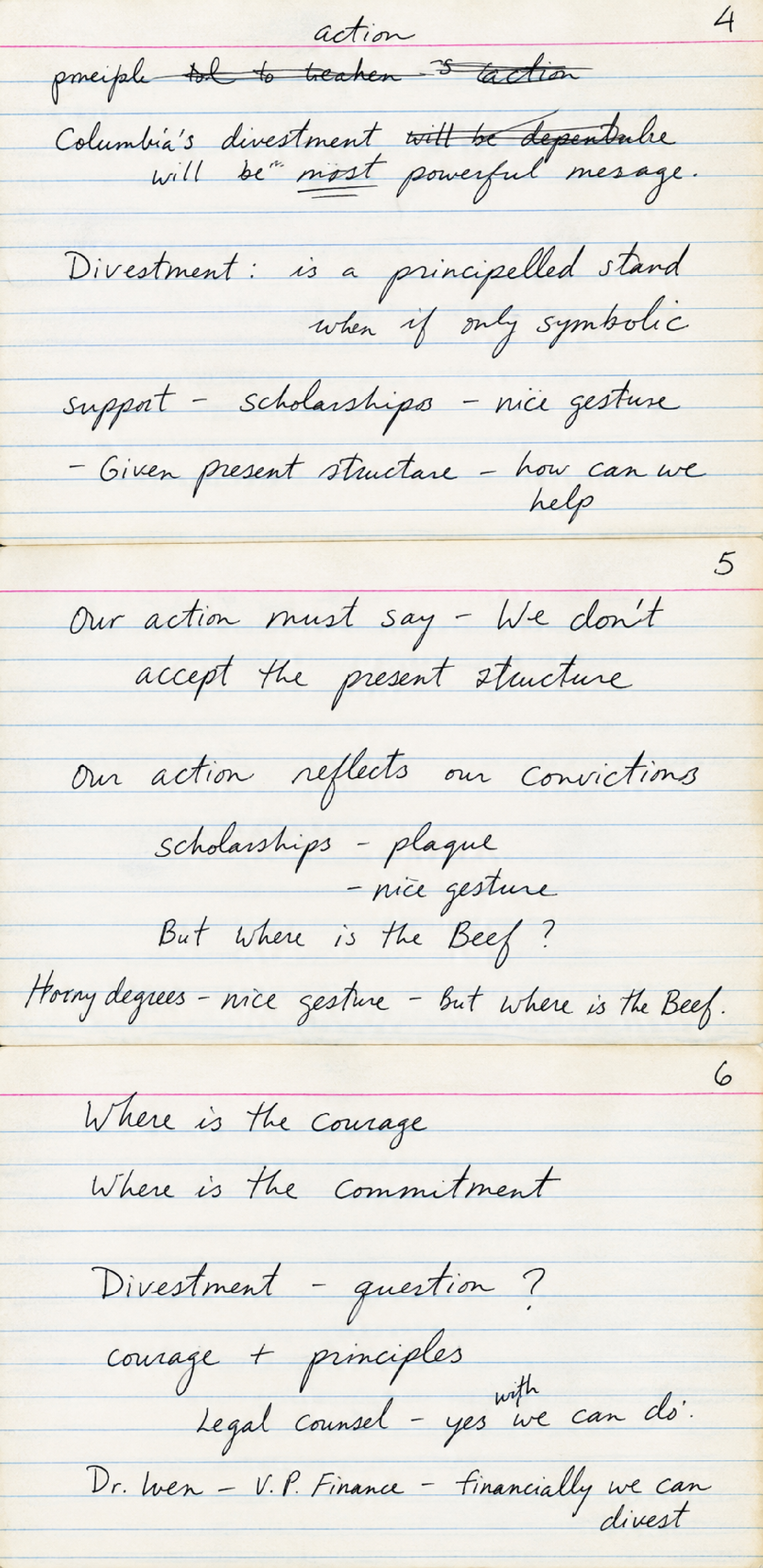
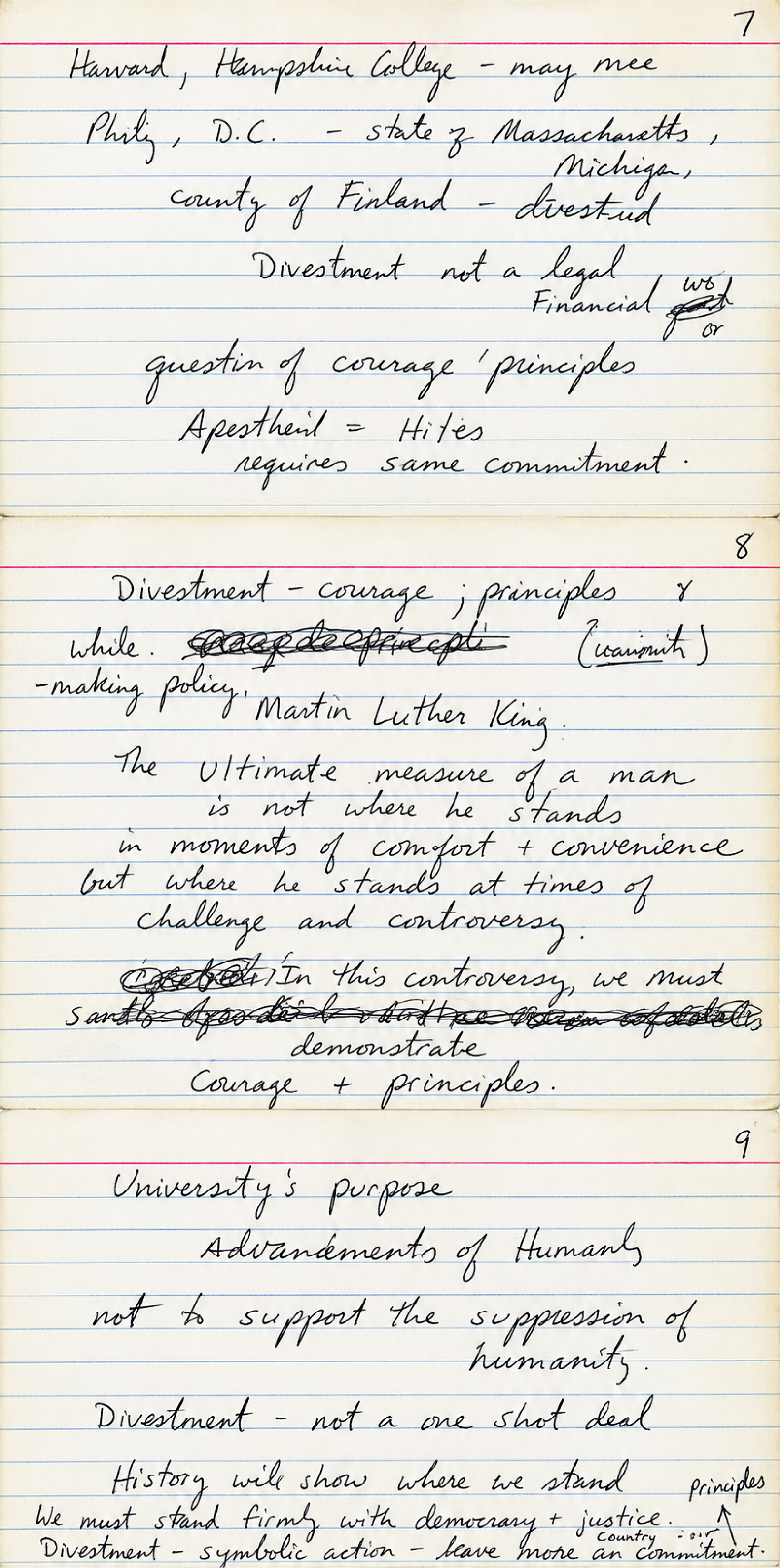
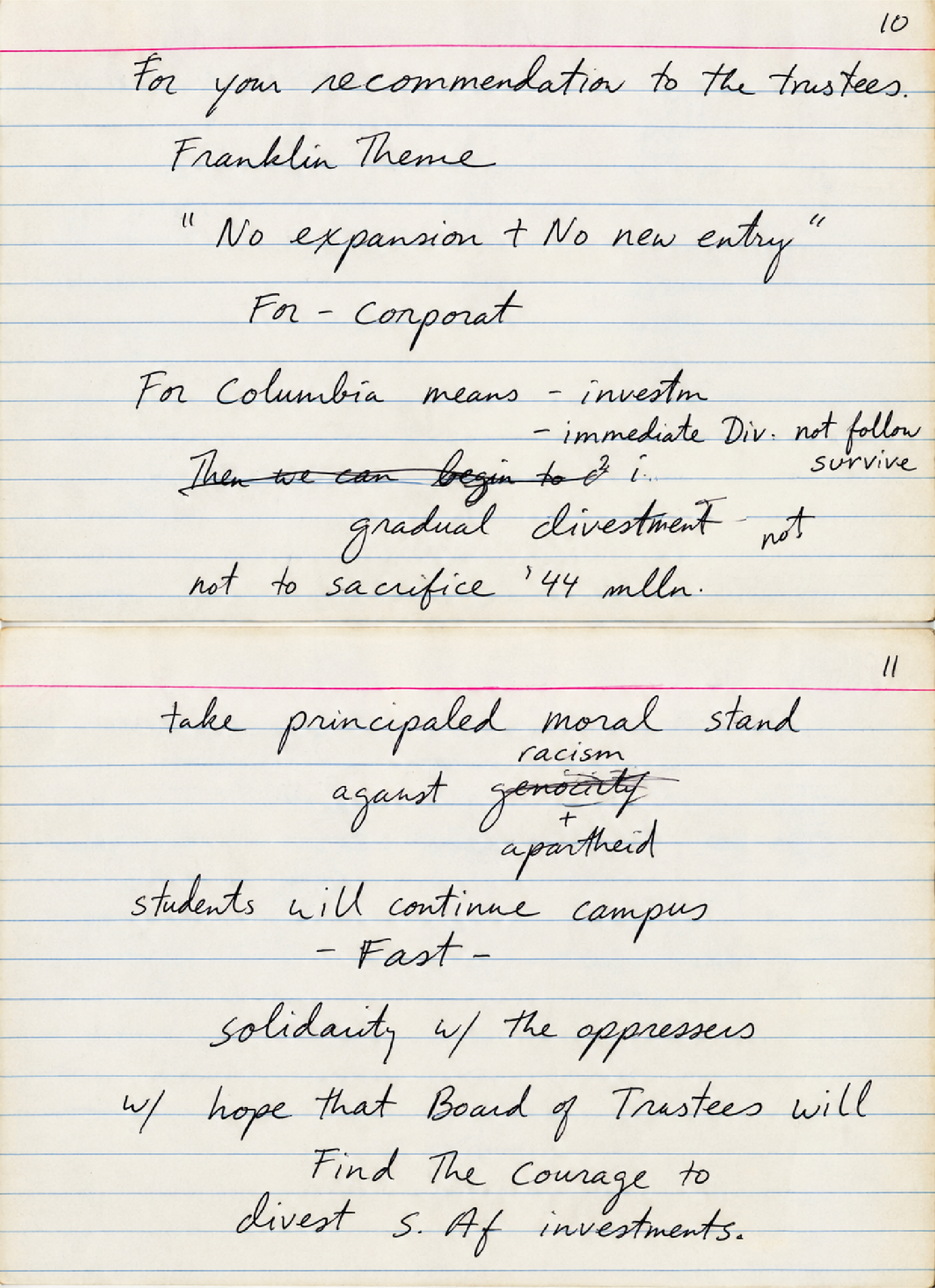
On March 23, 1984, the Senate’s Ad Hoc Committee on Investments met. Speakers advocated for divestment. I spoke and asked, “Where is the commitment? Where is the courage?” I concluded my remarks by announcing that I and others would fast for a week “to dramatize our solidarity with the oppressed of South Africa.” The Spectator (March 26, 1983) quoted Dean Robert Pollack as he speculated that the fast would be “a successful attempt to make people uncomfortable with their conscience.”
I had never fasted before. I had my last meal on Sunday, March 25. I had miso broth on Monday and only water after that. I recall getting very tired and having to rest during the day, as I tried to keep up my normal schedule of attending classes, organizing, and studying. In addition to the fast, students held a vigil on the steps of Low Library with a banner demanding Columbiaout of South Africa. On Tuesday March 25, 1984, campus Catholic chaplain Father Paul Dinter met with members of the Coalition.
1984
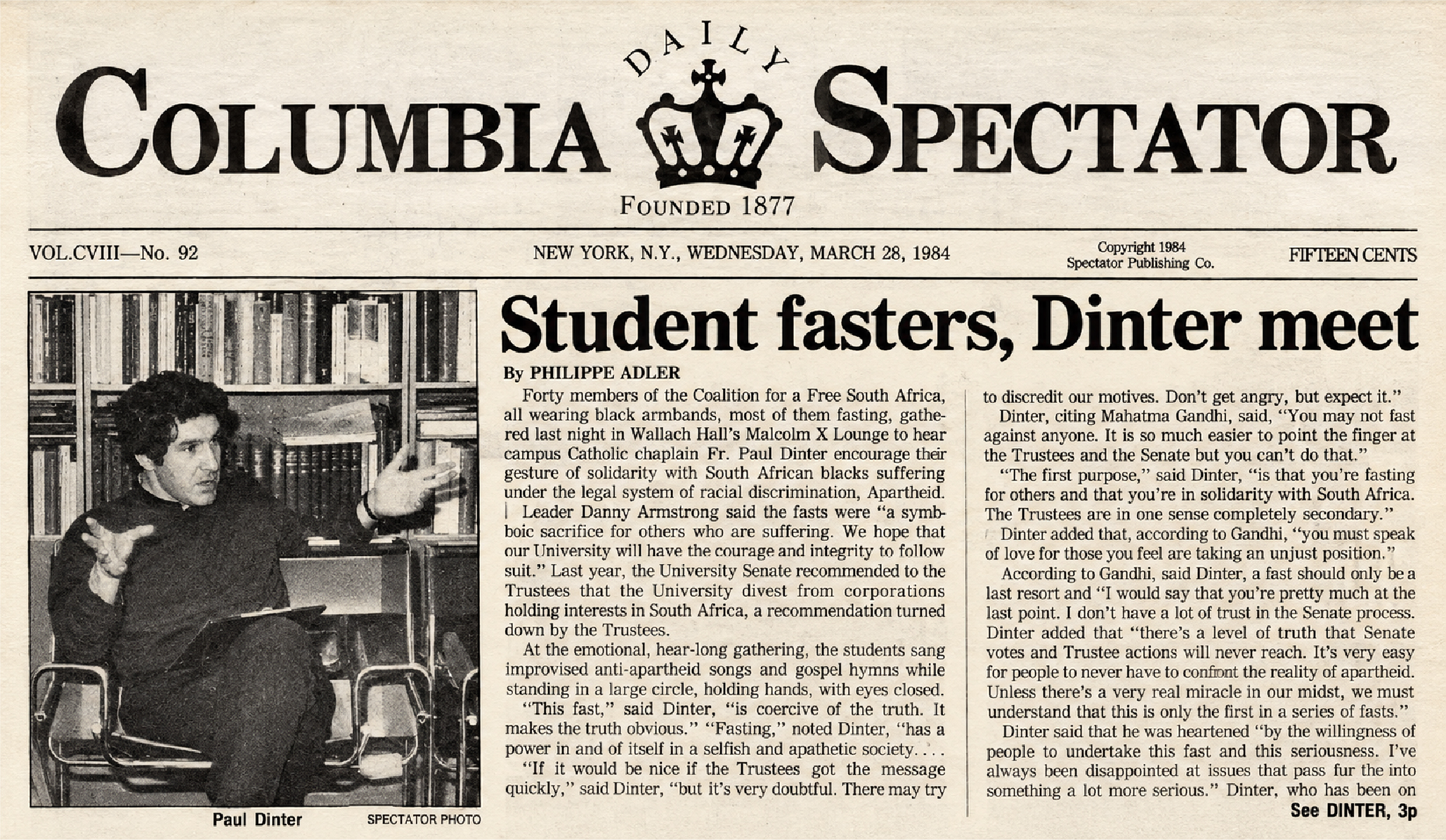
STUDENT FASTERS, DINTER MEET
Forty members of the Coalition for a Free South Africa, all wearing black armbands, most of them fasting, gathered last night in Wallach Hall’s Malcolm X Lounge to hear campus Catholic Chaplain Fr. Paul Dinter encourage their gesture of solidarity with South Africa blacks suffering under the legal system of racial discrimination, apartheid. Leader Danny Armstrong said the fasts were “A symbolic sacrifice for others who are suffering. We hope that our University will have the courage and integrity to follow suit.’” “Fasting,” noted Dinter, “has a power in and of itself in a selfish and apathetic society.”
—Columbia Daily Spectator
March 28, 1984
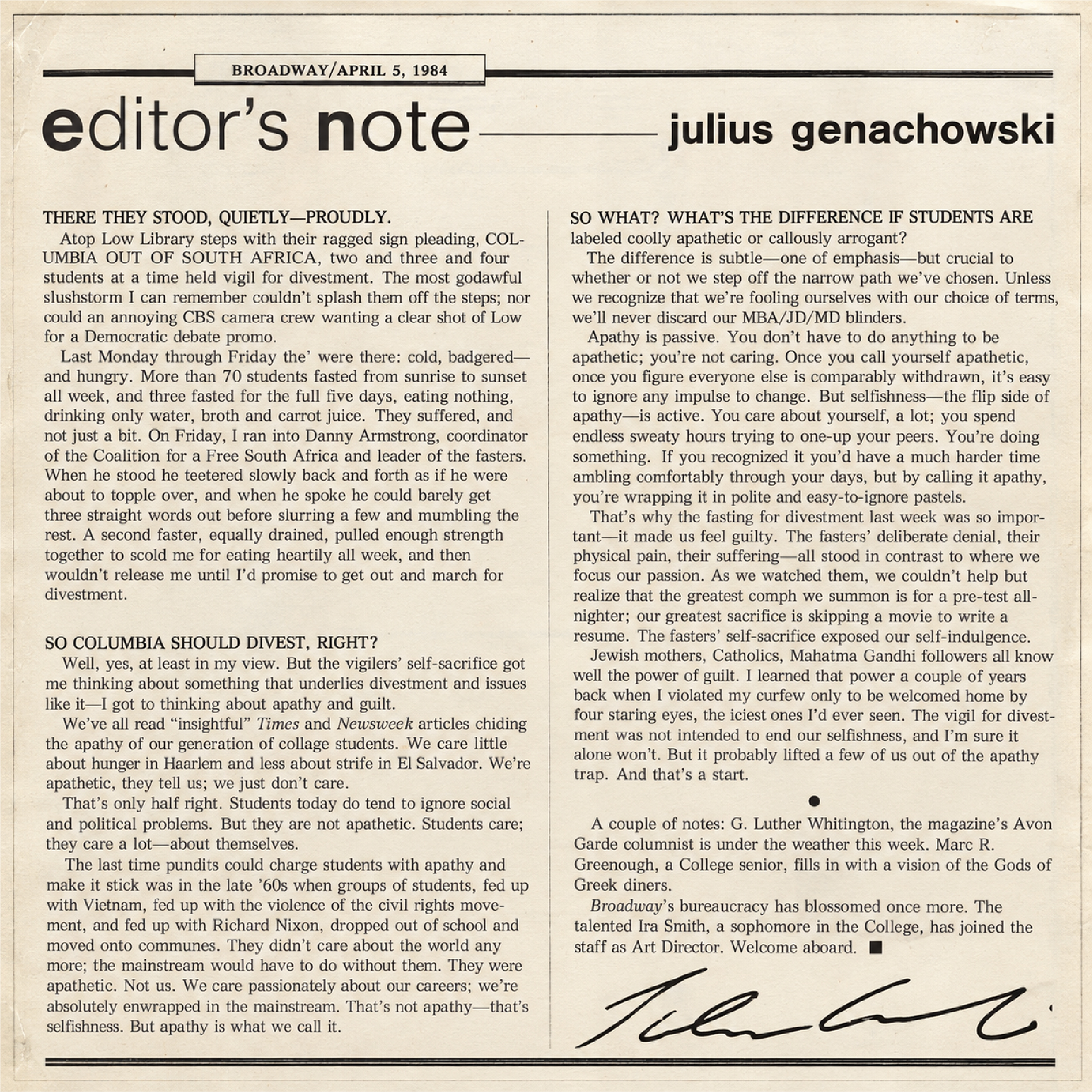
The fast attracted the quiet support of students who were apathetic toward the issue of divestment. In Broadway magazine, student Julius Genachowski wrote, “The fasting for divestment last week was so important—it made us feel guilty….The vigil for divestment was not intended to end our selfishness, and I’m sure it alone won’t. But it probably lifted a few of us out of the apathy trap. And that’s a start.”
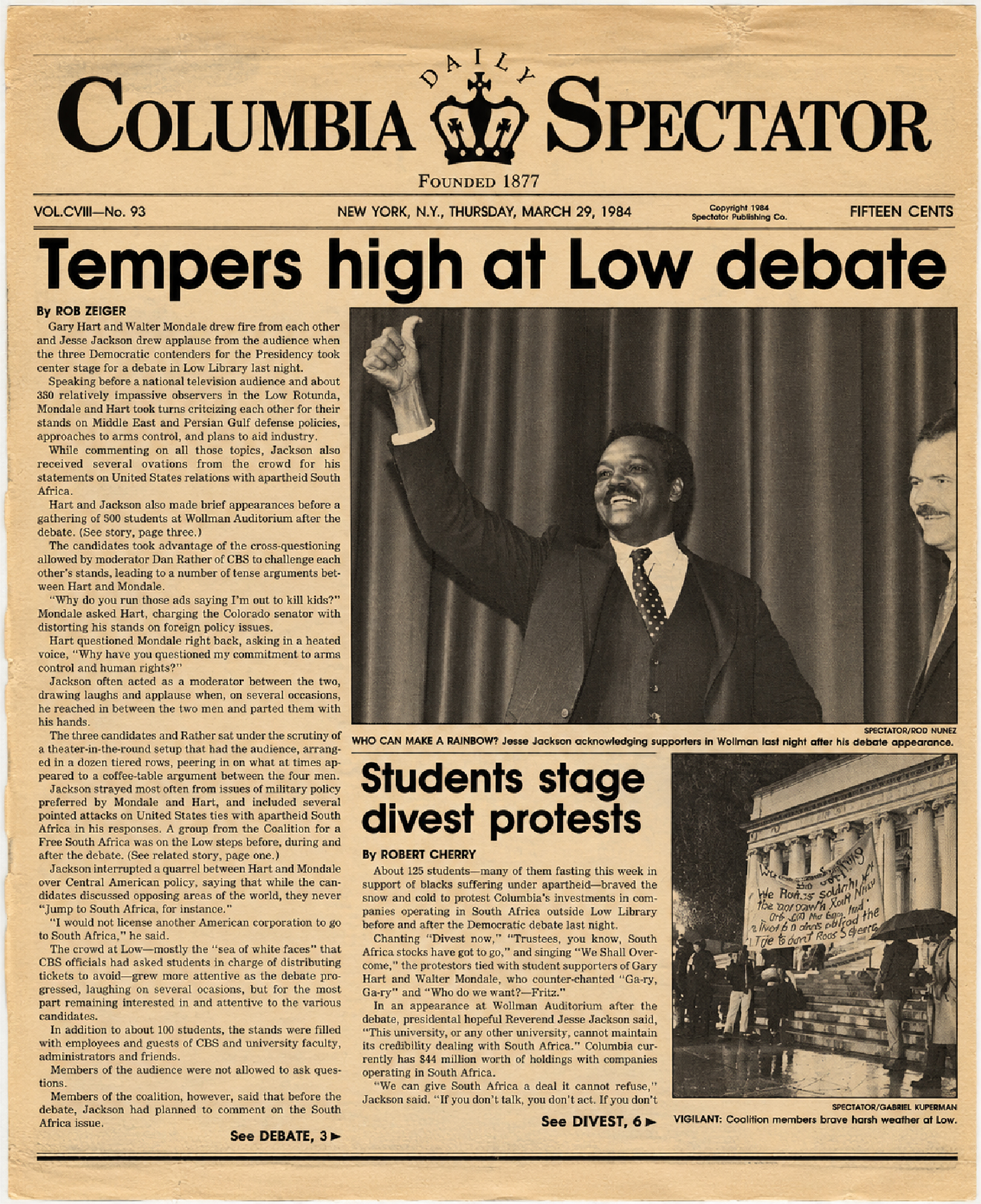
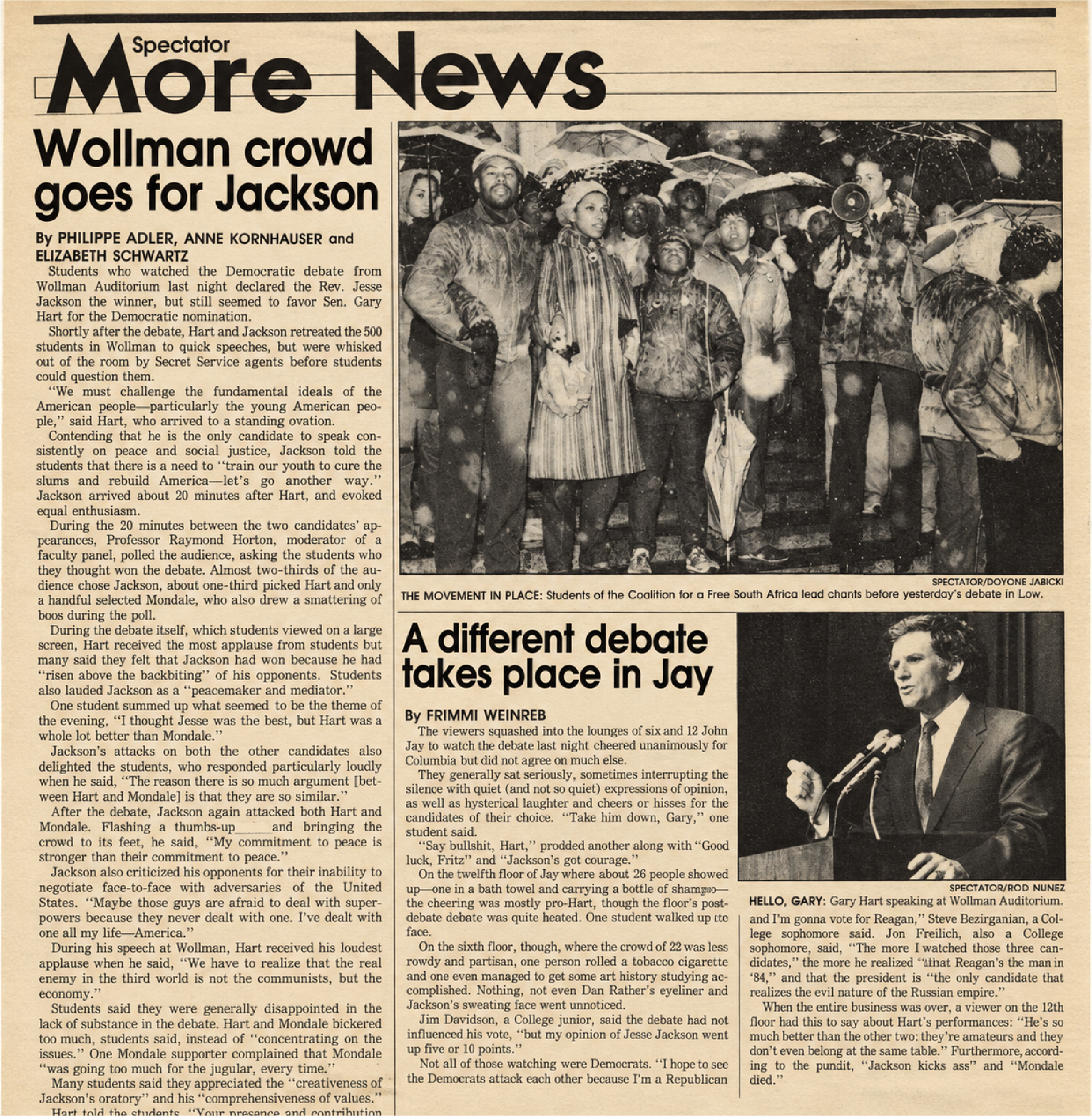
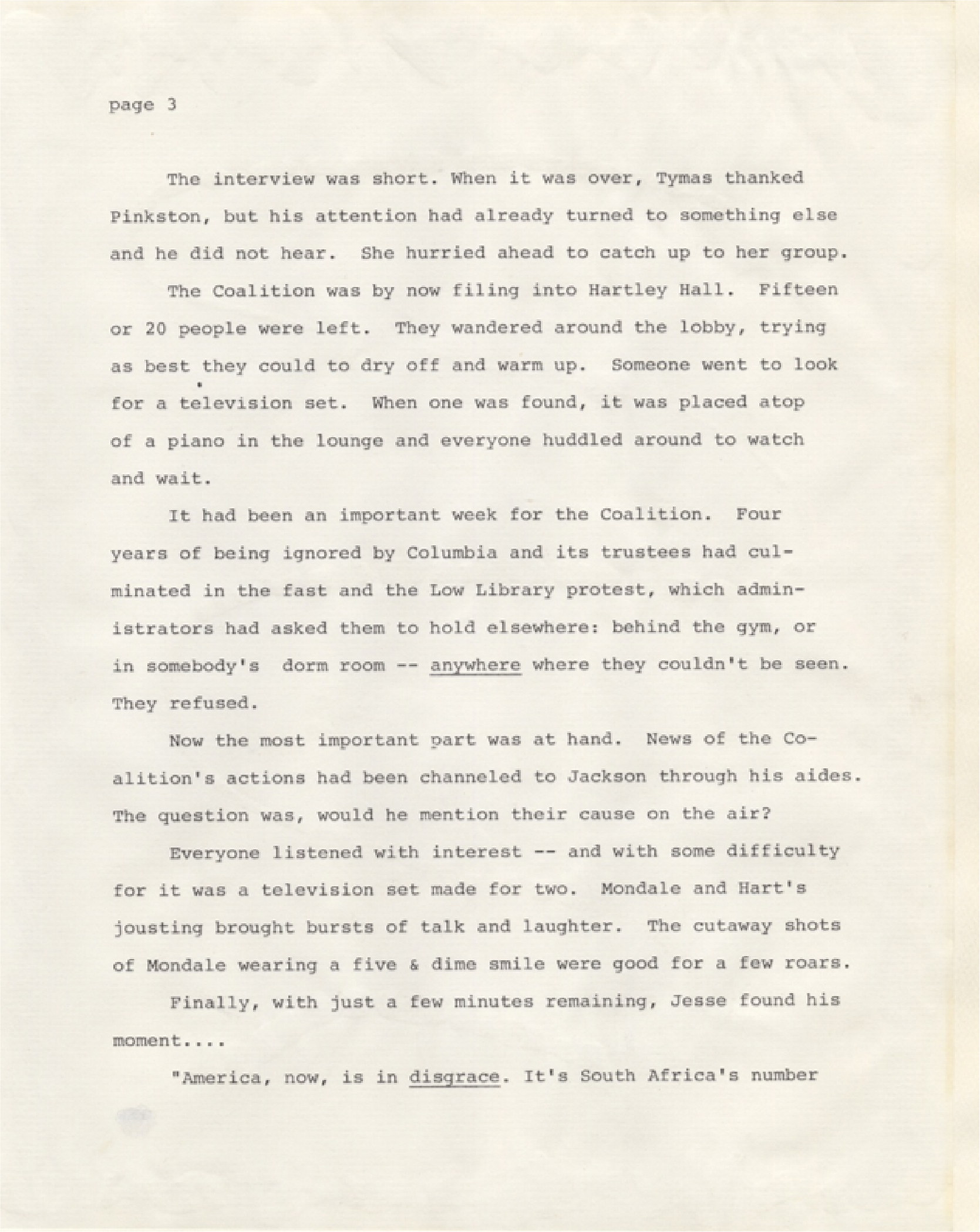
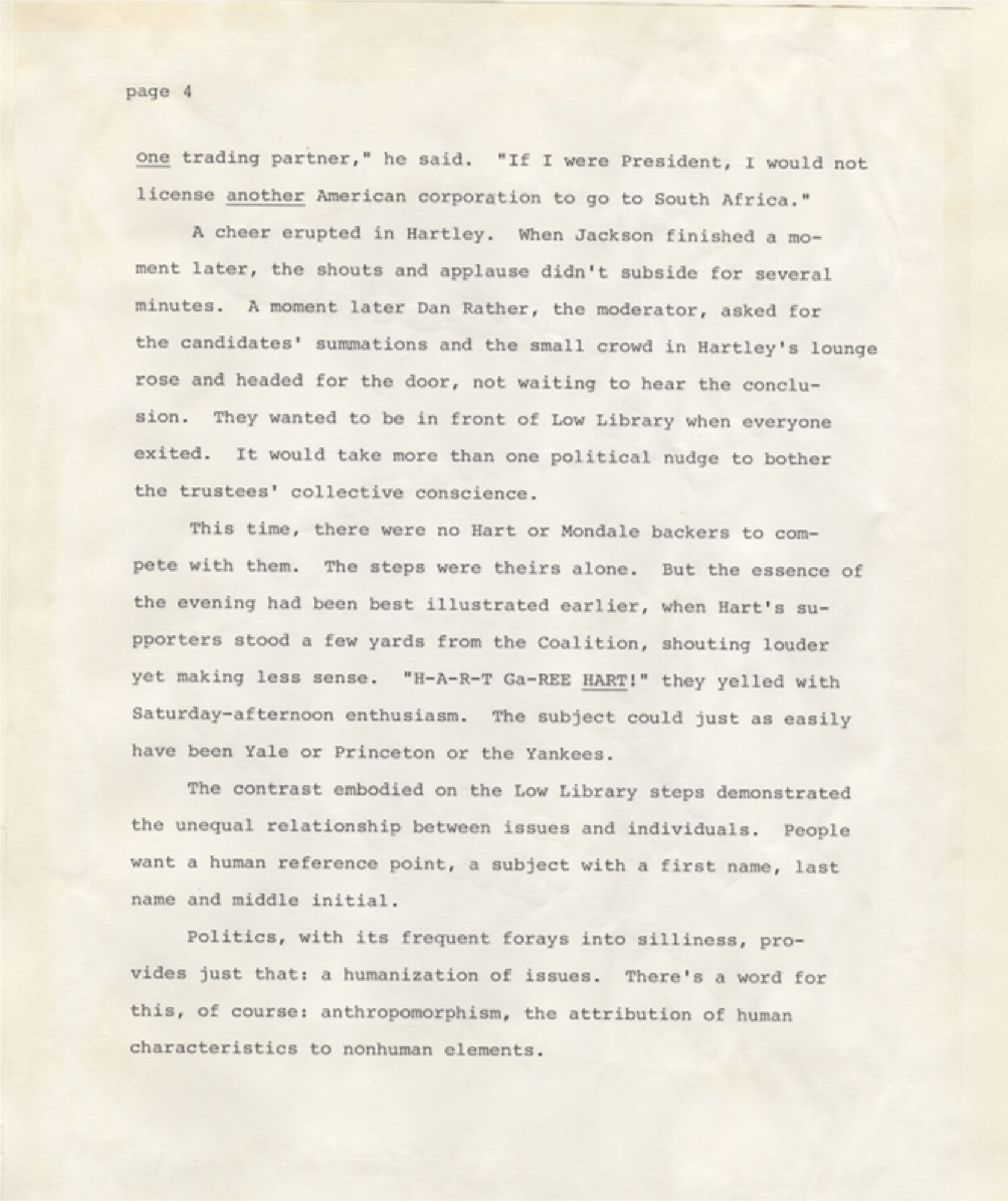
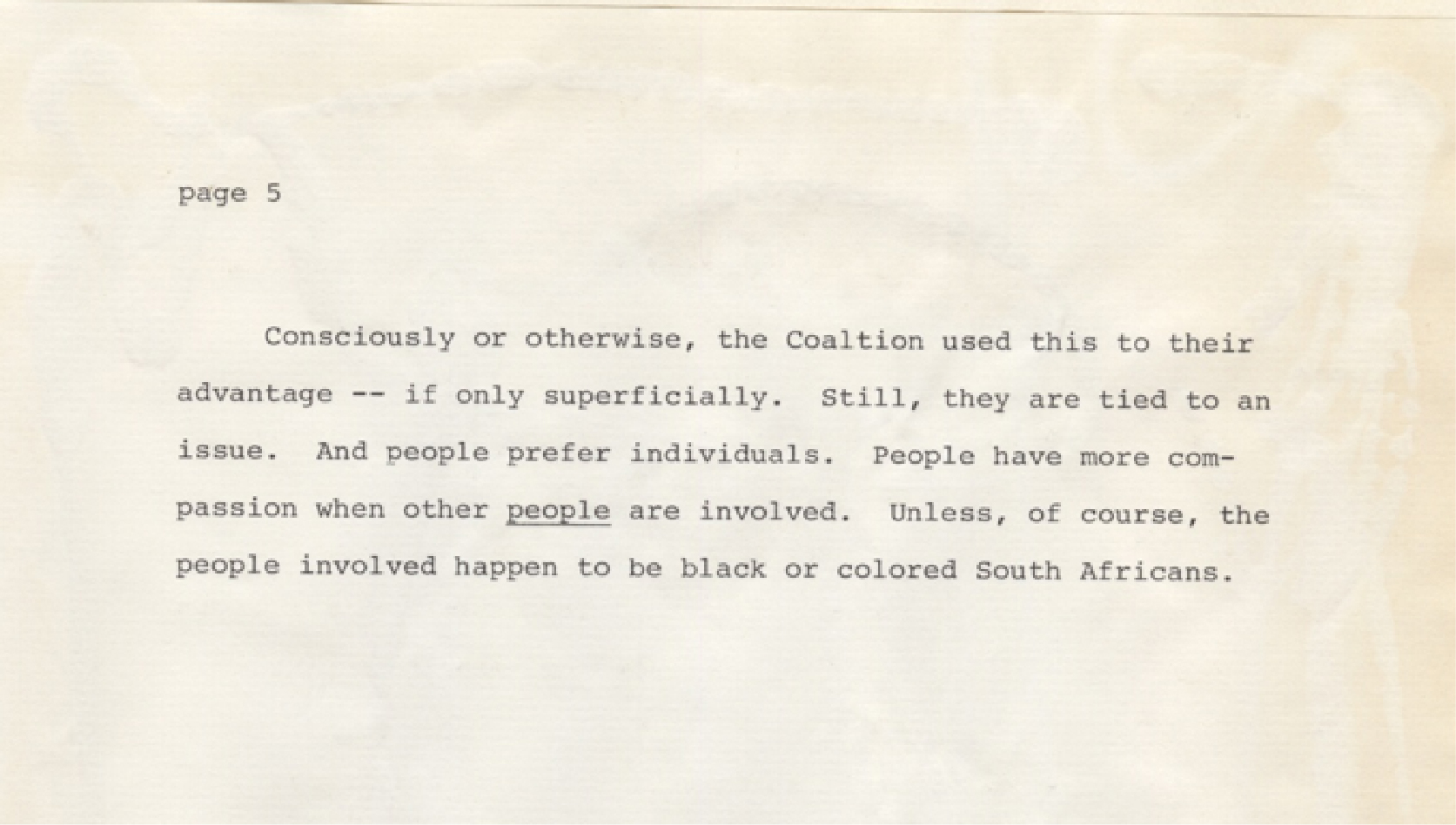
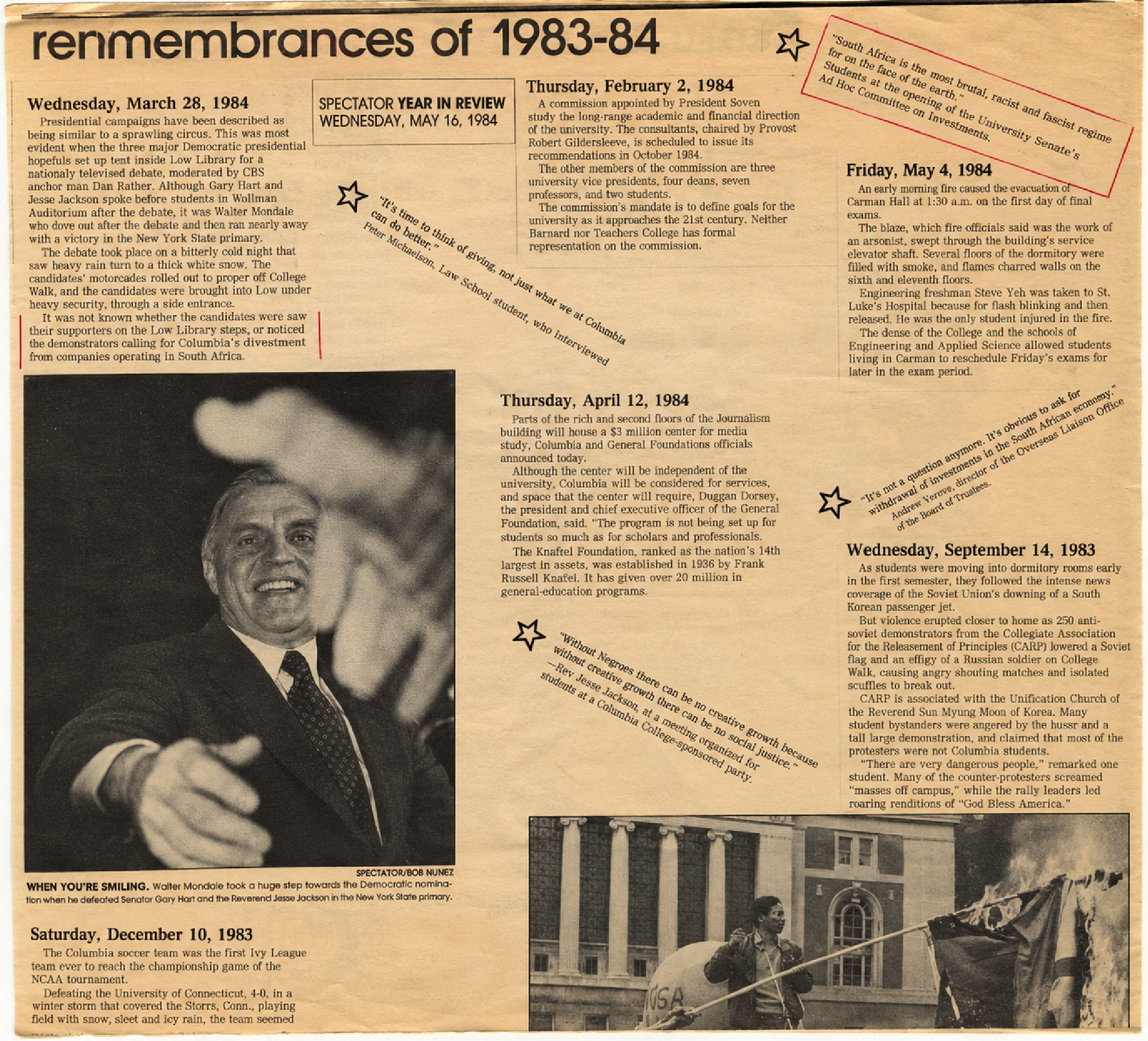
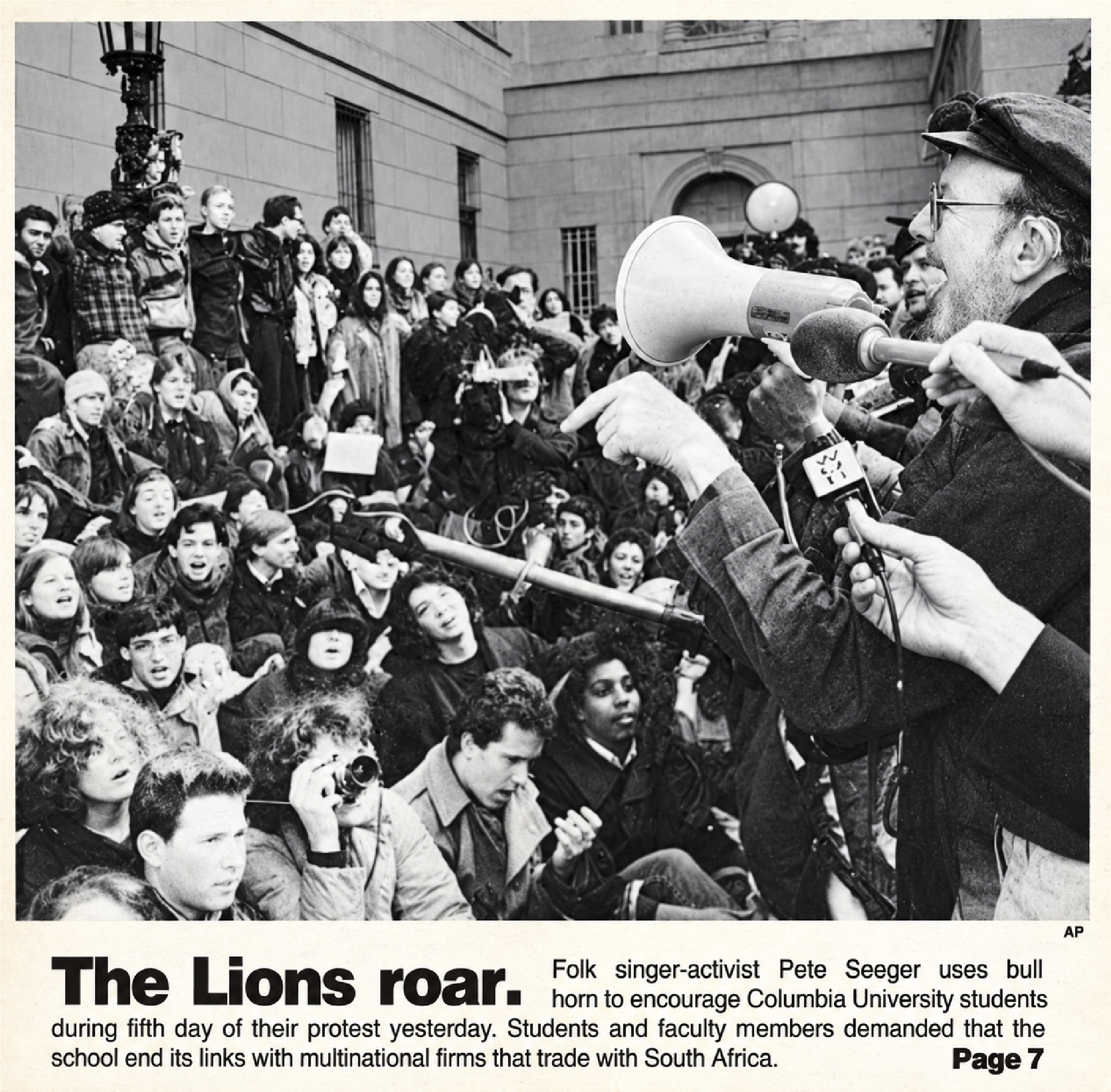
During the week of the fast on March 28, there was a U.S. presidential debate between candidates for the Democratic nomination. Walter Mondale, the former vice president to Jimmy Carter, was the frontrunner and eventual nominee, but civil rights leader Reverend Jesse Jackson captivated Democrats and black Americans with his trailblazing run at the nomination. Former U.S. Senator f rom Colorado Gary Hart was the third debate participant. The candidates and the media converged on Low Library for the debate. Coalition members stood on the steps of Low singing anti-apartheid songs and chanting divestment slogans. Reverend Jackson called on American companies to leave South Africa during the televised debate. Coalition members, watching on television, cheered.
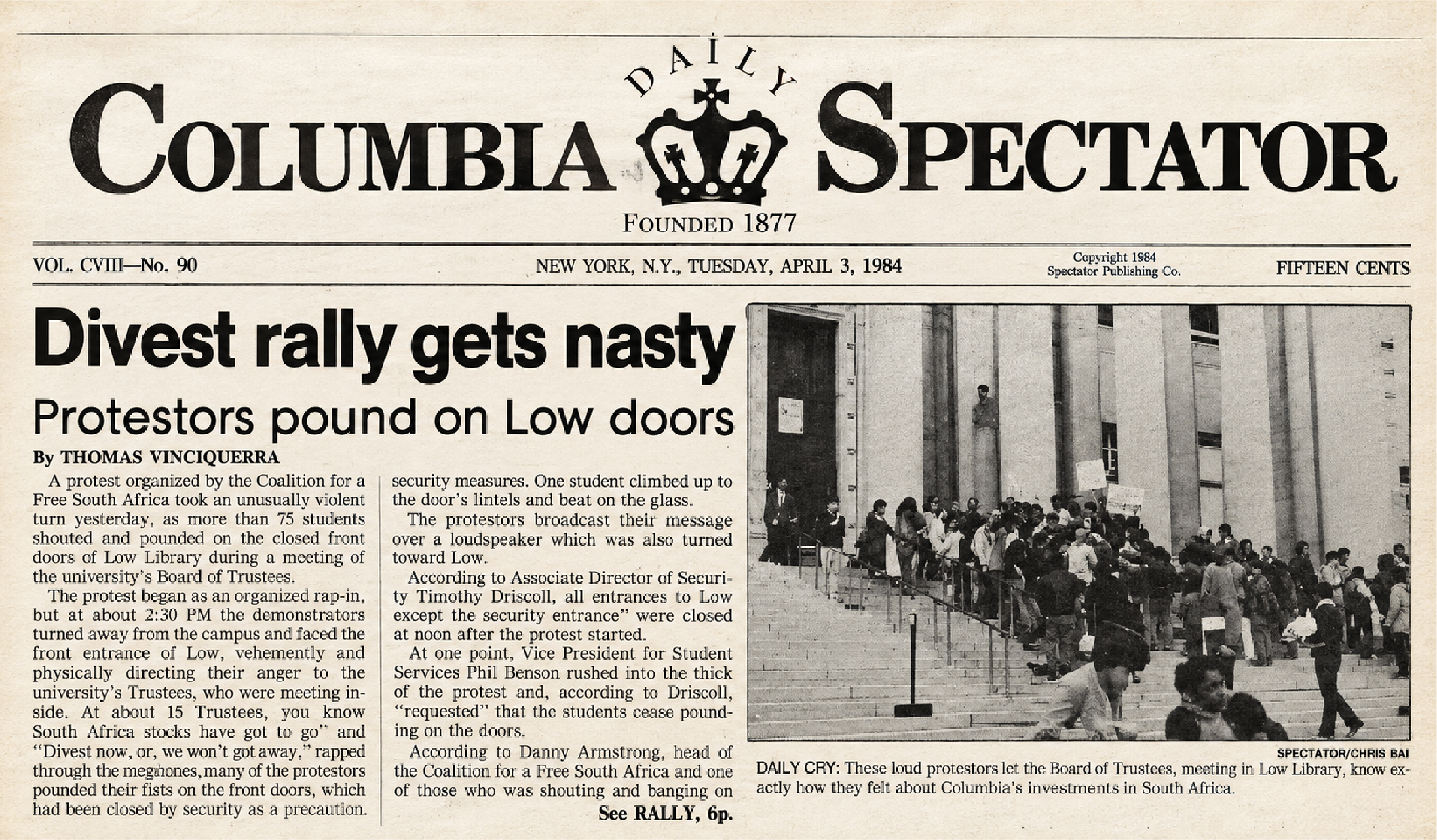
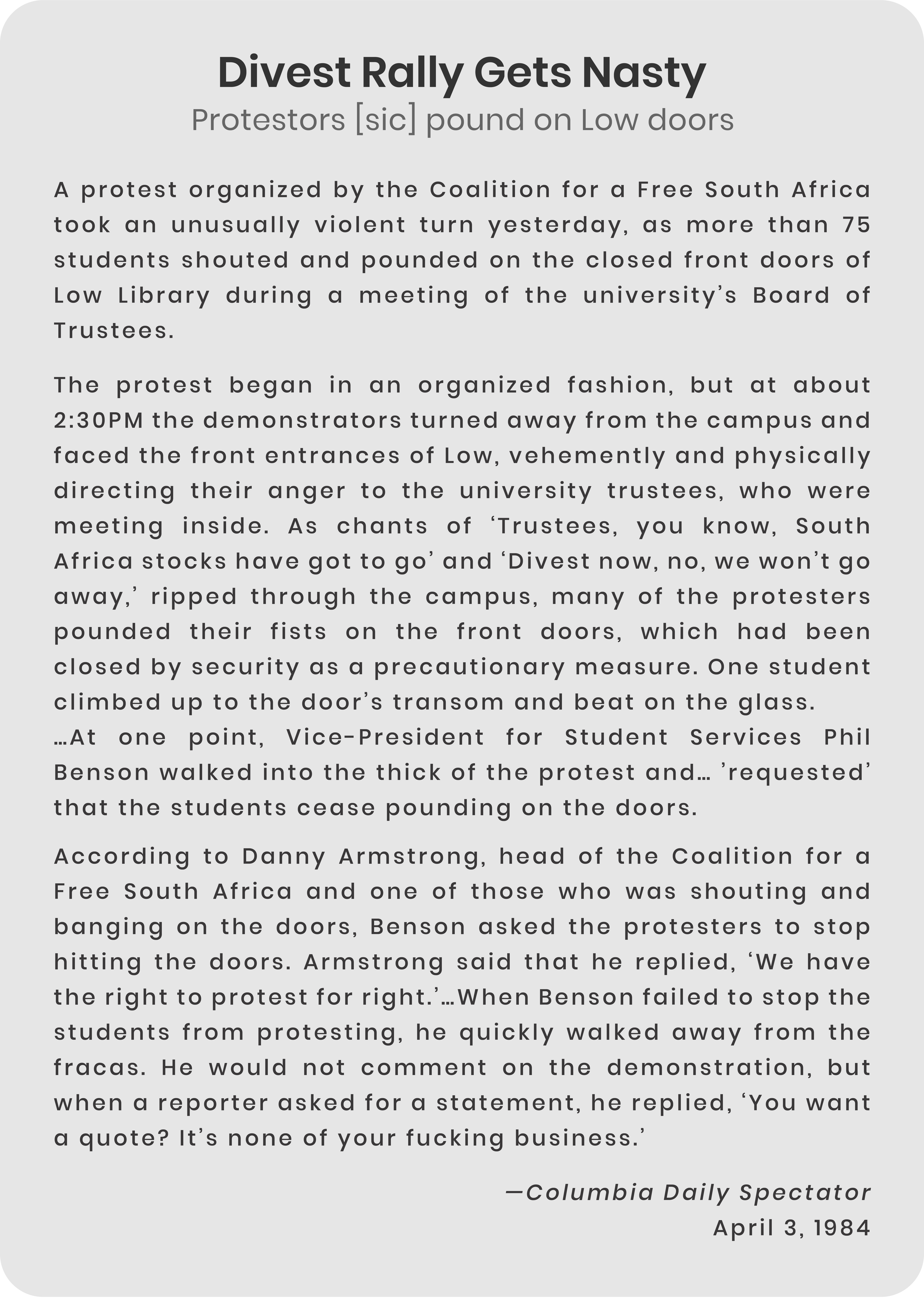
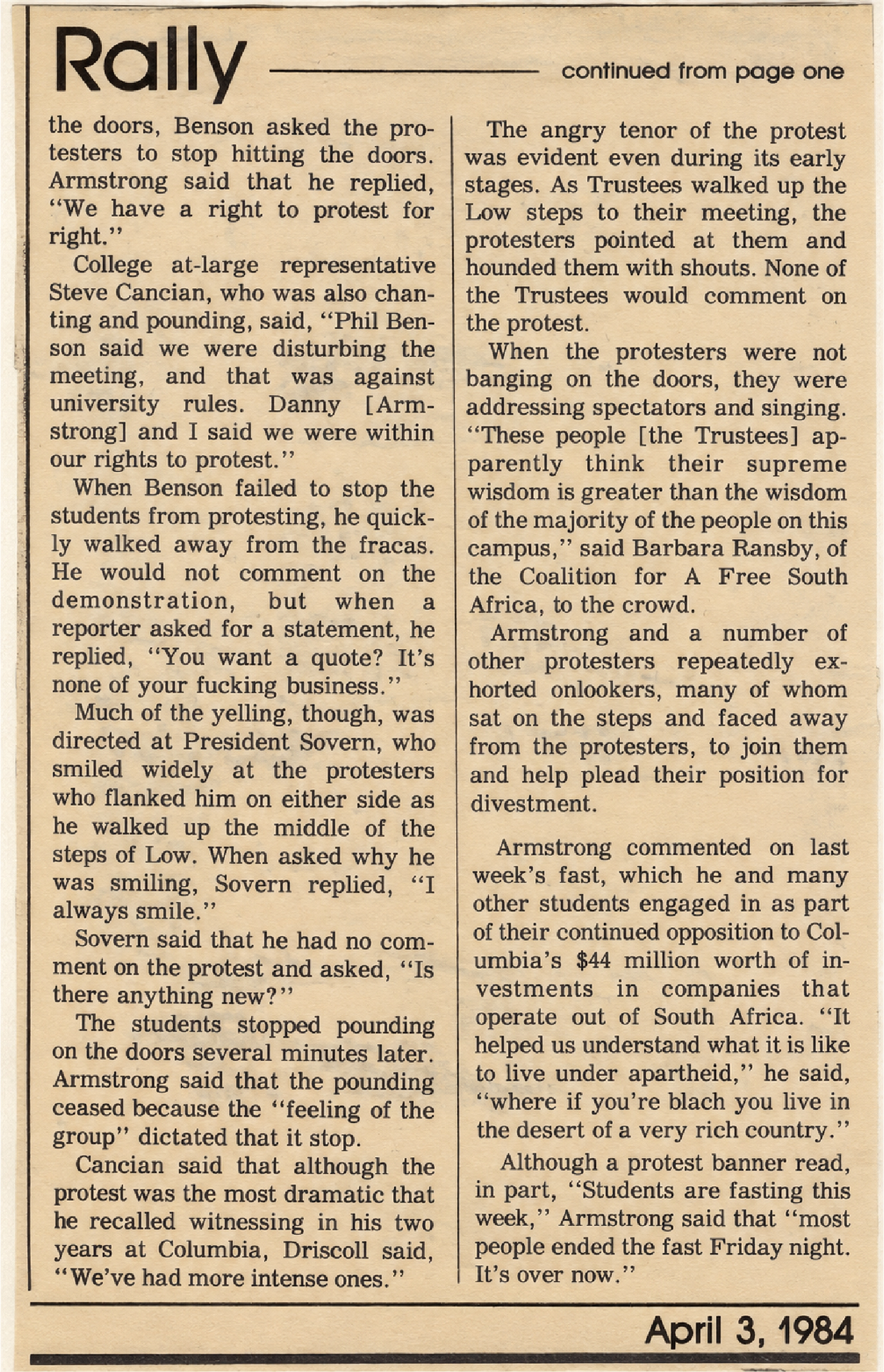
As the Trustees dug in, the Coalition and its supporters became more aggressive in our demands that the university divest. On April 2, 1984, a rally was held outside the trustees’ meeting. The Spectator quoted Barbara Ransby as telling the crowd: “These people [the trustees] apparently think their supreme wisdom is greater than the wisdom of the majority of the people on this campus.” Rally attendees no longer stood back a respectfuldistance from the entrance of Low Library, chanting. At this rally, we converged on the glass doors, angrily shouting and pounding on them. At one point, a crack appeared on one of the glass doors. We were no longer talking nice and leaving.
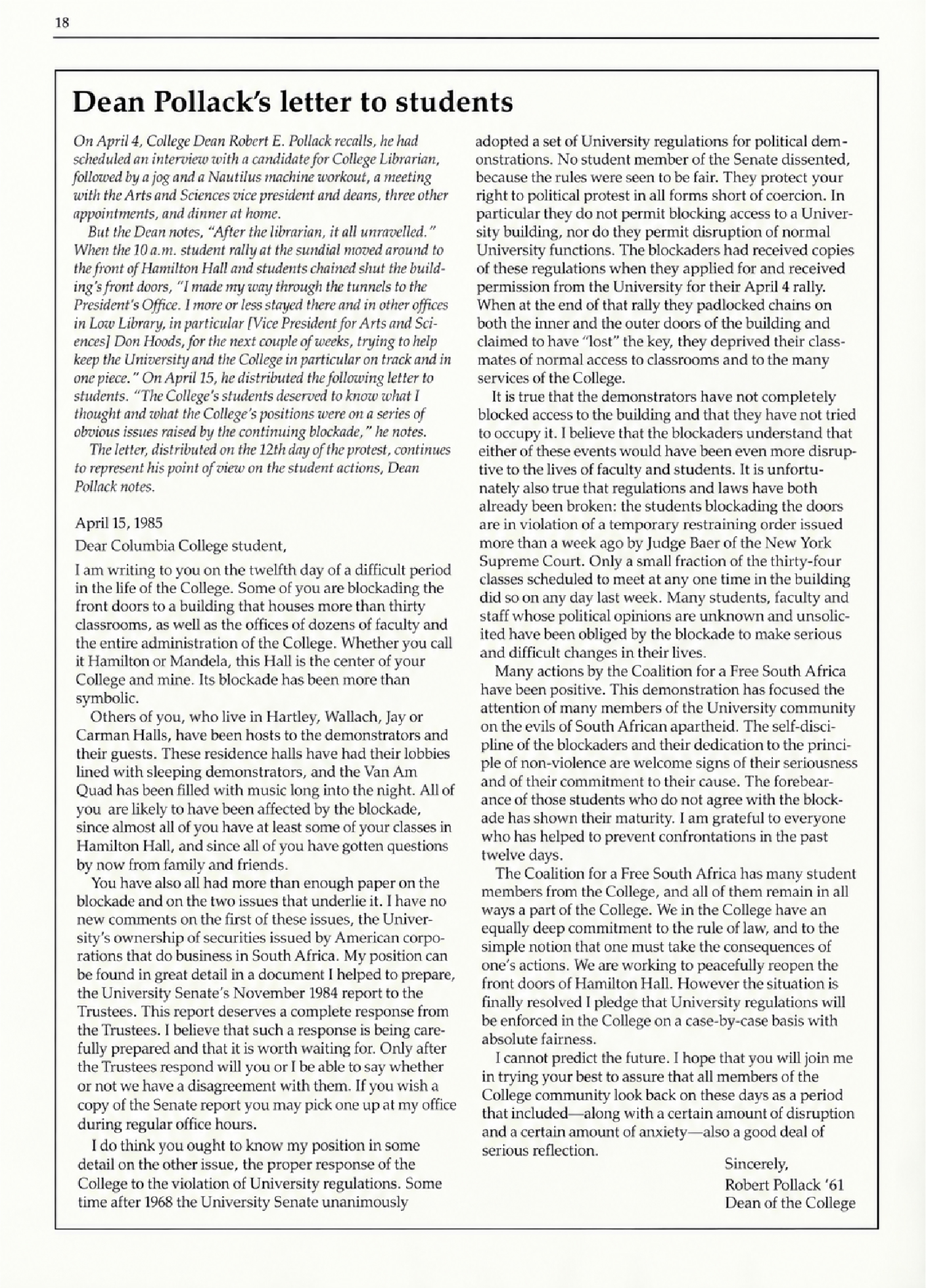
On April 26, 1984, the Spectator announced that the University Senate Ad Hoc Committee on Investments would not deliver a final report with its recommendation to the Board of Trustees. College Dean Robert Pollack who headed the Committee, sought unanimity from the Ad Hoc Committee members. Senator Barbara Ransby stood firm on the demand that the trustees commit to divestment. Dean Pollack and other committee members were prepared to present to the trustees a recommendation to freeze investments, which Pollack suggested would eventually lead to total divestment. There was a great deal of back and forth between senators and Pollack. I met with Dean Pollack and Senator Stuart Garcia, as well as with Barbara and Coalition members.
This issue of a freeze versus demanding divestment was the first and only disagreement I can recall having with Barbara. I advocated for a freeze. A key concern in my mind was if we held out for divestment, who would carry on the work next year? Barbara was graduating and going on to the University of Michigan. I was graduating and eventually going to Zimbabwe for a year. I knew what it took to build the support we had on campus. Organizing,meeting, and preparing every day; I had done it for three years. We built support by having events nearly every two or three weeks. We had a small nucleus of committed members. We could pull numbers of supporters for a rally or a speaker, but the work of the Coalition was done by a small group—posting flyers, standing at tables, and using their personal money, when necessary, to cover expenses. I could always count on Greg Smith and Greg Butler (“the Gregs”) and a few others. Others drifted in and out. I had learned early that supporters/helpers were in a revolving door. Who would do the day-to-day work next year? This concern was a major reason I felt a freeze would be advantageous. We got something.
Barbara’s position, according to the Spectator (April 30, 1984) was stated by her as follows: “It is wrong for us not to deal with the crux of the controversy. The only recommendation is one which points us in the direction of divestment. To call for a freeze does not mean divestment, it does not lead to divestment, and it is not sufficient…it is a contradiction to say that it’s unethical to purchase more stock in these companies, but that it’s okay to keep what you have. Basically, I don’t think a freeze is enough. It isn’t a step toward divestment.” I failed to grasp the depth and breadth of student support for divestment. In one Coalition meeting, as we debated to agree to a freeze or stand firm for total divestment, I recall a new student supporter, whom I did not recognize, gleefully express his excitement for the issue of divestment and saying how committed he was to go all out next year organizing. I could only think, “I have heard that before….and what happens when midterms hit or a paper is due?” The revolving door was in my mind. To continue to demand divestment would require a committed group who were willing to sacrifice. I did not see it.
I misjudged. Barbara was correct in holding out for divestment. Students were committed and willing to sacrifice and organize. Holding out for divestment was the principled stance. Sometimes you just have to have faith; Barbara had it. In response to lacking unanimity, Dean Pollack delivered an “interim report” to President Sovern. In delivering the interim report, Dean Pollack asked President Sovern “to ask the trustees to impose a freeze in investments in companies operating in South Africa as a sign of good faith to my committee as we continue next year” (Spectator April 30, 1984). On April 27, 1984, President Sovern agreed to recommend that the Trustees freeze investments.
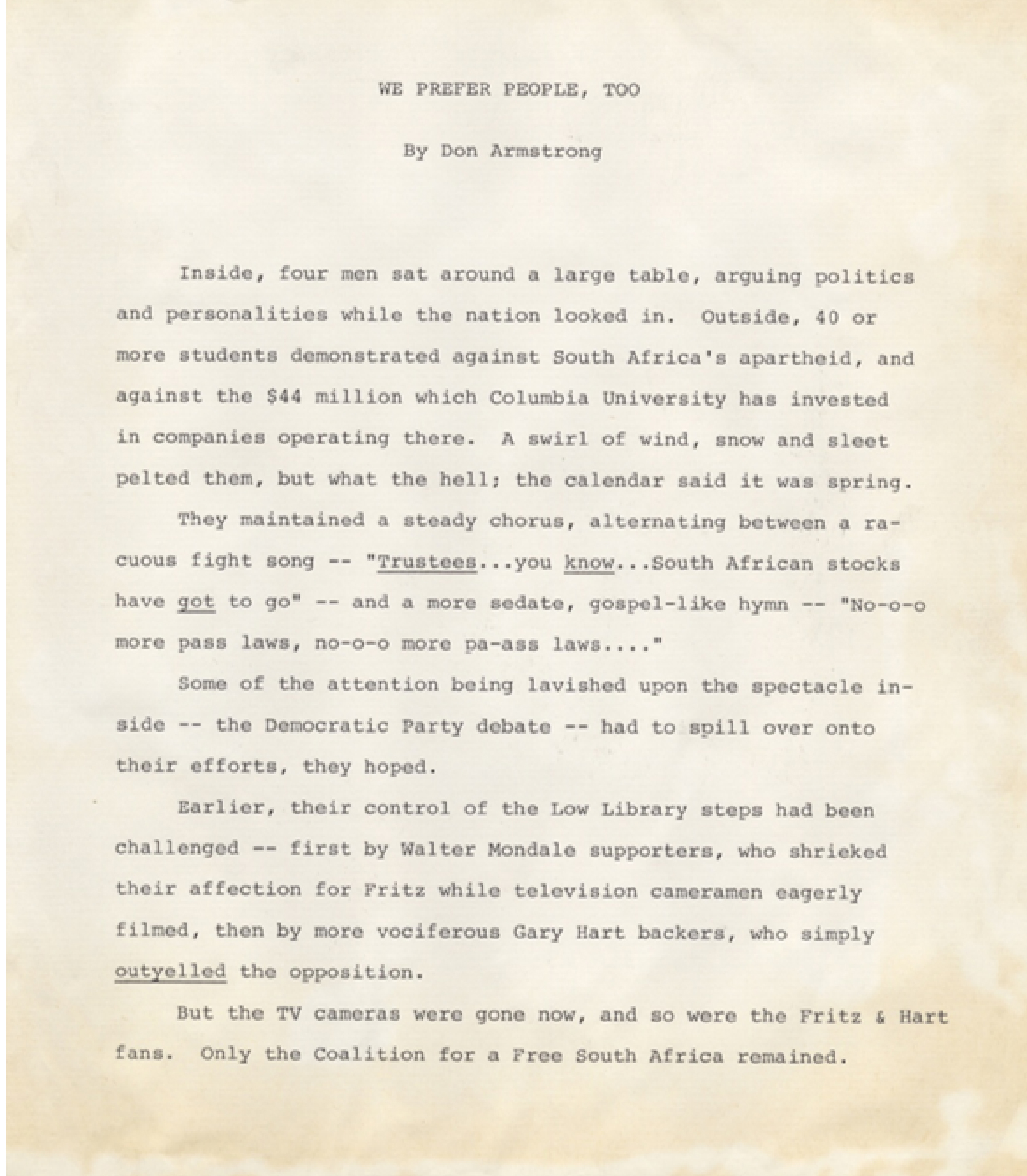
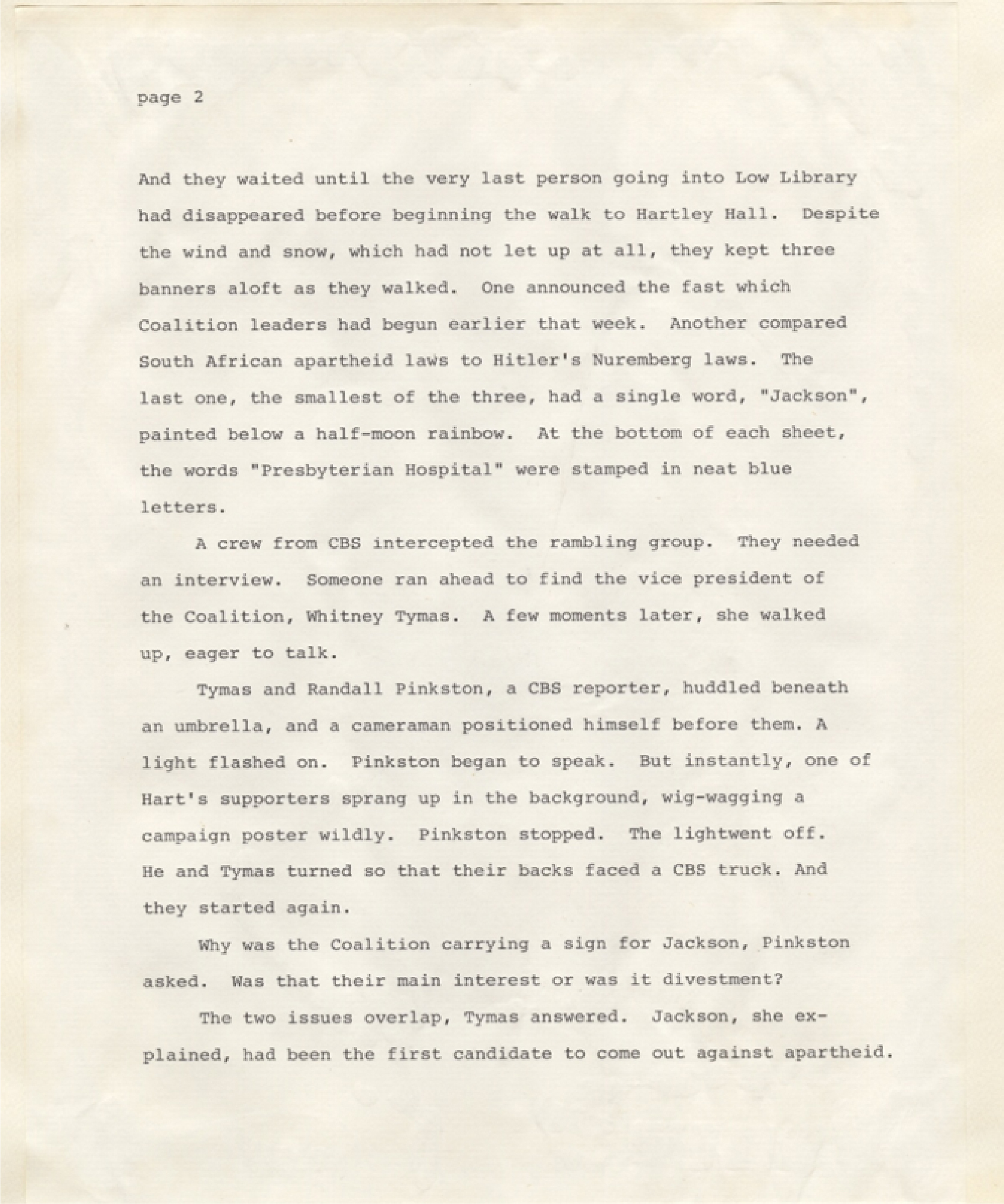
An article by Daniel’s brother, Don, reflecting on his experience at a Coalition for a Free South Africa rally outside Low Library, Columbia University’s administration center, while Democratic presidential candidates debated live on national television.
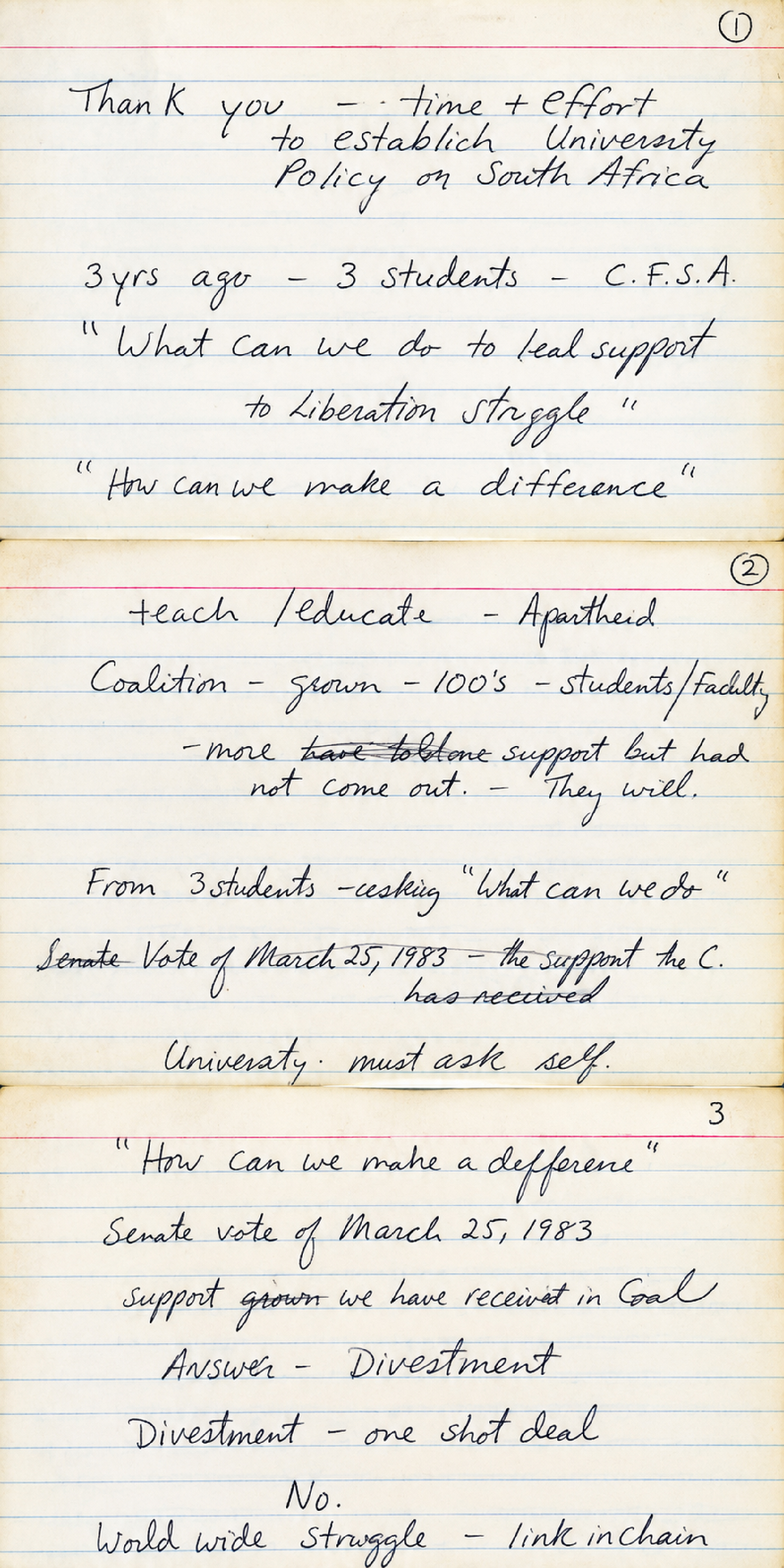
Daniel’s Speech Notes
The Blockade
April 4 to 25, 1985
In May 1984, I graduated from Columbia University. That October, I traveled to Zimbabwe for nine months of research on youth development as a Ford Foundation fellow.
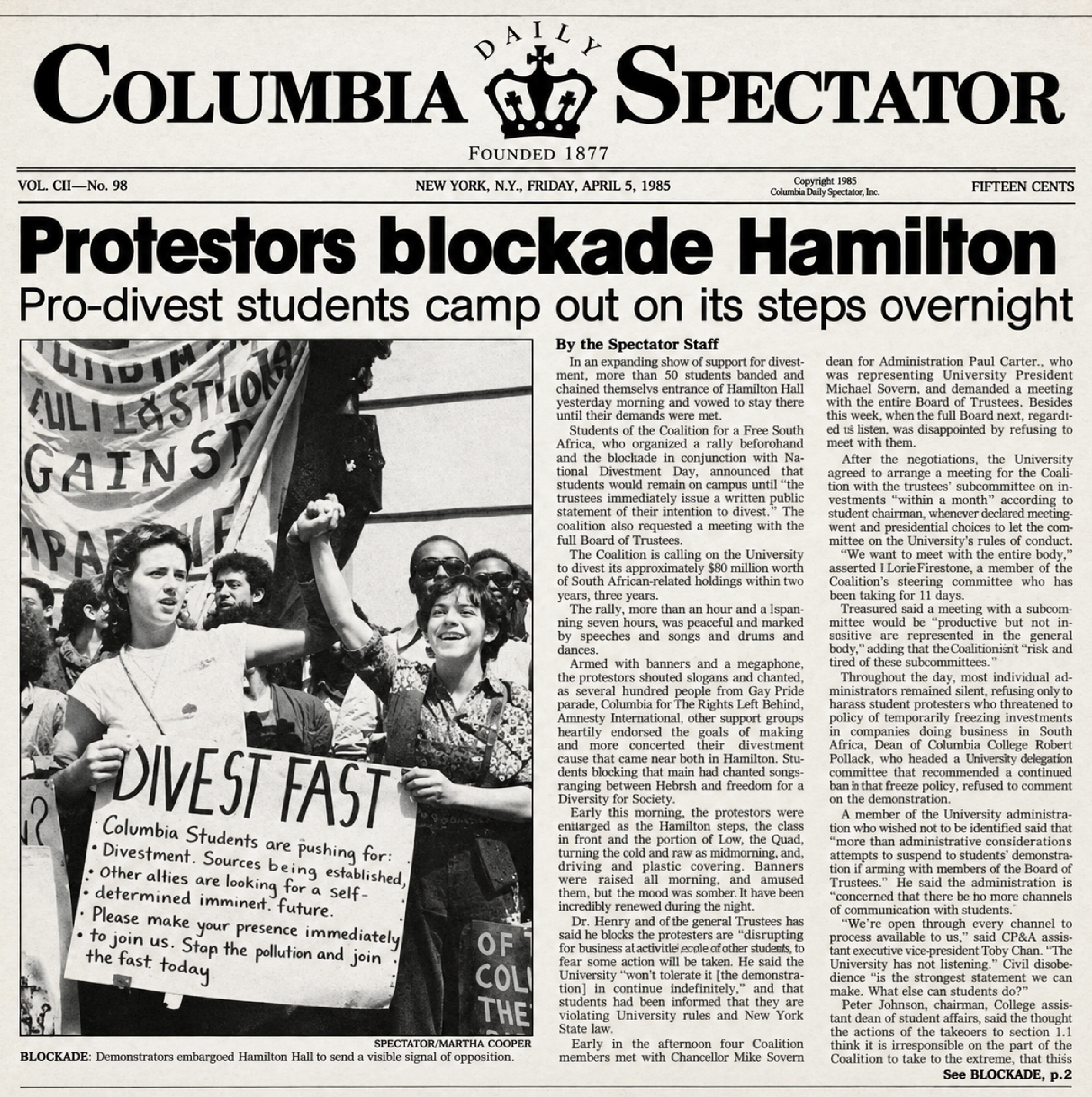
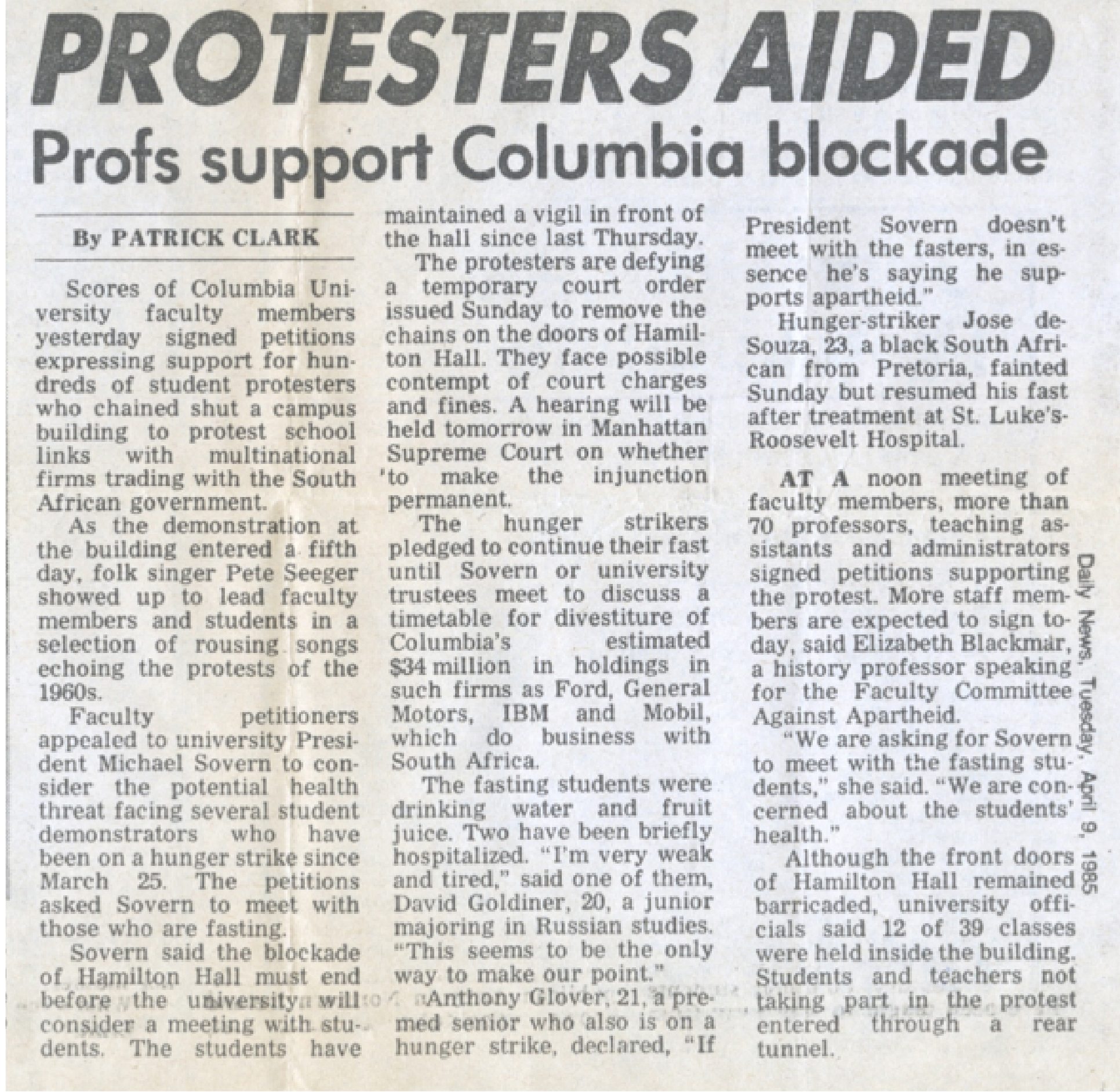
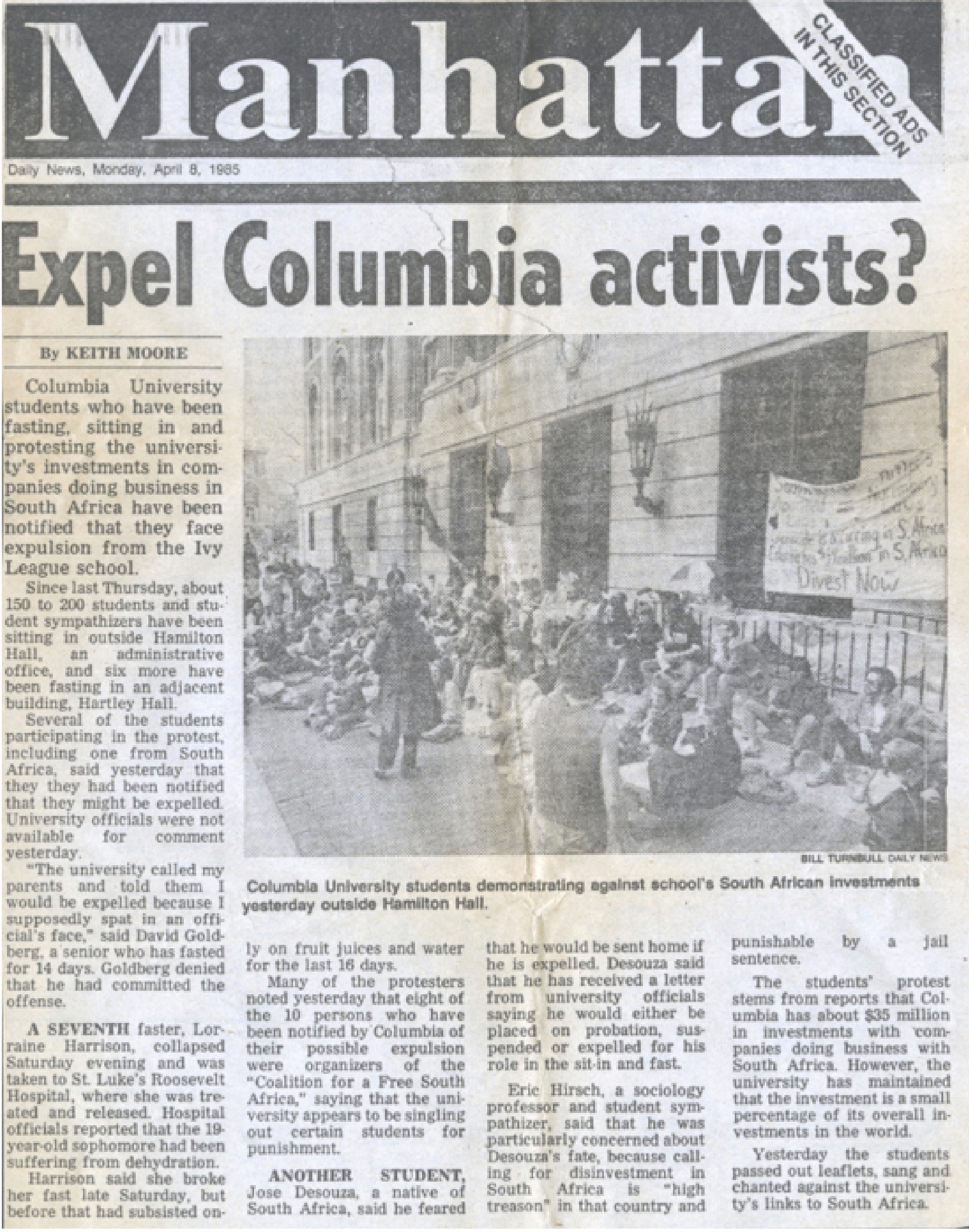
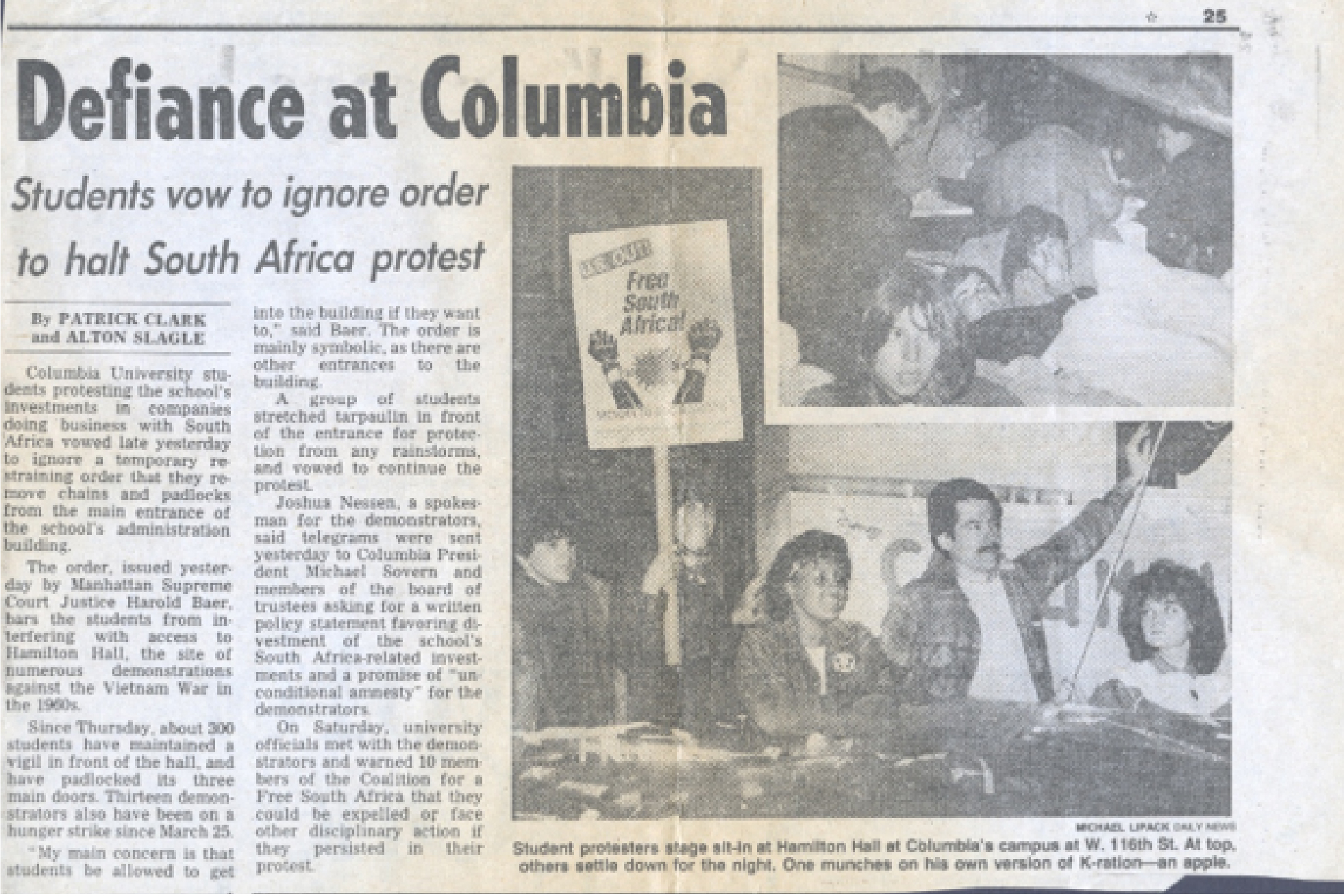
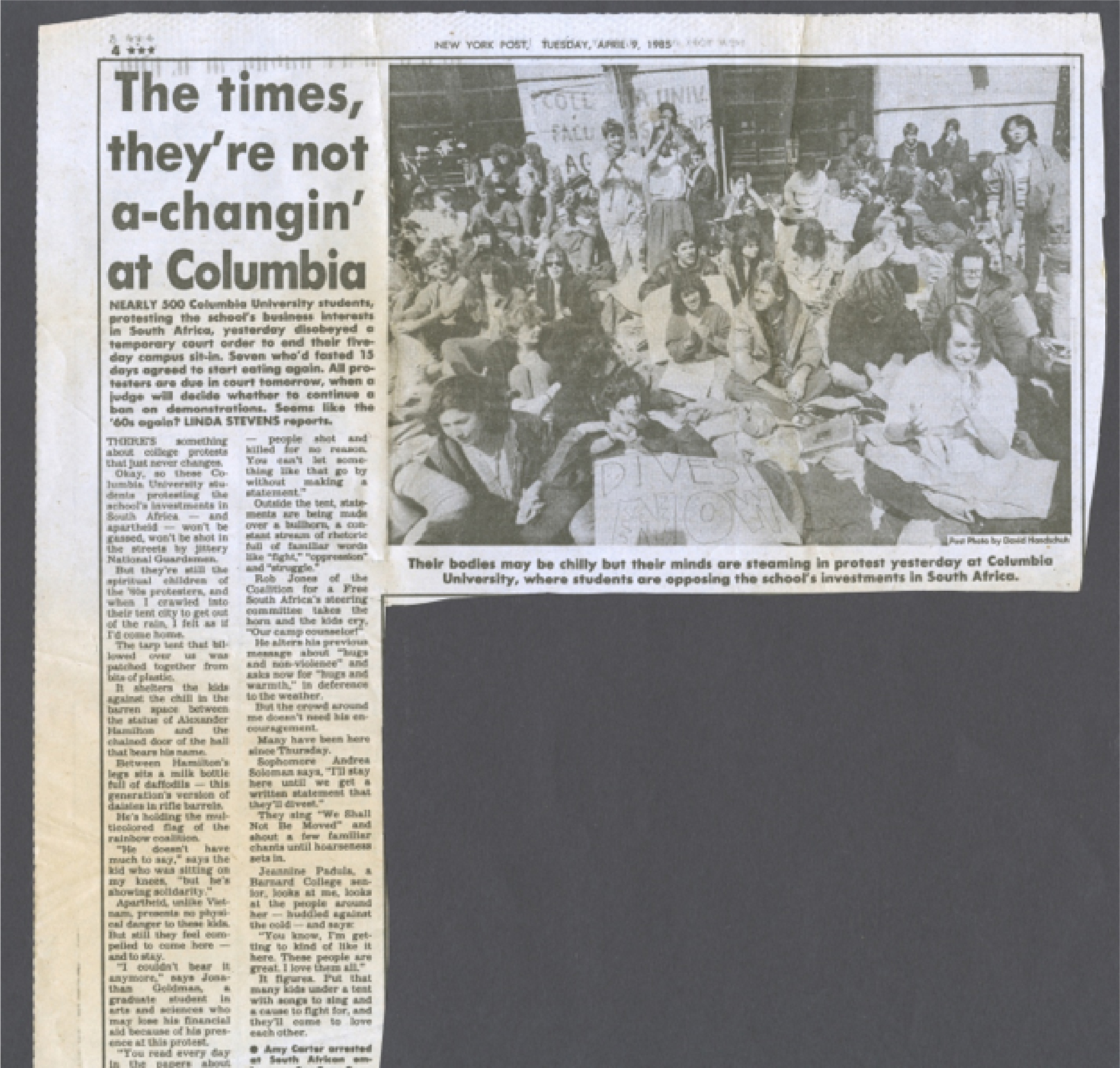
In April 1985, I visited South Africa to observe firsthand the realities of apartheid. On April 4, Columbia students blockaded Hamilton Hall, a building housing undergraduate classrooms and administrative offices, to demand that the University divest from companies doing business in South Africa. The following day, South African news media reported the protest.
After reading news reports, I called the editor of the Columbia Daily Spectator, the University’s student newspaper, to let him know that the protest was receiving coverage in South Africa. According to the editor, Columbia president Michael Sovern had responded to the blockade with a letter to the University community stating that Desmond Tutu, a Nobel Peace Prize laureate and Columbia honorary degree recipient, would oppose the protest.
I was scheduled to meet with Tutu that afternoon. I told the editor that he would ask Tutu directly where he stood on the issue. Tutu told me, “I support the students, and if divestment causes us to suffer more, then turn up the heat.” Tutu said that he was scheduled to a radio interview with a New York radio station, and he would endorse the protest during the interview.”
Six months following my meeting with Tutu, Columbia’s trustee committed to divest funds from companies with operations in apartheid South Africa.
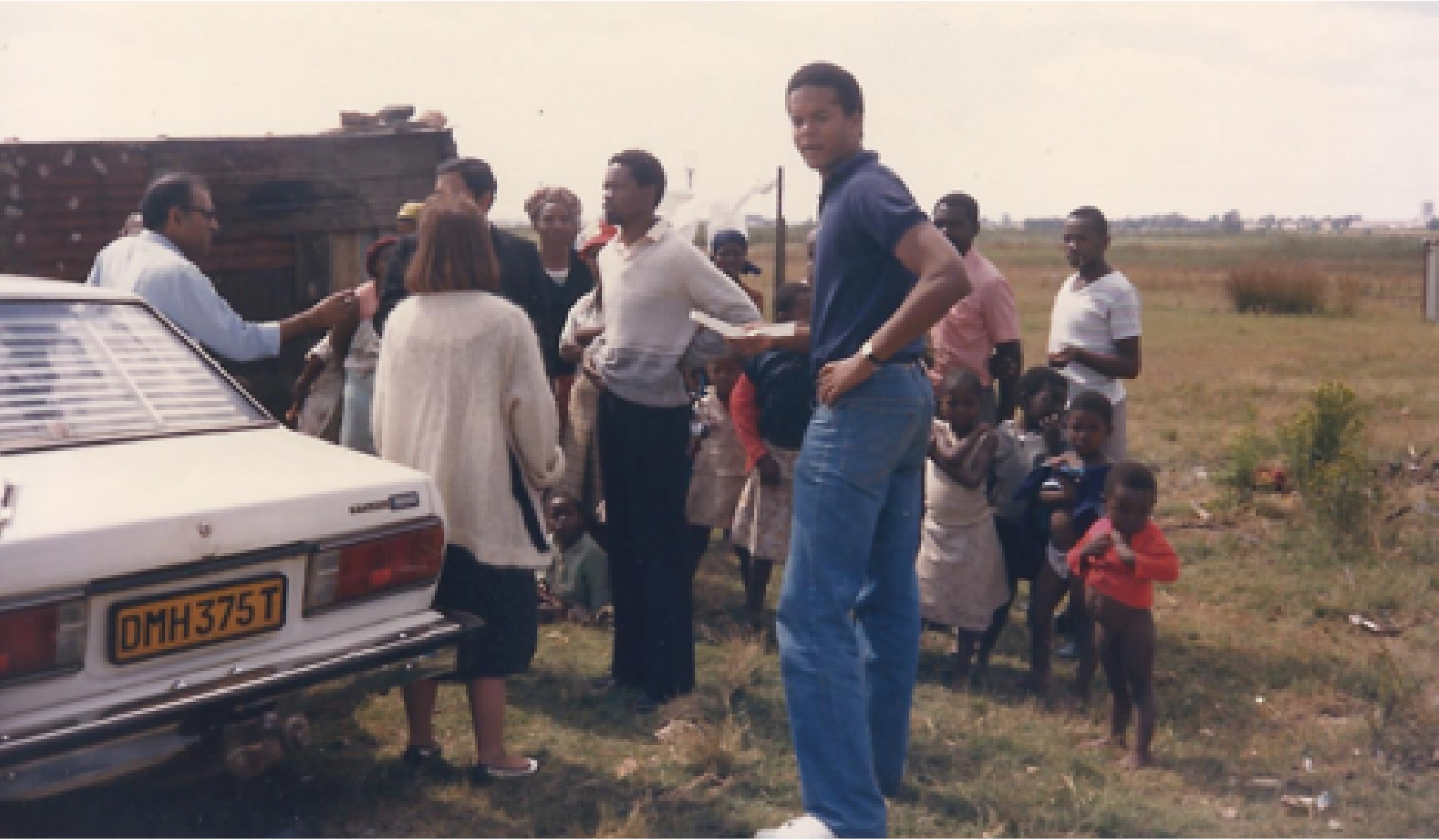
While visiting Apartheid South Africa, Daniel met with residents whose shack-like homes were bull dozed by the South African army earlier that morning. Here, he is reading an order from the Apartheid government to residents demanding that they leave the area in 24 hours. Daniel asked one mother what she was going to do when the army returns the next day. She picked up a broken Coke bottle and said, "We are going to fight back."
(April 1985 – Johannesburg, South Africa)
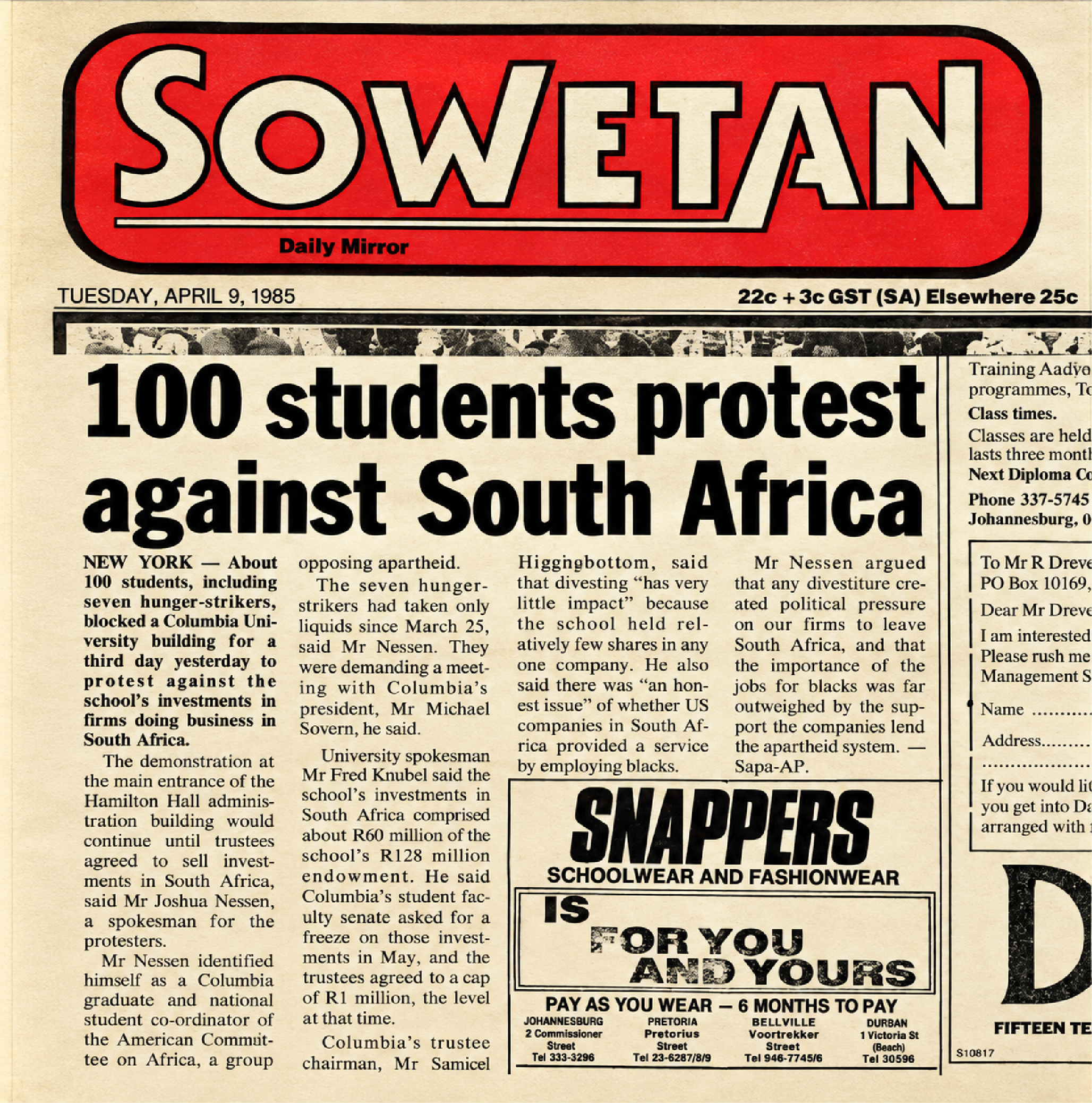
Sowetan - South African newspaper
(Johannesburg, South Africa - April 9, 1985)
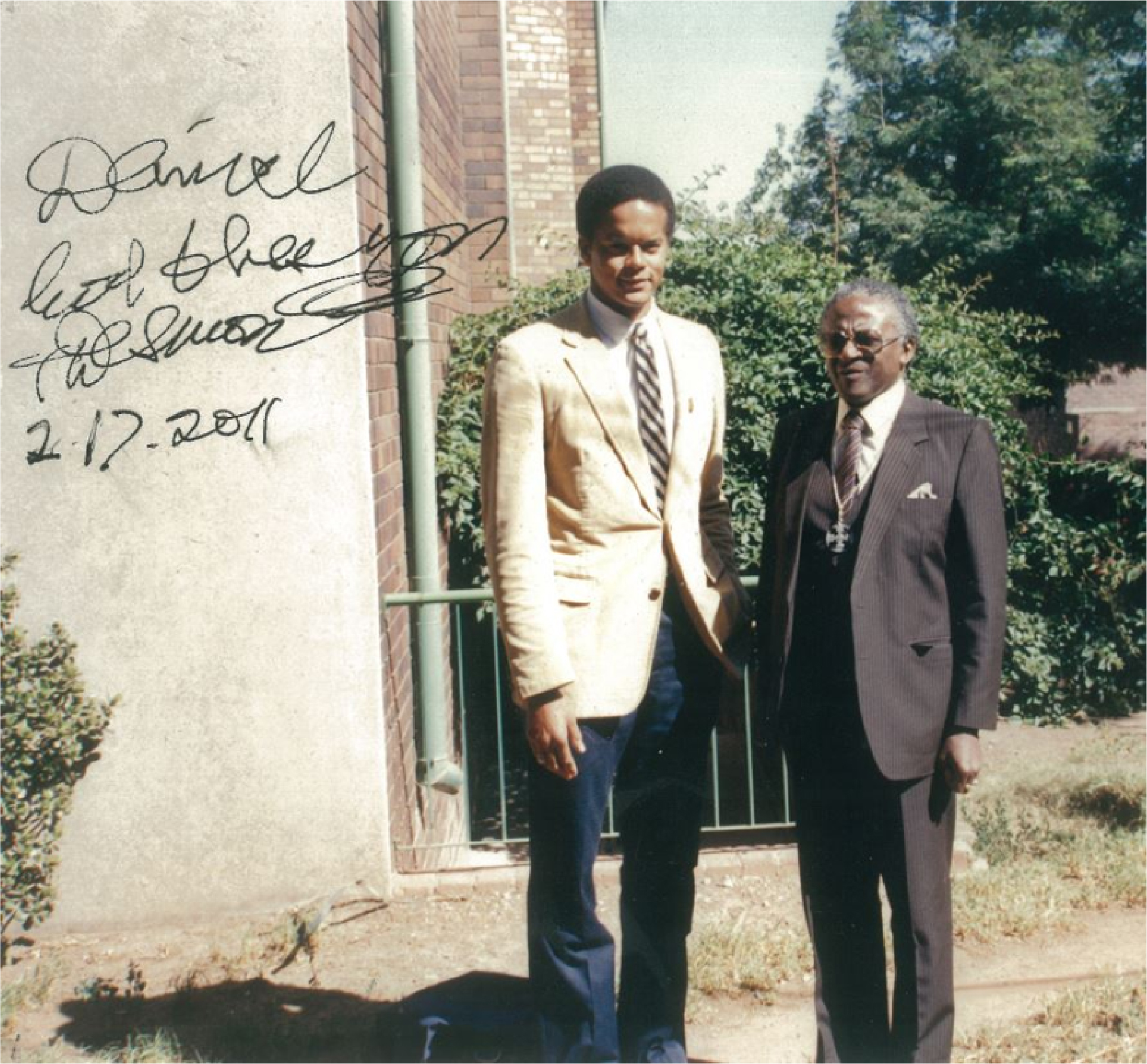
Following Daniel’s meeting with Nobel Laureate Desmond Tutu, he gave his endorsement of the Columbia University divestment campaign.
(April 1985 – Johannesburg, South Africa)
Now the students could point to Bishop Tutu as a supporter of divestment. His declaration discredited the argument that divestment would hurt black South Africans. The trustees found themselves on a lonely island as the sea of support for divestment surrounded them from campus to South Africa.
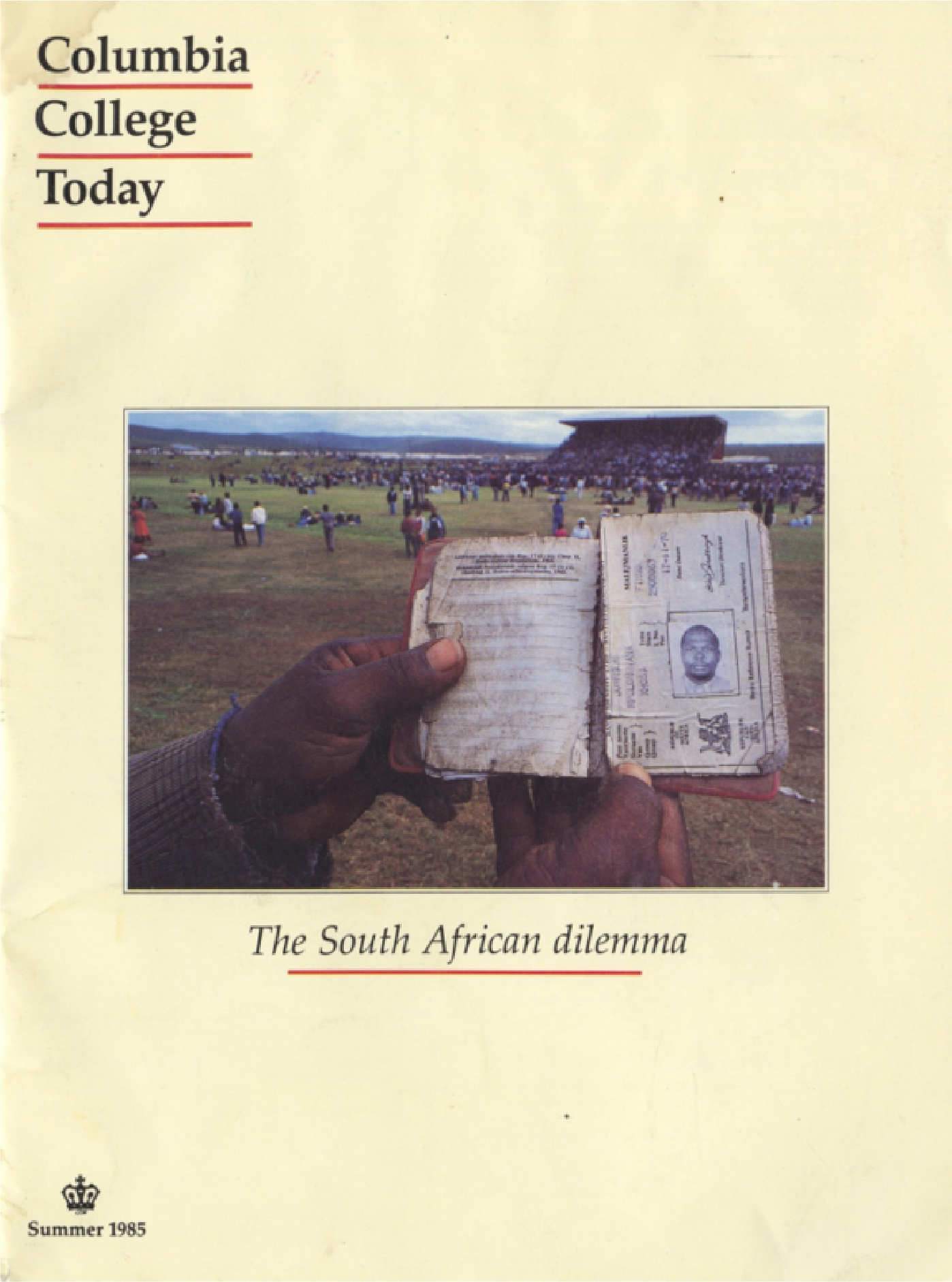
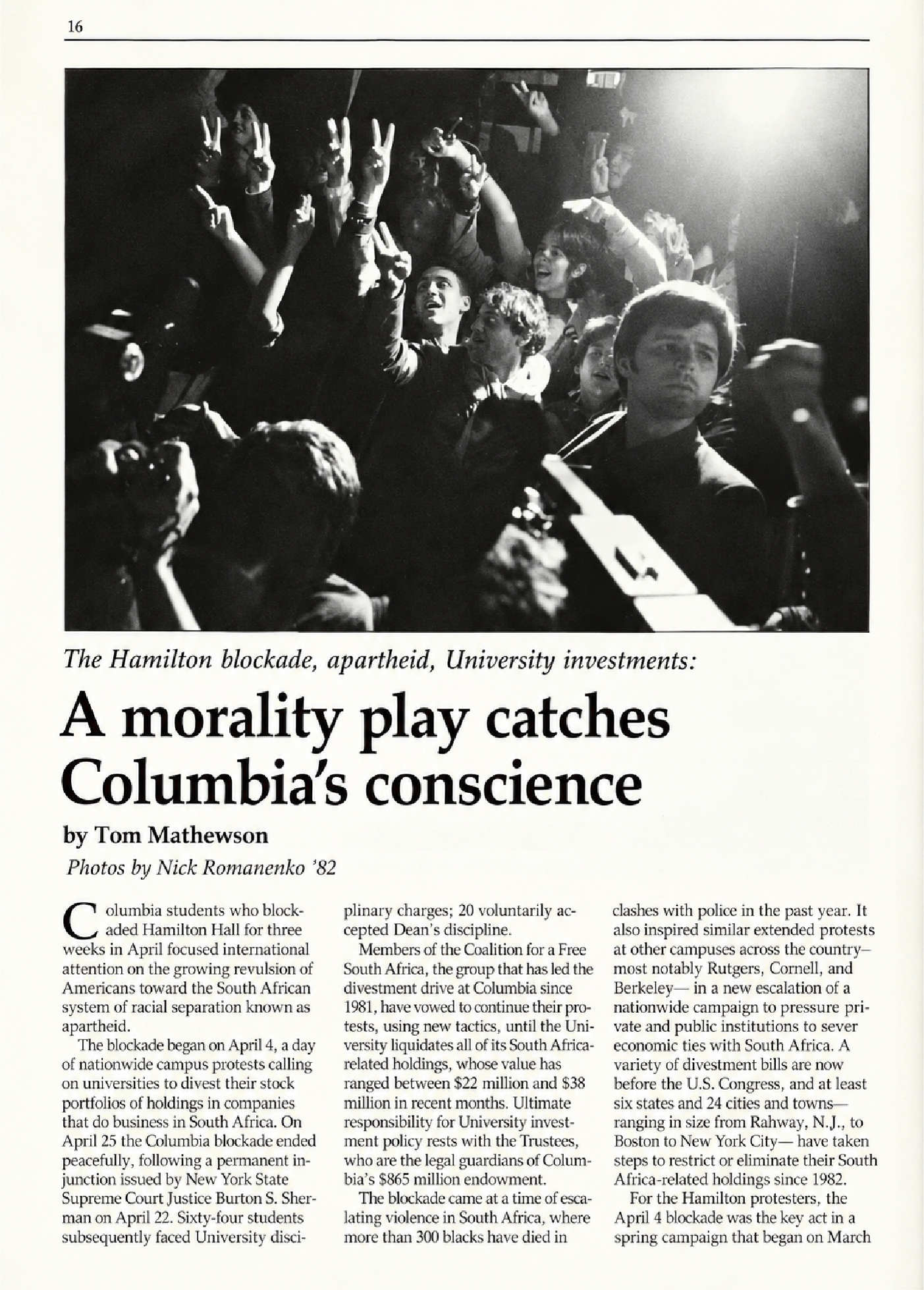
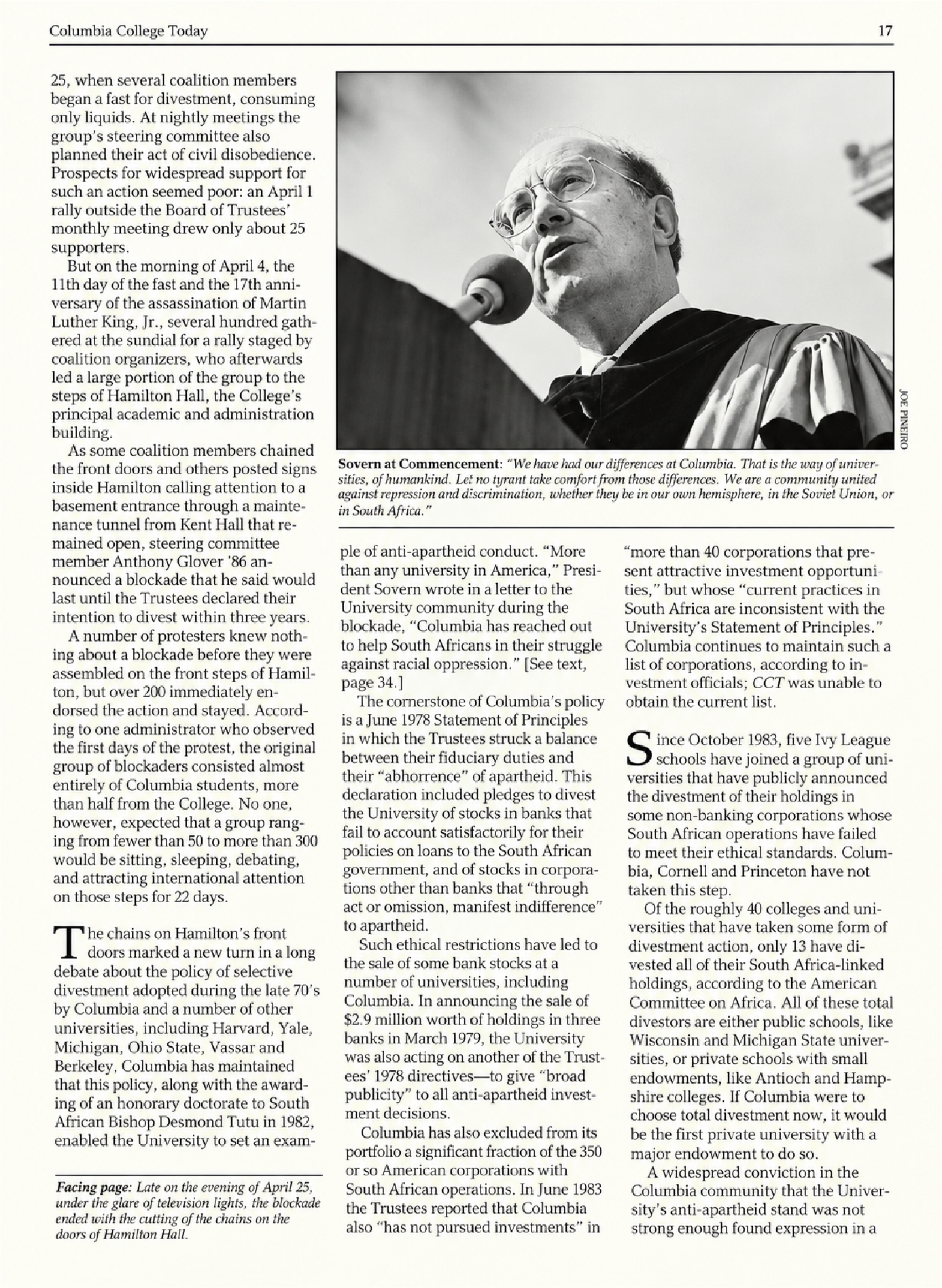
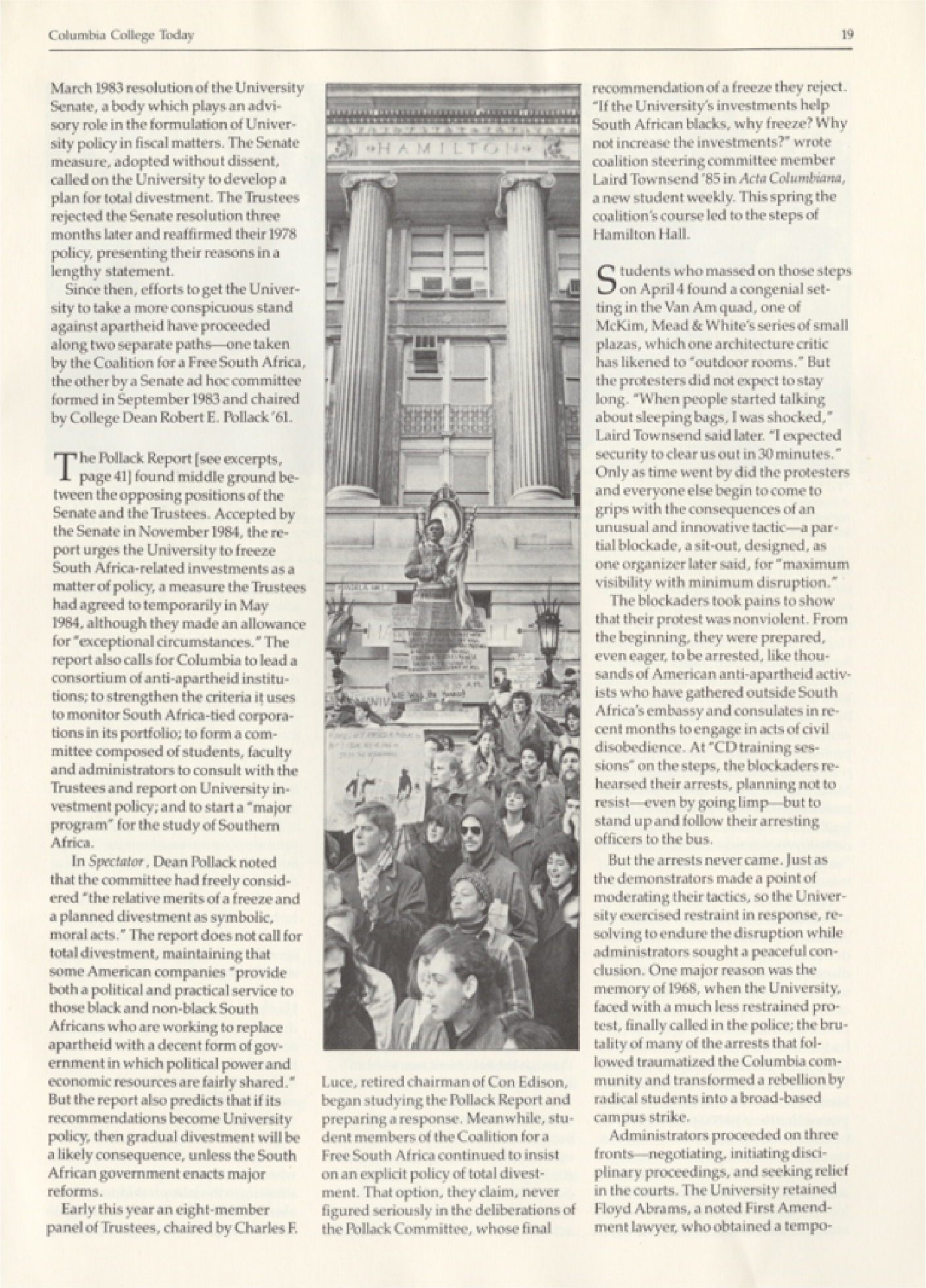
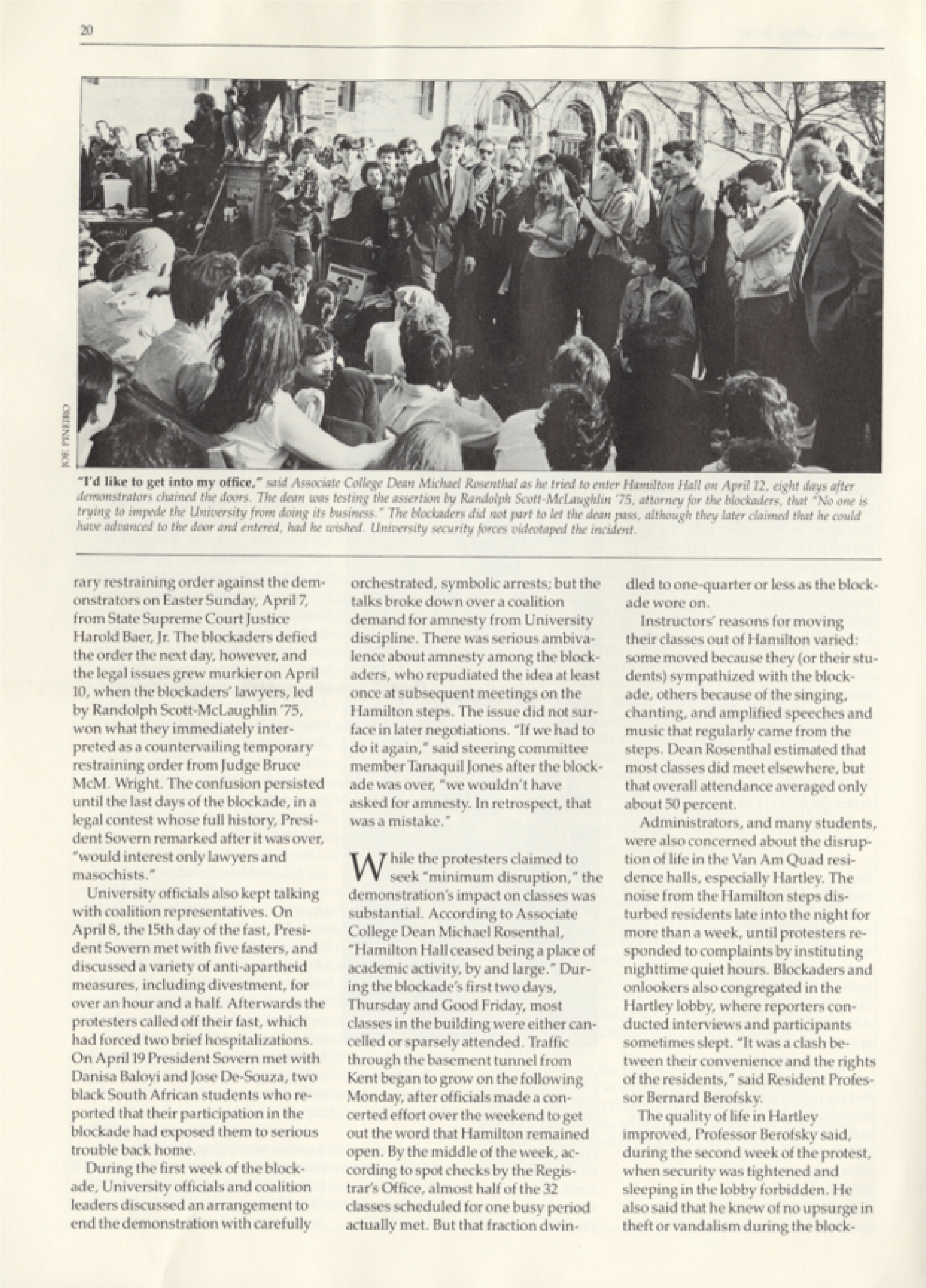
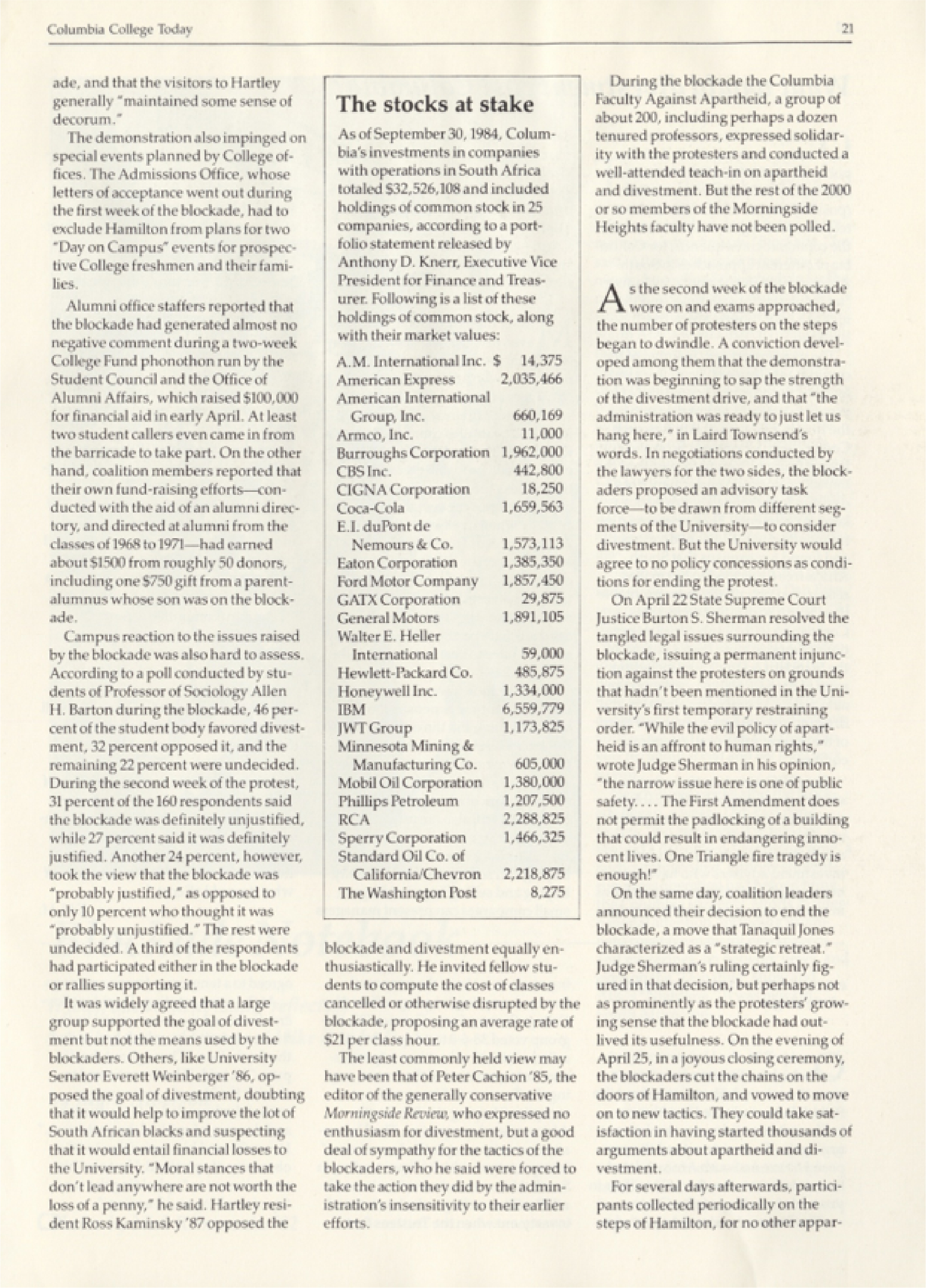
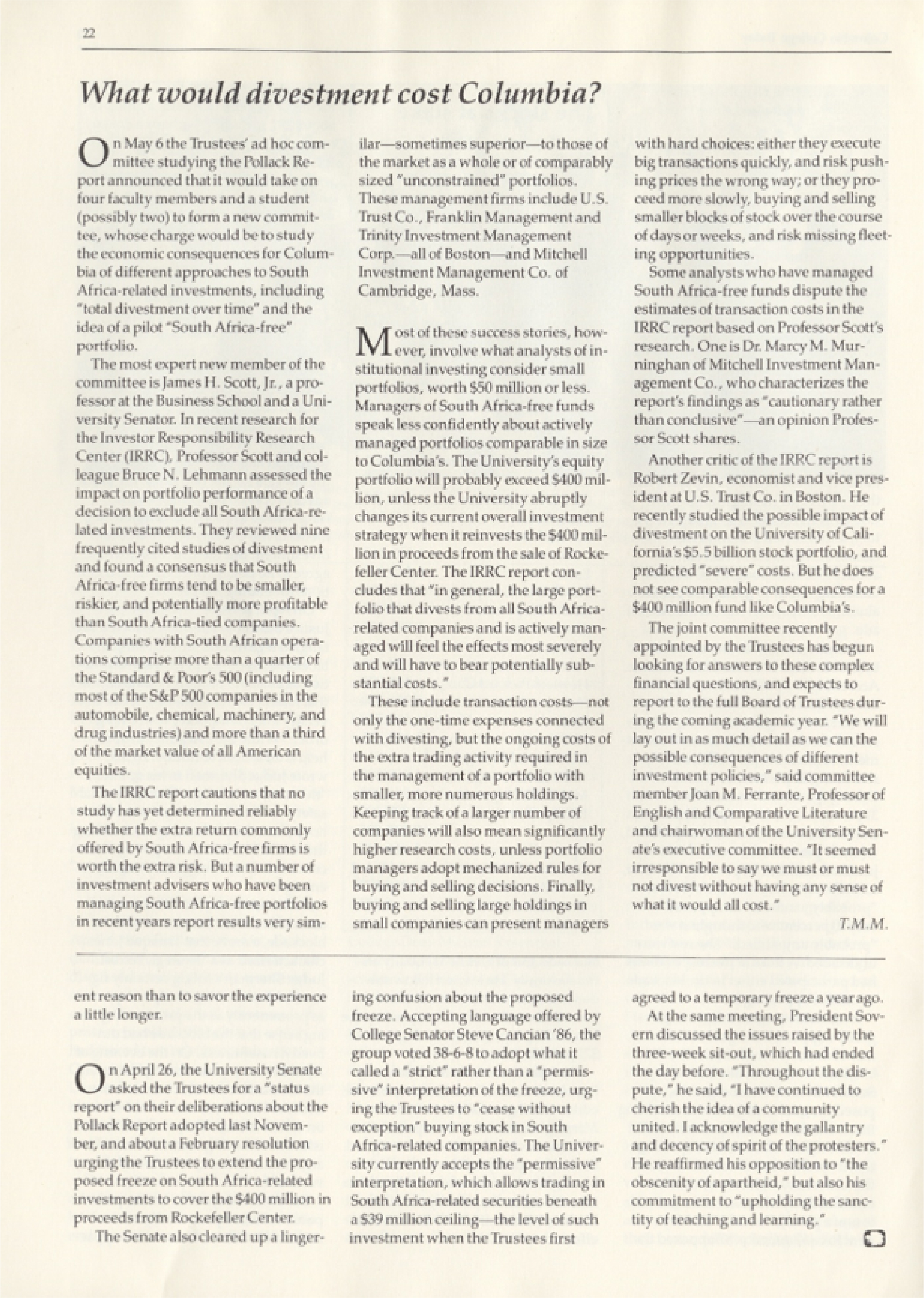
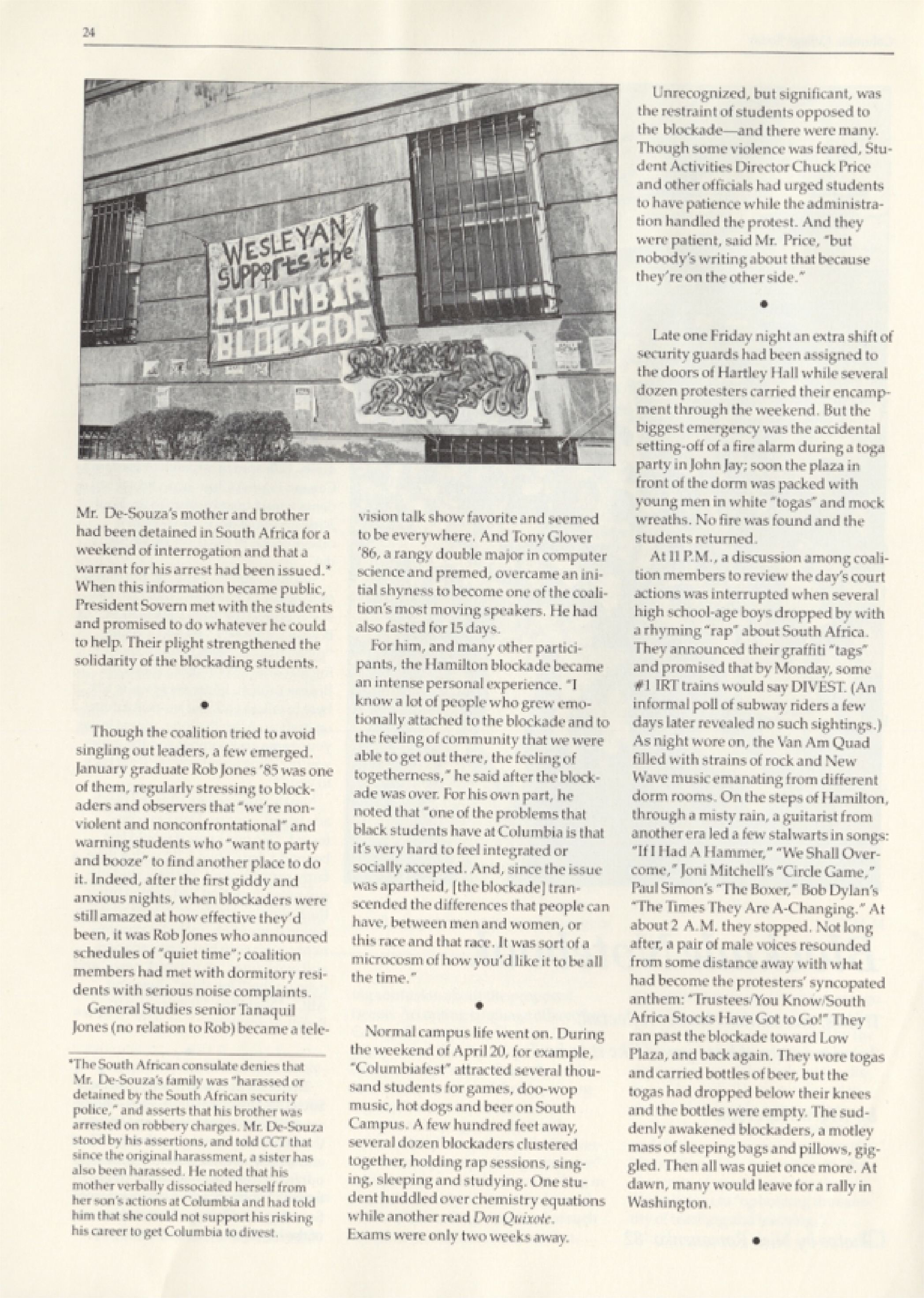
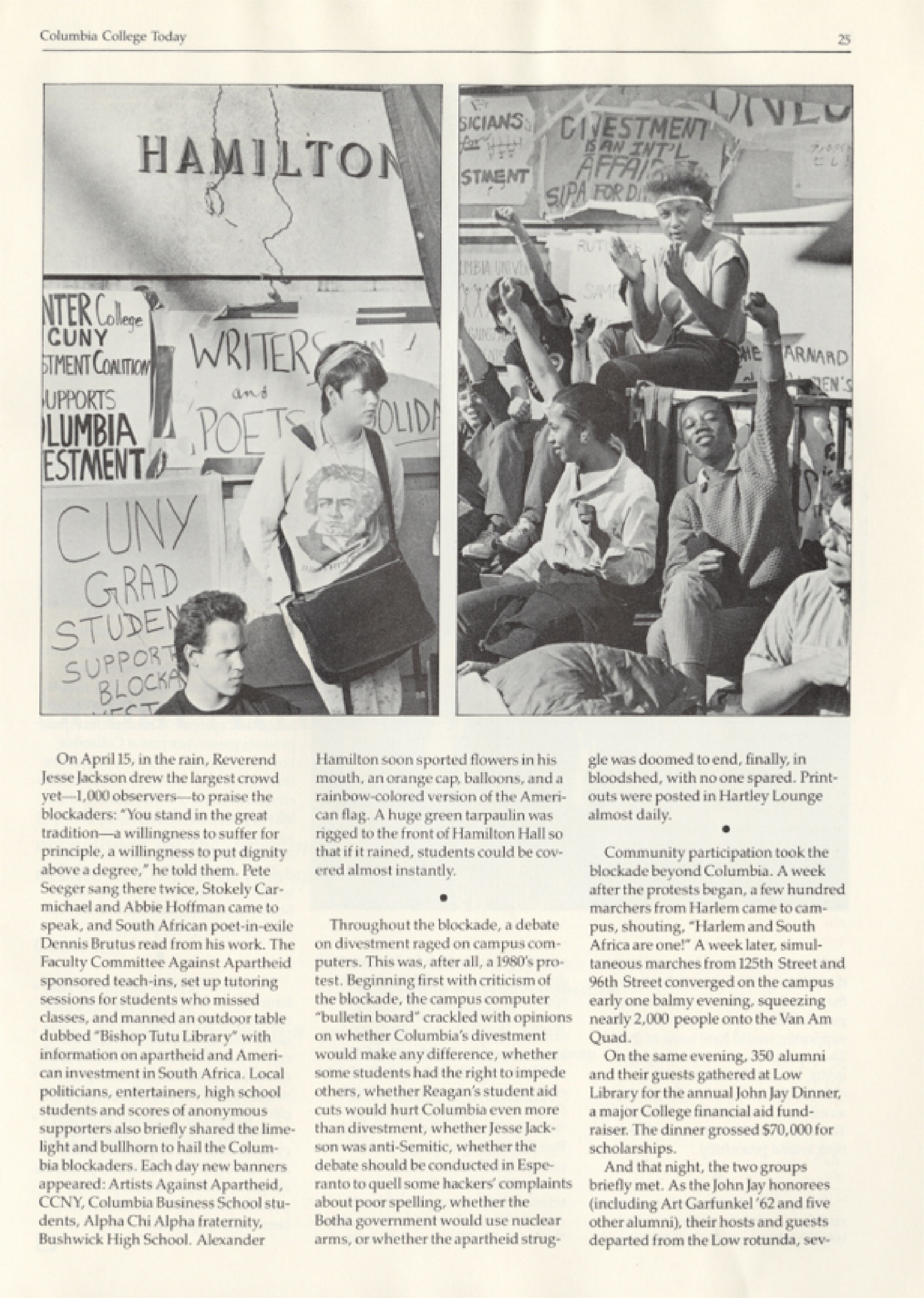
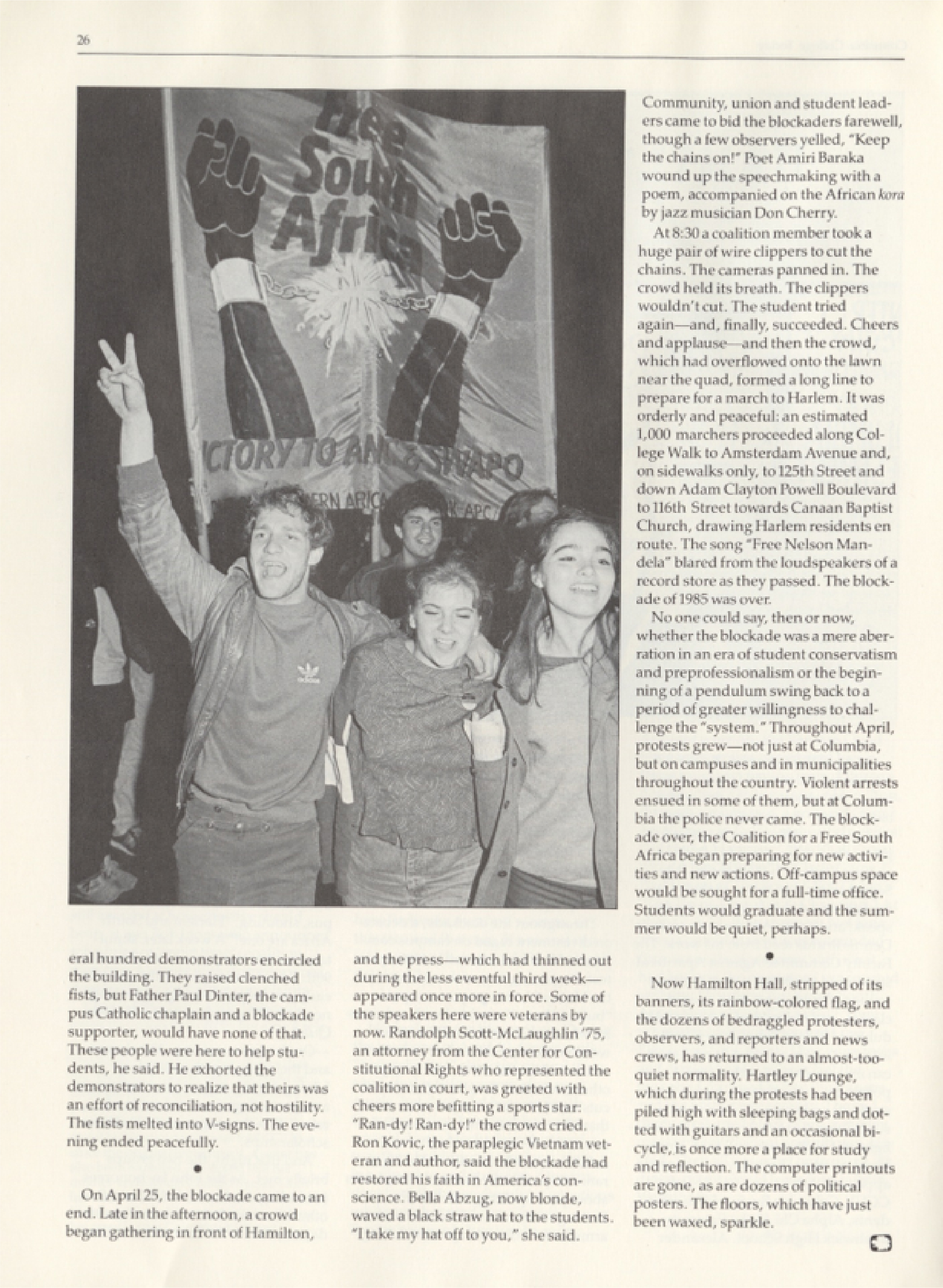
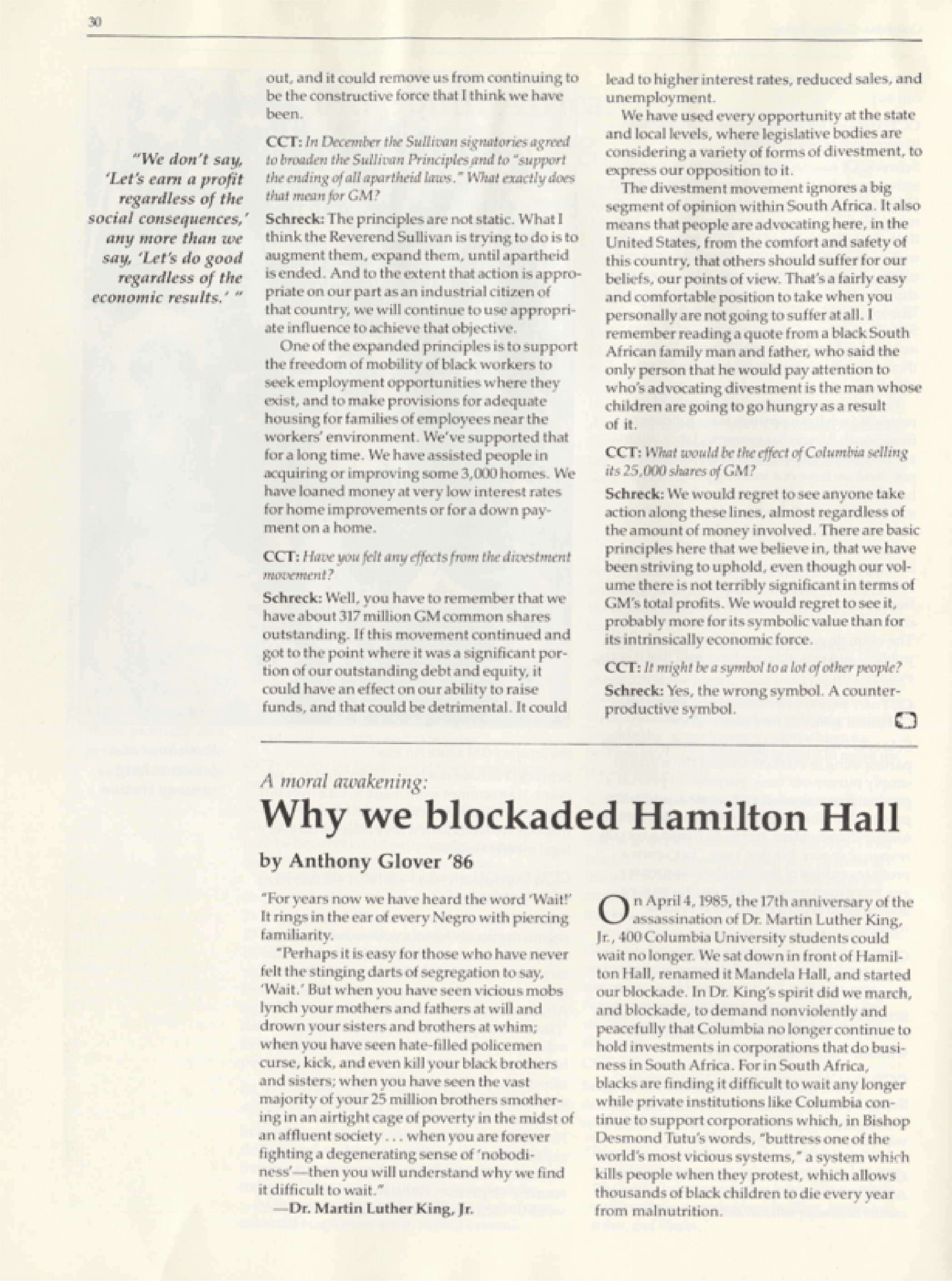
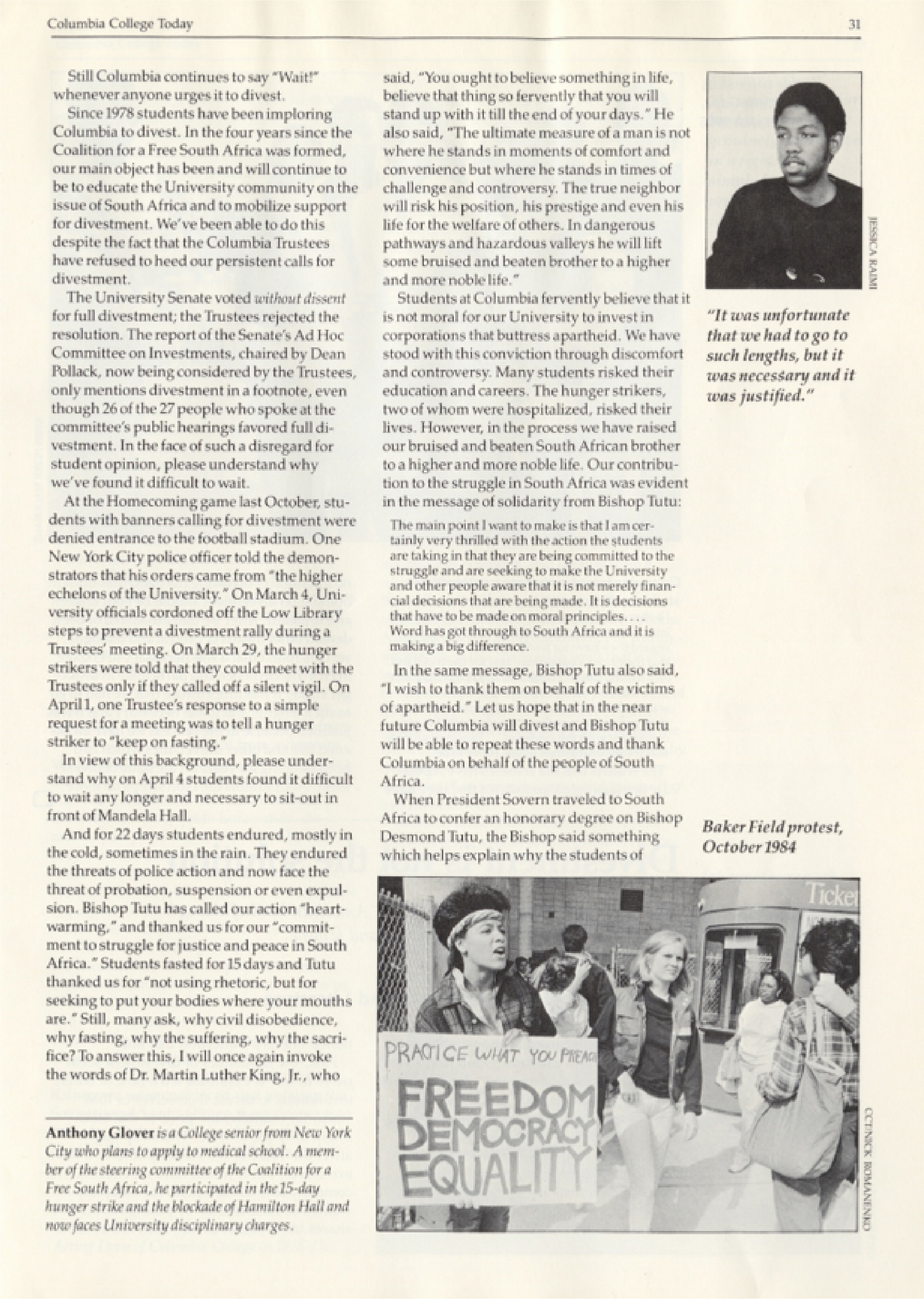
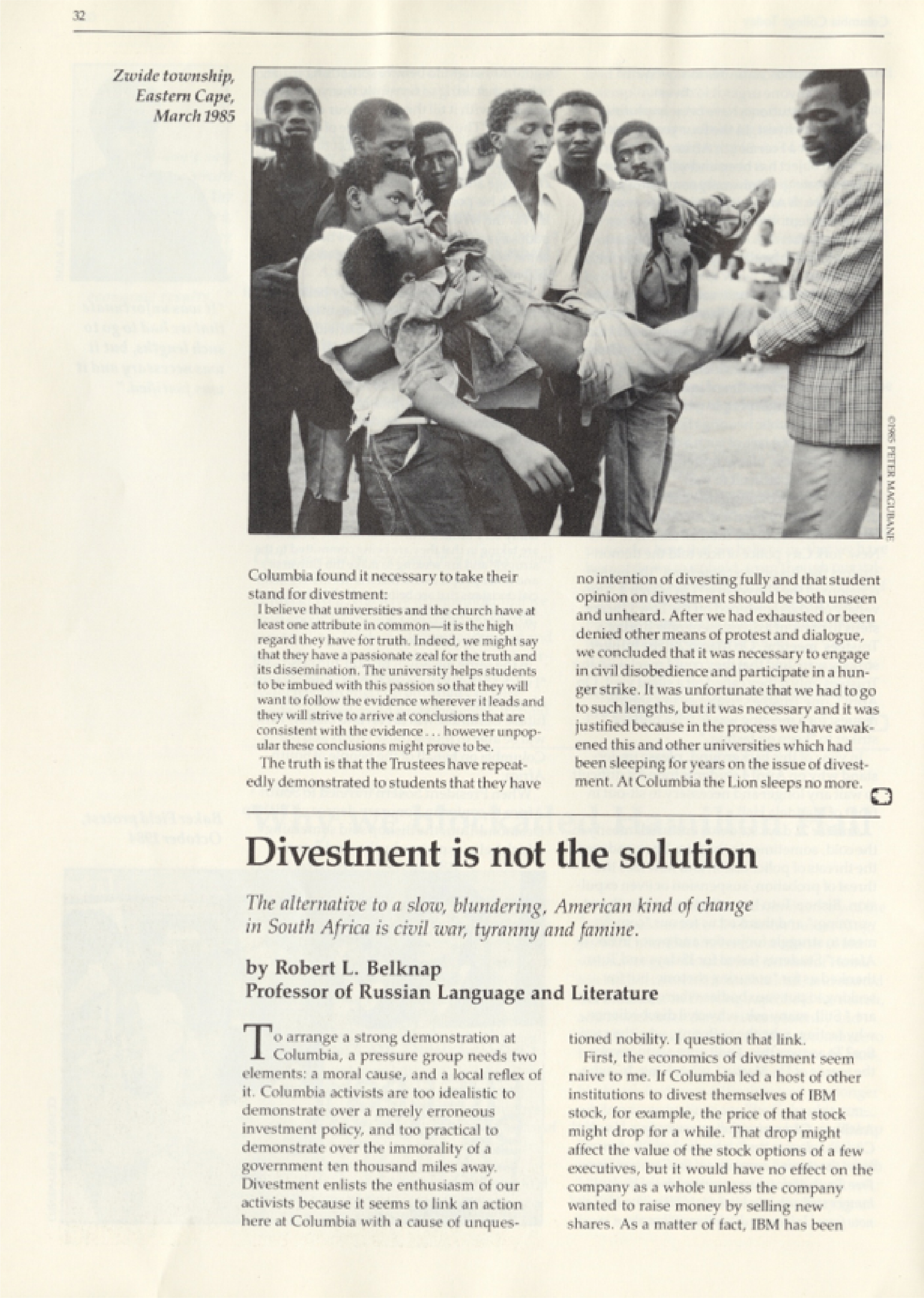
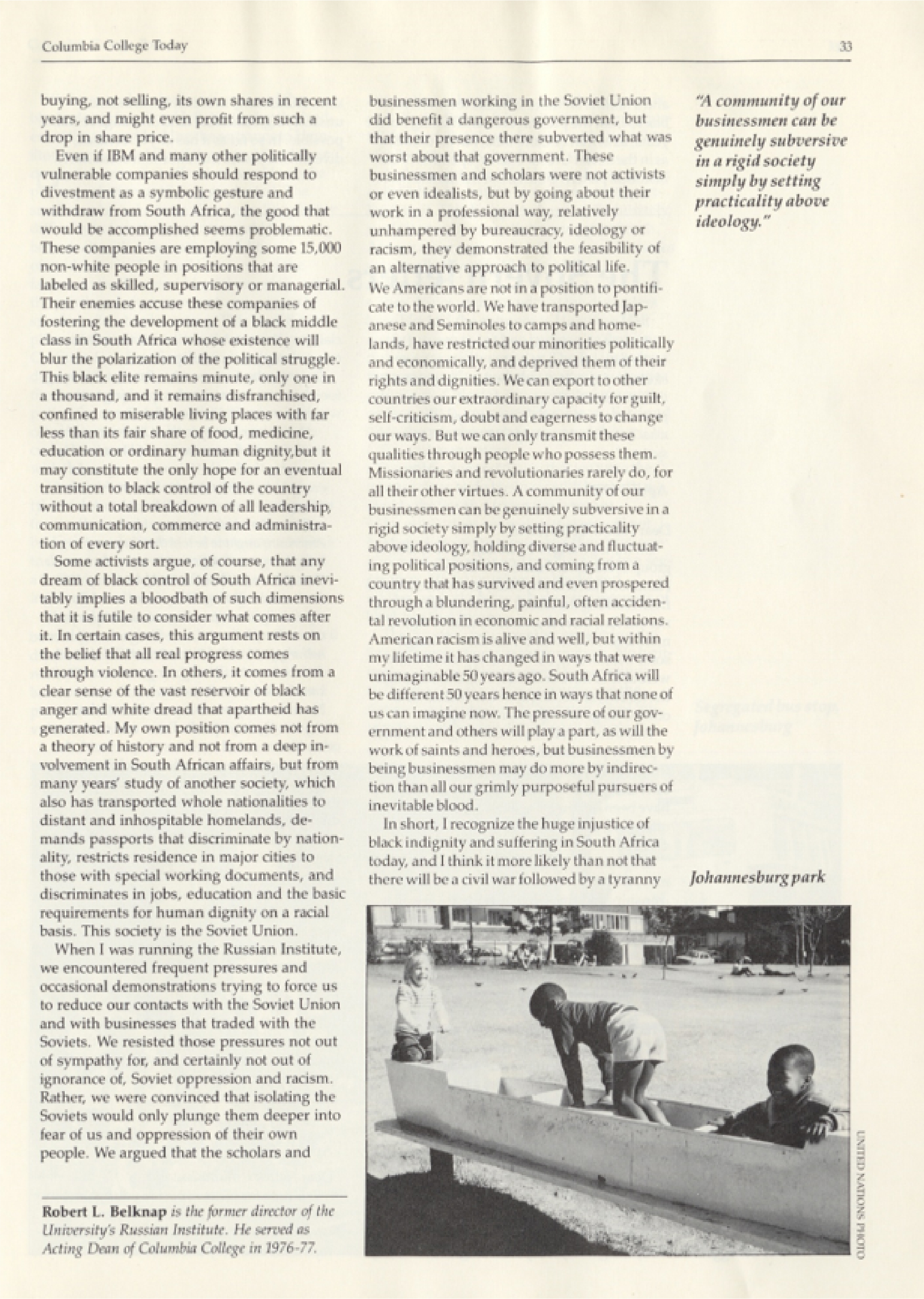
The summer of 1985 edition of Columbia College Today magazine reported on the blockade with the magazine’s cover heading “The South African Dilemma.” One of several articles regarding the issue of South Africa was written by Tom Mathewson, who summarized the blockade: “Columbia students who blockaded Hamilton Hall for three weeks in April focused international attention on the growing revulsion of Americans toward the South African system of racial separation known as apartheid.
The blockade began on April 4, a day of nationwide campus protesting calling on universities to divest their stock portfolios of holdings in companies that do business in South Africa. On April 25th the Columbia blockade ended peacefully, following a permanent injunction issued by New York Supreme Court Justice Burton S. Sherman on April 22nd. Sixty-four students subsequently faced University disciplinary charges; 20 voluntarily accepted Dean’s discipline.
Members of the Coalition for a Free South Africa, the group that has led the divestment drive at Columbia since 1981, have vowed to continue their protests, using new tactics, until the University liquidates all of its South Africa-related holdings, whose value has ranged between $32 million and $38 million in recent months. Ultimate responsibility for University investment policy rests with the Trustees, who are the legal guardians of Columbia’s $863 million endowment.
The blockade came at a time of escalating violence in South Africa, where more than 300 blacks have died in clashes with police in the past year. It also inspired similar extended protests at other campuses across the country —most notably Rutgers, Cornell, and Berkeley—in a new escalation of a nationwide campaign to pressure private and public institutions to sever economic ties with South Africa...
For the Hamilton protesters, the April 4 blockade was the key act in a spring campaign that began on March 25, when several coalition members began a fast for divestment, consuming only liquids. At nightly meetings the group’s steering committee also planned their act of civil disobedience. Prospects for widespread support for such an action seemed poor: an April 1 rally outside the Board of Trustees’ monthly meeting drew only about 25 supporters.
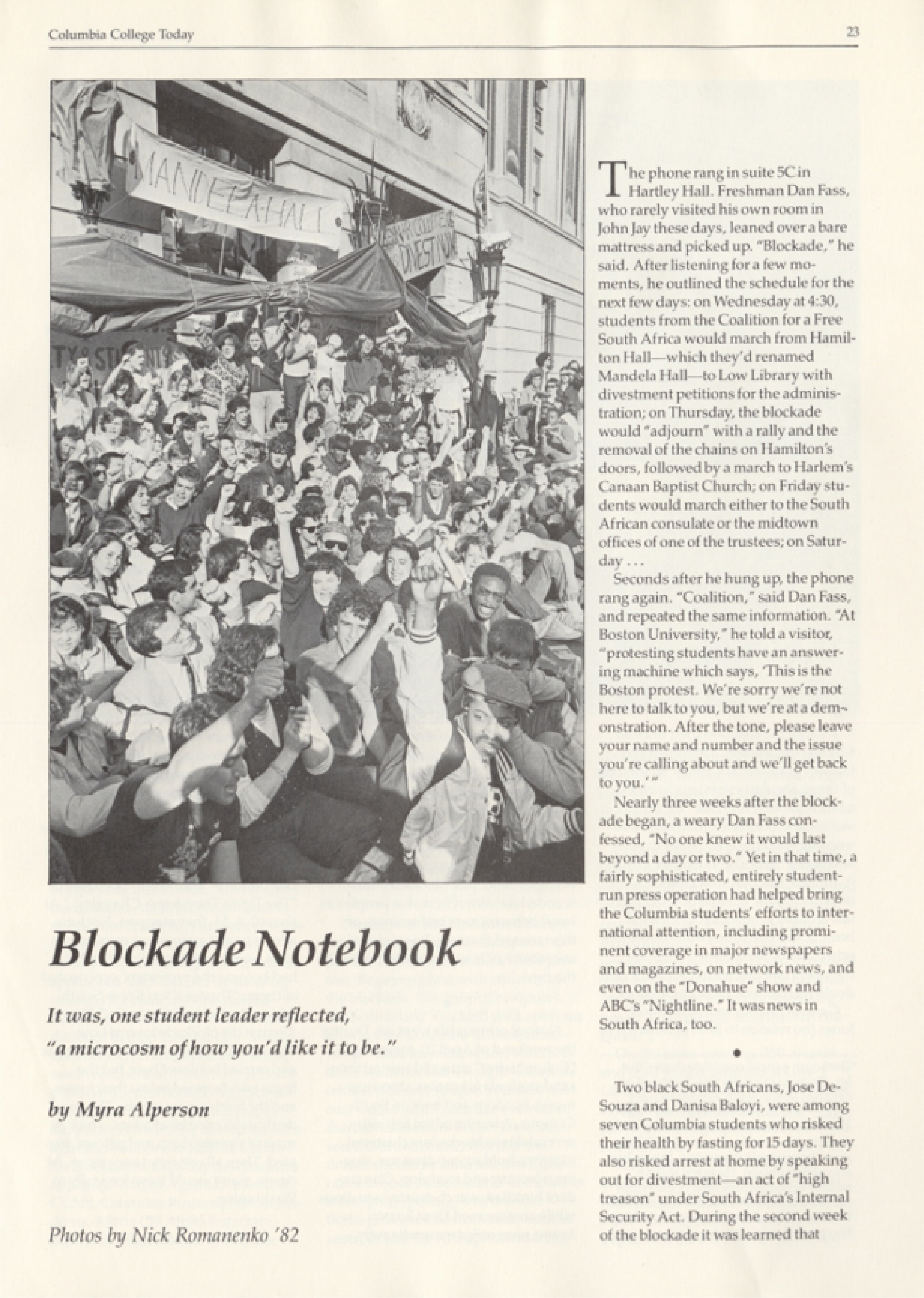
But on the morning of April 4, the 11th day of the fast and the 17th anniversary of the assassination of Martin Luther King, Jr., several hundred gathered at the sundial for a rally staged by coalition organizers, who afterwards led a large portion of the group to the steps of Hamilton Hall, the College’s principal academic and administration building.
As some coalition members chained the front doors and others posted signs inside Hamilton calling attention to a basement entrance through a maintenance tunnel from Kent Hall that remained open, steering committee member Anthony Glover ’86 announced a blockade that he said would last until the Trustees declared their intention to divest within three years.
A number of protesters knew nothing about a blockade before they were assembled on the front steps of Hamilton, but over 200 immediately endorsed the action and stayed. According to one administrator who observed the first day of the protest, the original group of blockaders consisted almost entirely of Columbia students, more than half from the College. No one, however, expected that a group ranging from fewer than 50 to more than 300 would be sitting, sleeping, debating, and attracting international attention on those steps for 22 days.”
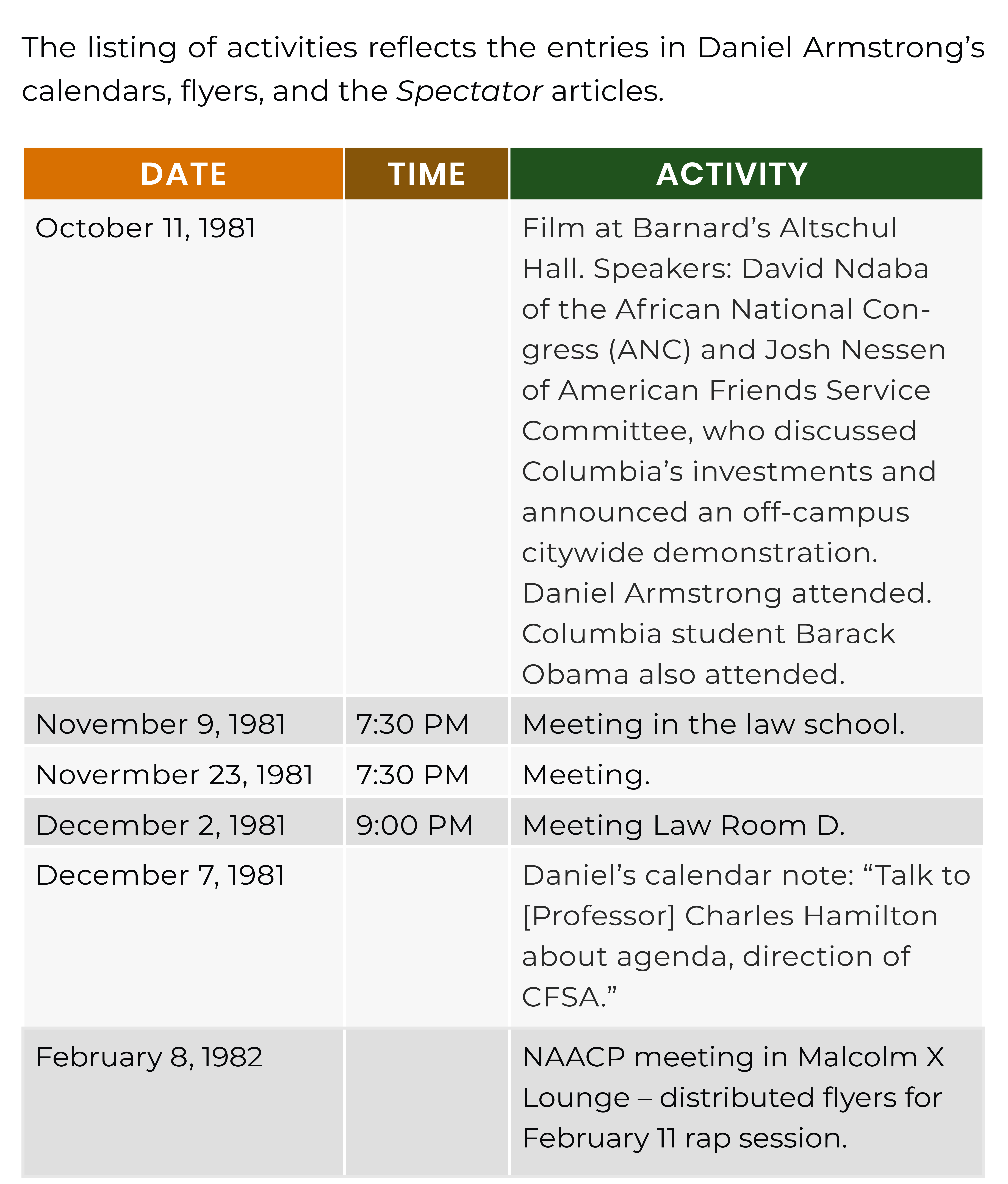
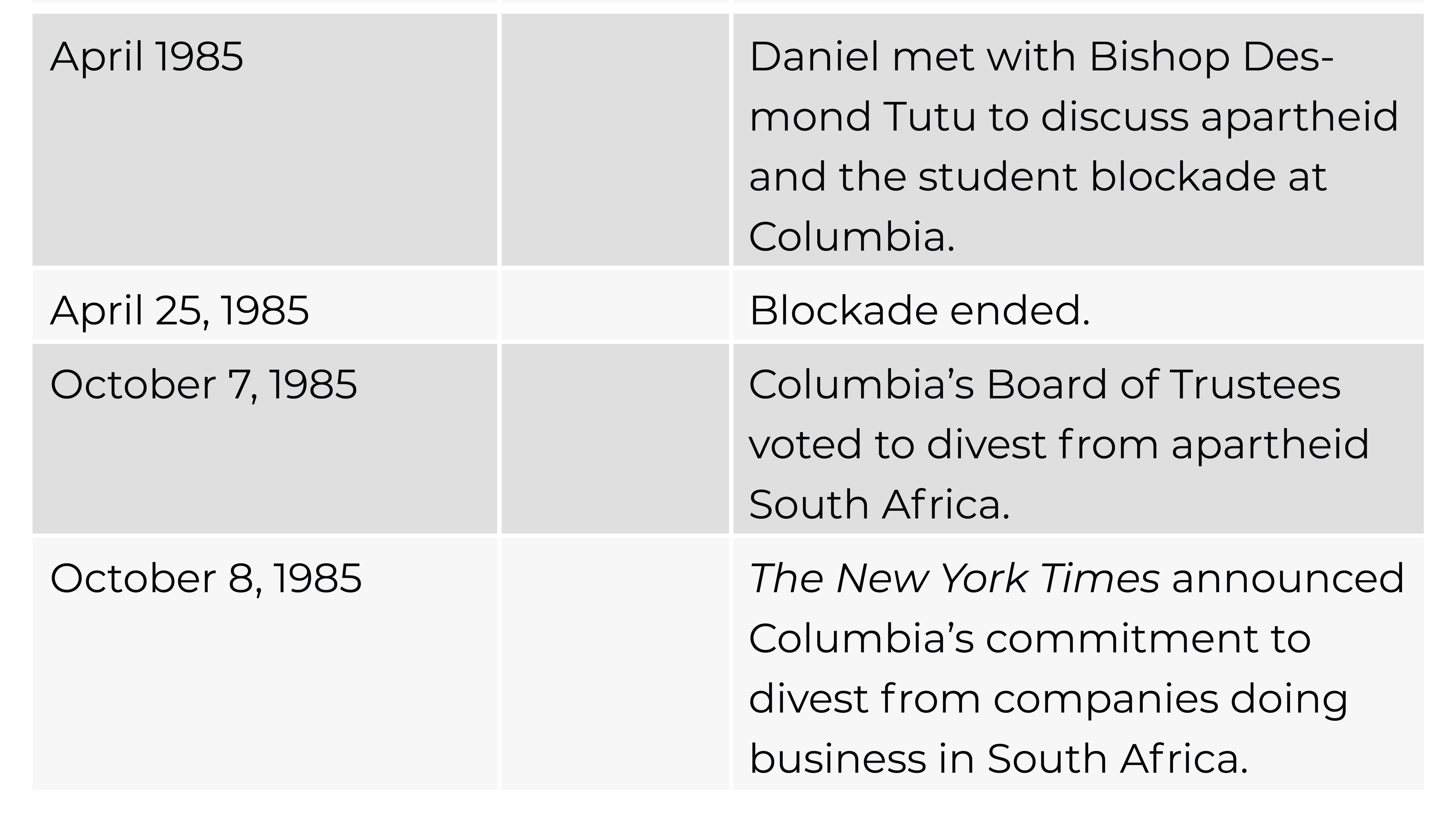
Calendar of Activities
EXPLORE MORE ARCHIVE STORIES